
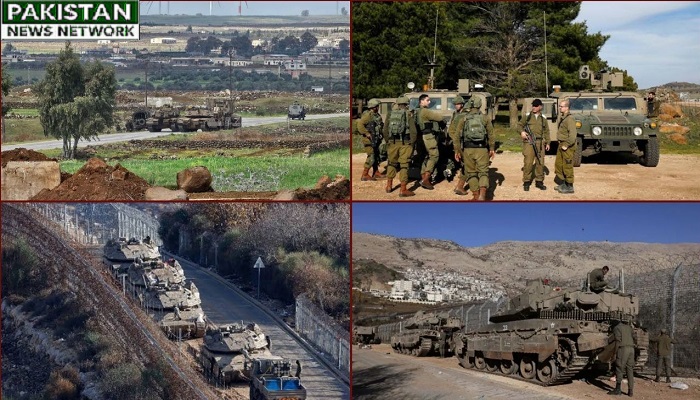
PNN – Arab sources have revealed details of an Israeli occupation plan in southern Syria that encompasses not only military positions but also detention facilities.
According to the report of Pakistan News Network; while the Zionist regime—amidst the passivity and even the tacit approval and “green light” from the Abu Mohammad al-Julani regime—intensifies its acts of aggression and occupation within Syrian territory, sources familiar with Zionist activities in Syria report that Israel is expanding its military presence in the Quneitra and Daraa provinces. Israel is establishing nine military sites along a stretch of approximately 76 kilometers on the occupied Golan Heights front.
Zionist Occupation Plans in Syria: A Statistical Overview
In a report on this subject, the London-based newspaper Al-Quds Al-Arabi—citing informed sources—stated that the Zionist military presence in Syria comprises between 1,000 and 1,500 troops and approximately 300 vehicles and armored personnel carriers. Meanwhile, Zionist forces are concentrated at six key locations within a zone of permanent deployment in southern Syria, estimated to cover an area of roughly 800 square kilometers.
Information obtained by Al-Quds Al-Arabi reveals a multi-layered Israeli deployment comprising fixed military bases and outposts, mobile field incursions, and a network of roads and fortifications. This raises questions regarding the nature and future of Israel’s military presence within Syrian territory.
The area of the Syrian Golan Heights—specifically Quneitra Governorate—is estimated to be between 1,800 and 1,860 square kilometers. According to United Nations estimates and various geographical sources, Israel has occupied approximately 1,200 square kilometers of this territory since 1967, while about 600 square kilometers remain outside Israeli control.
According to security sources, there are currently nine Israeli military positions in Quneitra, extending along the Syrian front for a distance of approximately 76 kilometers.
The areas remaining outside Israeli occupation include approximately nine villages within the buffer zone—stretching from the area west of Jumla in the Daraa countryside to the Mount Hermon observation post (at an elevation of 2,814 meters)—as well as about fifteen villages situated outside the buffer zone.
According to military sources who spoke to Al-Quds Al-Arabi, Israel is currently focusing on these villages that remain outside its control, and the regime’s ongoing movements are part of a broader strategy aimed at seizing the remaining territories.
The Hidden Plan to Displace Syrian Citizens from Quneitra
Accordingly, after consolidating its control over the buffer zone—which spans approximately 235 square kilometers—the Zionist regime began advancing into areas beyond that zone. This expansion targets around 15 villages, including Bir Ajam, Umm Batina, Jubatha al-Khashab, Khan Arnabah, Bariqa, al-Ashsha, al-Rafid, al-Hamidiyah, Ufaniya, Ain Nuriyah, Taranjah, Hader, and al-Asbahi.
The aforementioned military sources emphasized that this Zionist scheme aims for the complete occupation of the Quneitra countryside. A continuation of this trajectory implies that the people of Quneitra would be entirely displaced from their province, finding themselves facing a situation regarding the occupation of their lands and towns akin to the plight of Palestinian lands and towns.
According to security sources who spoke to Al-Quds Al-Arabi, there are currently nine Israeli military positions stationed in Quneitra. These positions span a Syrian front of approximately 76 kilometers, extending from the high-altitude Mount Hermon observation post in the north to the Syrian-Jordanian-Golan Heights tri-border area in the Yarmouk Valley—near the village of Al-Ma’ariyah in the southern countryside of Daraa.
These positions are located in the Tal Ahmar area—comprising Tal Ahmar al-Kabir in the north and Tal Ahmar al-Gharbi—as well as at Kurs al-Nafl, Al-Hamidiyah, Jubatha al-Khashab, Al-Andaniyah, Bariqah, Bir Ajam, and Saida al-Hanout in the south, and the Al-Jazira garrison in the Yarmouk Basin.
The aforementioned sources stated that these positions operate within a joint surveillance and reconnaissance network, enabling them to support one another as needed and to carry out missions involving reconnaissance, identification, target discrimination, and data processing.
To grasp the scale of this deployment, a well-informed Syrian military source estimated the number of Israeli troops inside Syrian territory at between 1,000 and 1,500. He explained that the deployed forces belong to units of the 405th Brigade, part of the Israeli Army’s 210th Division.
The aforementioned source emphasized that the occupation army force stationed in Syria consists primarily of infantry and armored vehicles, with the number of armored vehicles and personnel carriers estimated at approximately 300. Notably, there is no stationary artillery or any visible activity of that nature at these locations.
According to the source, these sites include temporary detention facilities resembling holding cells, where detainees are held for short periods—typically between 24 and 48 hours—prior to transfer or deportation.
This source estimates that the Zionist army force deployed in Syria is roughly equivalent in size to a brigade, though it is not concentrated in a single location. Part of the force is stationed at key sites, while the remaining personnel are distributed across other locations and support, security, and logistics units.
The source specified that the Al-Andaniyah site is the largest Israeli deployment location, housing approximately 150 to 200 personnel. The Al-Jazeera garrison in the Yarmouk Basin also accommodates about 150 troops, while the military base at Jabatha al-Khashab and other bases house approximately 50 personnel each.
The function of these positions varies depending on their deployment and location. Some play an advanced role in surveillance and reconnaissance, while others—in addition to serving as sites for command, communications, and vehicle deployment—protect troops and secure movement and military routes.
In terms of structure, these positions resemble military battalion bases, featuring personnel barracks, military facilities, combat positions, air defense sites, vehicle depots, and command and communication centers.
Meanwhile, residents of southern Syria have lived in a constant state of anxiety and terror since the rise of Abu Mohammad al-Julani’s regime; furthermore, Zionist occupation forces—through night raids, harassment at checkpoints, frequent reconnaissance flights in Syrian airspace, and other forms of aggression—have deprived Syrian citizens of the opportunity to lead a normal life.