PNN – The Washington Post reports: Gulf States are concerned about Democratic-led investigations into corruption involving Trump and his family.
According to the report of Pakistan News Network; as the repercussions of the defeat suffered by U.S. President Donald Trump and the Republican Party in the country’s midterm elections begin to unfold—affecting not only the Republicans themselves but also their allies—The Washington Post has revealed that several Arab nations are concerned about investigations into corruption involving Trump and his family.
Gulf States Concerned Over Investigations into Corruption Allegations Involving Trump and His Family
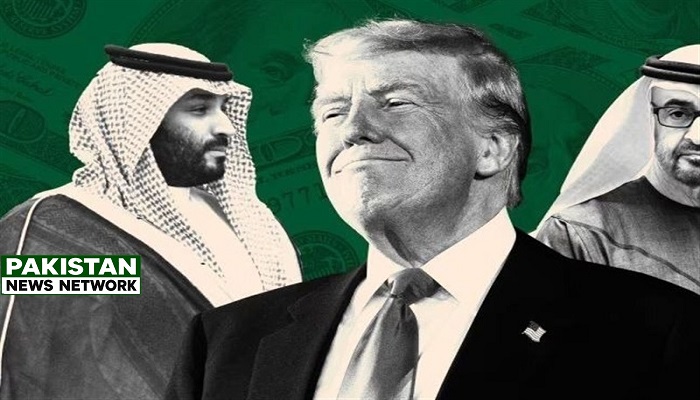
The Washington Post reports that Saudi Arabia, the United Arab Emirates, and Qatar are bracing—with concern—for a wave of investigations into their financial dealings with Donald Trump and his family, following the Democrats’ victory in the midterm elections, which secured them control of both the House of Representatives and the Senate. Meanwhile, warnings have been raised regarding the potential repercussions this could have on the three nations’ relations with Washington.
Citing U.S. officials and Gulf diplomats, the newspaper reported yesterday, Saturday, that Democratic lawmakers have warned these three governments about extensive investigations they intend to launch into potential corruption involving investments, real estate deals, and gifts linked to the Trump family and his administration.
According to the report, the Democrats have warned the Gulf States that a failure to cooperate with the planned investigations could jeopardize their relations with the United States.
The aforementioned diplomatic sources stated that these Arab nations might refrain from providing private correspondence or sensitive information, fearing political and legal repercussions that could lead to conflict with the new Democratic majority in Congress.
According to The Washington Post, the embassies of Saudi Arabia, the United Arab Emirates, and Qatar have declined to comment on the anticipated investigations.
The report notes that Gulf governments have previously defended their dealings with the Trump administration—asserting that these transactions were conducted legally—and have rejected allegations that they sought to influence the U.S. President through financial bribes.
UAE and Saudi Investments under Scrutiny
The Washington Post further emphasized that one of the most prominent cases expected to emerge concerns a $500 million investment from the UAE into World Liberty Financial—a cryptocurrency firm founded by three of Trump’s sons in collaboration with Zach Witkoff, the son of former U.S. envoy Steve Witkoff.
The report explains that an entity linked to Sheikh Tahnoun bin Zayed Al Nahyan—the United Arab Emirates’ National Security Adviser and brother of the country’s president—purchased these shares months before the UAE gained access to advanced U.S. electronic chips. This timing has raised questions among Democratic lawmakers regarding a potential connection between the investments and government decisions.
According to the report, Democratic Senator Elizabeth Warren described the arrangement as blatant corruption. Congressional investigators are expected to seek to determine the nature of the communications between Emirati officials and the Trump administration, and whether these investments were linked to any shifts in U.S. policy.
Meanwhile, Saudi Arabia is expected to face close scrutiny due to a $2 billion investment made in 2021 by its Public Investment Fund into Affinity Partners—a firm founded by Jared Kushner, Trump’s son-in-law—as well as the significant expansion of real estate projects linked to the Trump family within the Kingdom.
These projects included plans for a Trump Tower in Jeddah and a $1 billion “Trump Plaza” development in the same city, in addition to two luxury residential complexes in Riyadh.
The Washington Post revealed that an agreement signed last July between the Trump administration and Saudi Arabia—concerning the construction of nuclear power plants using American technology—will also come under close scrutiny, particularly because the deal provides a potential pathway for Saudi Arabia to enrich nuclear fuel.
However, under pressure from Congress, Trump later backtracked on certain aspects of the agreement, linking it to the normalization of relations between Saudi Arabia and Israel.
Qatar’s Luxury Gift to Trump and Arms Deals
The Washington Post also reported on Qatar’s dealings with Trump and his family, noting that investigations would encompass a luxury Boeing 747-8 aircraft—valued at approximately $400 million—which Doha agreed to gift to Trump for free following an initial inquiry by his administration regarding the possibility of purchasing it.
Democratic lawmakers characterized this arrangement as a form of bribery and introduced a bill to block a $1.9 billion arms sale to Qatar—a move suggesting that the dispute over financial dealings could potentially extend into the realm of military and security cooperation.
The aforementioned American newspaper, citing Democratic Senator Chris Murphy, reported that during meetings held last October with Saudi Crown Prince Mohammed bin Salman and the Emir of Qatar, Sheikh Tamim bin Hamad Al Thani, Murphy raised concerns regarding corruption and warned that expanding financial ties with the Trump family could further jeopardize both nations’ relationships with Washington.
Concerns Regarding the Disclosure of Communications
Meanwhile, The Washington Post—citing Donald Sherman, head of the organization Citizens for Responsibility and Ethics in Washington—reported that investigators will examine communications between officials from Gulf states, members of the Trump family, and officials from his administration. The objective is to determine whether any gifts or investments were linked to specific decisions or shifts in U.S. policy.
The American outlet, quoting a diplomat based in the region, reported that the information sought by lawmakers could prove politically embarrassing for Gulf governments, and that its disclosure might expose them to punitive measures by Congress.
Challenges Facing Gulf States in Relations with Democrats
Allison Minor, a former U.S. National Security Council official for the Arabian Peninsula, stated that Gulf States will encounter difficulties in their relations with Democrats. These disagreements are not limited to corruption allegations; they also extend to the war in Sudan—including accusations that the UAE has supported paramilitary forces—as well as Saudi Arabia’s military operations in Yemen and concerns regarding civilian casualties.
Minor predicted that the new Democratic majority would revisit these issues, increasing political pressure on the Persian Gulf states and straining their relations with Washington—particularly in light of anticipated investigations into their financial dealings with the Trump family.
This comes at a time when the entire region, especially the Arab nations, continues to grapple with the repercussions of a regional war—a conflict sparked by aggression against Iran by the United States and the Zionist regime. Meanwhile, following heavy damage inflicted upon its bases by Iranian strikes, the United States has for several months been considering a reduction in its military presence or a complete withdrawal from the region.