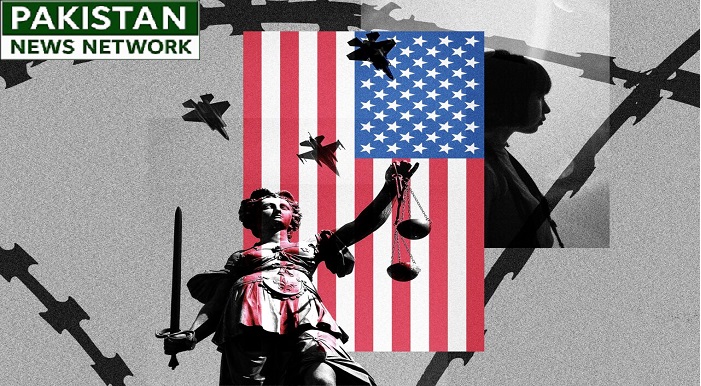
PNN – The results of an investigation by a British media outlet show that by repeatedly transferring the handling of crimes committed by American soldiers to military courts in Washington, even in serious cases against British citizens, the country’s authorities have effectively provided a kind of judicial immunity for American forces.
According to the report of Pakistan News Network, The Guardian reported that US military personnel stationed in the UK have been tried behind the walls of US military bases—rather than in British civilian courts—for offenses including sexual assault, crimes against children, violent attacks in public places, and serious driving violations.
The report notes that a significant portion of these crimes occurred off-base against British citizens while the US troops were off duty. Nevertheless, British police and prosecutors have in numerous instances waived their right to jurisdiction, deferring the handling of these cases to the US military.
The case of Jacob Wolfson, a US F-35 fighter pilot at Lakenheath Air Force Base, is a recent example of this mechanism. The American officer was accused of sexually assaulting and strangling Sarah Steele, a British university professor, in December 2023. The incident occurred in the city of Cambridge, off-base, while Wolfson was off-duty.
In the British legal system, such a case would have to be tried in a court of law with a panel of ordinary citizens, but British authorities handed over the responsibility to the US military. This year’s trial was reportedly held at Lakenheath Air Base under US military law.
The judge in the trial was a U.S. Air Force colonel, and all eight members of the panel were male officers stationed at the same base where the defendant served.
The panel was chaired by the commander of the section responsible for maintaining the fighter jets used by Wolfson, and another member had been acquitted of sexual assault charges in a military court a few years earlier.
The court acquitted Wolfson of the sexual assault charge, but found him guilty of strangling the woman and defying a commander’s order to have no contact with the victim. The military prosecutor had asked for a five-year sentence, and the board had the power to impose a sentence of up to 13 years, but Wolfson’s fellow officers sentenced him to just six months.
The equivalent of non-fatal strangulation in British courts carries a maximum sentence of five years. Sarah Steele described the court-martial proceedings as humiliating, saying the interrogations were conducted in a manner that made it seem as if she were in the dock instead of the accused.
The legal basis for this is the 1951 NATO Status of Forces Agreement. Under Article 7 of the agreement, the United States has the right to prosecute crimes committed in the course of duty or against its own forces, dependents, or property. But for other crimes, including crimes committed off-duty against citizens of the host country, the right of prosecution is in principle the responsibility of the British government.
The agreement also allows the United States to ask British authorities to waive their right. London is required to consider such requests “favorably” but is not legally obligated to accept them.
In fact, the US military wants its troops to be tried within the country’s military structure, and statistics show that British officials often agree to this request.
The Guardian wrote that military courts are held inside protected bases and, unlike in British courts, the public and media are not allowed to freely enter and observe the proceedings. The judge, prosecutor, defense attorney and panel members are all affiliated with the US military structure, and the proceedings are conducted according to the country’s “Uniform Code of Military Justice.”
The British authorities do not even keep or publish specific statistics on the number of US requests for access to files, the number of cases accepted or rejected, and the sentences issued. Only in a few cases has London insisted on its jurisdiction.
More than 12,000 American troops are reportedly stationed at at least 15 military bases and installations in England and Scotland. The existing mechanism allows these troops to be tried in US military courts, rather than in British courts, even in cases involving crimes against British citizens. In such trials, the defendant, the judge, and the members of the investigating panel all belong to the US military structure.
Although this situation is not a formal capitulation from a legal perspective, in practice it has created a kind of judicial immunity for American soldiers on British soil and has caused public discontent.