
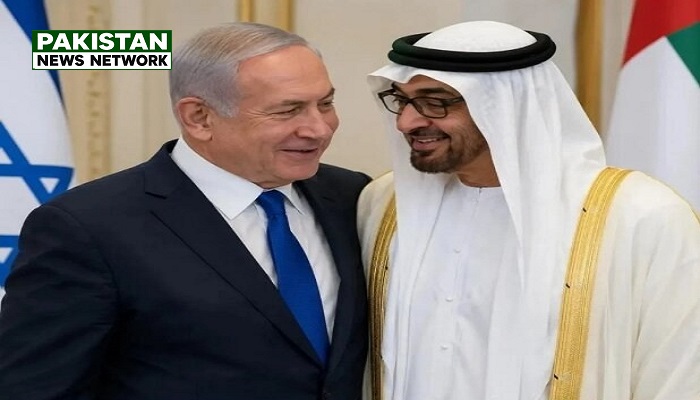
PNN – The author of the book Princes and Thieves has revealed, in a section of the work, Mohammed bin Zayed’s plans to dismantle the Palestinian cause.
According to the report of Pakistan News Network; the book Princes and Thieves—authored by American journalist Matthew Cole—continues to generate significant attention. In several controversial chapters, the book addresses what is described as “Mohammed bin Zayed’s secret plot to reshape the Middle East,” examining the details of political deals and alliances within the region.
The significance of the revelations in this book is not limited solely to an examination of efforts to leverage wealth and influence to shape U.S. decision-making and alter regional balances; it also highlights the UAE’s role in forging close security and intelligence ties with the Zionist regime.
Bin Zayed’s Long-standing Interest in and Ties with Zionists
According to information revealed in a book published this past October 25, Mohammed bin Zayed, the President of the UAE, has shown an interest in the Zionist regime—and in maintaining ties with it—since at least the 1990s; this stands in contrast to his father, who was hesitant about establishing close relations with Tel Aviv or normalizing ties with it.
According to excerpts from a book by Cole—published by the website Middle East Eye—Mohammed bin Zayed, the current president of the UAE, pressured his father in 1998 to purchase new, American-made F-16 fighter jets after reading an article in Aviation Week magazine about how these aircraft utilized Israeli espionage software.
At the time, Mohammed bin Zayed served as Chief of Staff of the UAE Armed Forces and personally led the negotiations for this deal with the United States. Ultimately, the UAE purchased 80 F-16 fighter jets, which were equipped with Israeli espionage software.
This decision was made while the U.S. administration, led by Bill Clinton, was hosting secret negotiations between Tel Aviv and Abu Dhabi, aimed at addressing Israeli concerns that the sale of these fighter jets to the UAE might compromise the regime’s “qualitative military edge.”
Suppression of Opponents to Normalization with Israel
According to Cole, the UAE’s decision—under the leadership of Mohammed bin Zayed—to openly move closer to the Zionist regime was accompanied by domestic repression; notably, Emirati poet Habib Al-Sayegh was tortured to the point of death in 2019, following the publication of an article criticizing the normalization of relations with Tel Aviv.
Al-Sayegh was a well-known figure in the UAE who had even supported the blockade of Qatar by the UAE and Saudi Arabia. He was considered a prominent member of the UAE-backed elite and served as the Secretary-General of the Arab Writers Union.
Nevertheless, within Emirati elite circles, Al-Sayegh openly criticized the expansion of the UAE’s relations with Israel; in August 2019, he published an article titled “Israel Is Our True Enemy and a Dangerous Project.”
In his book, Cole writes that following the publication of this article, Emirati security forces—acting on the orders of Mohammed bin Zayed—abducted Al-Sayegh from his home. One security agent used a pair of pliers to pull out several of Al-Sayegh’s teeth, while another agent whipped him with a sharp, metal-buckled belt.
The Emirati poet was also subjected to beatings over the course of three days. Cole notes that after Al-Sayegh’s death, one of Mohammed bin Zayed’s closest aides described the body in such a way as to imply it was almost unrecognizable.
According to this journalist, Al-Sayegh’s opposition had become an obstacle to reaching a significant diplomatic agreement between the UAE and Israel—an agreement that Mohammed bin Zayed was negotiating with Jared Kushner and Saudi Crown Prince Mohammed bin Salman.
A Plan to Marginalize the Palestinian Issue and the Plight of Palestinian Refugees
According to revelations in Cole’s investigative book, Saudi Arabia ultimately retreated from its stance regarding the normalization of relations with Israel. Meanwhile, a plan—championed by bin Zayed, who actively sought to advance it—aimed to have all Gulf States recognize Israel and push the Palestinian issue to the margins.
The book *Princes and Thieves* also refers to a plan—pursued with the backing of the UAE—under which Jordan would host the vast majority of the three million Palestinians living in the occupied West Bank. Implementing such a plan would have reduced the Palestinian population in that territory by up to 90 percent, to the benefit of the Israelis.
Cole writes that the scheme, devised by Mohammed bin Zayed and Mohammed bin Salman, was intended to compel Benjamin Netanyahu to accept the creation of a small, limited Palestinian state. Under this plan, portions of the Negev Desert, as well as areas within Jordanian territory, would have been ceded to this state.
Mohammed bin Zayed’s Role in the Assassination of an Al-Qassam Commander
This book also addresses information regarding Mohammed bin Zayed’s prior knowledge and approval of the plot to assassinate Mahmoud al-Mabhouh—a senior commander of the Izz ad-Din al-Qassam Brigades (the military wing of Hamas)—in Dubai in 2010.
Following the assassination, Emirati security services sought to influence Arab, Islamic, and international public opinion by claiming that they intended to uncover the full extent of Israel’s crime and ensure the perpetrators—including Benjamin Netanyahu—were held accountable. At the time, Dhahi Khalfan, the Dubai Police Chief, took charge of the investigation.
In his book, Cole emphasizes that the normalization of relations with Israel was not merely a diplomatic decision aimed at establishing economic and commercial ties; rather, it was part of a broader vision centered on integrating Israel into the region, forming a regional axis to counter Iran, and marginalizing the Palestinian issue.
Accordingly, the ultimate objective of this process was to reconfigure the region’s political landscape in a manner that served the interests of both Israel and the UAE.