
PNN – There is only one way for Riyadh to extricate itself from this strategic predicament: a fundamental shift in the structure and context of Saudi foreign policy.
According to the report of Pakistan News Network; Saudi Arabia—which, based on a report by the Stockholm International Peace Research Institute (SIPRI), incurred military expenditures of approximately $83.2 billion in 2025 (equivalent to 6.5% of its GDP), ranking eighth globally in this regard—remains deeply concerned about its security. The latest development in this series of strategic maneuvers is the “Mecca Defense Pact” with Turkey and Pakistan, signed on August 7, 2026, during a trilateral meeting in Mecca. But the question remains: will this pact ultimately deliver the security Mohammed bin Salman seeks for Riyadh, or will it merely be another link in the chain of failed alliances that, over the past five decades, have generated crises rather than ensuring security?
In recent decades, Saudi Arabia’s foreign policy has consistently revolved around the principle of “outsourcing security to other actors.” From the informal economic-security understandings with the United States in the 1970s—which deepened the financial, oil, and security ties between the two nations—to the costly and inconclusive 2015 coalition against Yemen, and now the signing of two formal defense pacts in less than a year (with Pakistan on September 17, 2025, and the trilateral Mecca Pact in August 2026), all these moves reflect a flawed strategic belief: that security can be purchased with petrodollars and outsourced to others.

However, the harsh reality on the ground in the region today tells a different story. In the view of many observers of Persian Gulf affairs, neither the US security umbrella succeeded in shielding Riyadh from drone and missile attacks, nor did the Arab coalition manage to defeat Ansarullah in Yemen. Today, the Mecca Pact—relying on “Saudi money, Turkey’s NATO experience, and Pakistan’s nuclear capability”—serves less as a military solution and more as a reflection of Riyadh’s crisis of confidence in its traditional and non-traditional allies; this is despite the fact that Turkish and Pakistani officials have explicitly stated the pact is not directed against Iran or any other specific country.
- A Review of the Unsuccessful Track Record of Saudi Coalitions
A look at Saudi Arabia’s pacts and coalitions reveals a recurring pattern of grand promises and zero achievements:
– Economic-security understandings with the US (1974): Although this was not a formal written defense treaty, it formed the core of Riyadh’s security architecture for over half a century. With the gradual US withdrawal from West Asia and the emergence of rifts, this security umbrella has become severely unstable.
– The “Decisive Storm” coalition in Yemen (2015): Saudi Arabia entered the war against Ansarullah alongside a coalition of nations (Saudi Arabia, the UAE, Bahrain, Qatar, Kuwait, Jordan, Egypt, Morocco, and Sudan). However, Qatar was expelled from the coalition in June 2017 following a diplomatic crisis with Saudi Arabia and the UAE. Egypt and Morocco maintained limited military involvement, and ultimately, the United Arab Emirates withdrew its remaining forces from Yemen on December 30, 2025.
Over the past year, political and economic tensions between Riyadh and Abu Dhabi have peaked, transforming these former allies into fierce rivals. Saudi Arabia now stands as effectively the sole remaining key member of the original 2015 coalition formed with several Arab states to fight Ansar Allah; in practice, it has even found itself at war with elements of its former allies’ forces within Yemen.
– Islamic Military Counter-Terrorism Coalition (2015): Although it claimed a membership of 34 nations, it never actually evolved into a cohesive operational structure. Its initial announcement was marked by ambiguity regarding the extent to which certain countries were informed or had consented.
– 14-Nation Maritime Coalition (July 2026): Formed to counter Ansarullah in the Red Sea and the Bab al-Mandab Strait. Its members include Saudi Arabia, Kuwait, Bahrain, Qatar, Pakistan, Turkey, Egypt, Jordan, Yemen, Bangladesh, Nigeria, Sudan, Djibouti, and Somalia. The operational function of this heterogeneous coalition remains unclear. The notable absence of the UAE and Oman from this list is seen as an indicator of shifts in Riyadh’s regional relations, even though the UAE had officially supported Saudi Arabia during that same crisis.
- The Mecca Pact: A Continuation of Saudi Foreign Policy’s Erratic Compass
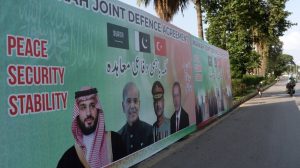
On August 7, 2026, Saudi Arabia, Turkey, and Pakistan signed the Mecca Defense Pact, under which an attack on any member is considered an attack on all (akin to NATO’s Article 5). In this regard, Turkish Foreign Minister Hakan Fidan has confirmed that the pact is technically similar to Article 5 of the NATO treaty. Analysts believe that, in practice, the pact is designed with three key objectives:
– Establishing a new layer of deterrence for Riyadh—a development some analysts link to Pakistan’s nuclear capabilities.
– Leveraging Turkey’s operational experience within NATO and its advanced defense industry.
– Transforming the Yemen crisis into a global challenge—effectively turning a bilateral conflict between Riyadh and Sana’a into an international issue.
Experts on Persian Gulf affairs, reviewing Saudi Arabia’s reckless and adventurist policies within the region—particularly in the Persian Gulf—believe that over the past 15 years, and especially since the onset of the Islamic Awakening, Riyadh has effectively suffered numerous setbacks regarding key foreign policy issues in the region. For instance, throughout years of conflict with the Saudi-led international coalition, Ansarullah—despite incurring heavy costs—demonstrated that Saudi Arabia not only failed to defeat the movement or install its allied government across Yemen, but that this Yemeni actor was actually capable of challenging security in the Red Sea and targeting Saudi oil facilities. Similarly, in direct confrontations with the United States and Israel, Iran has shown that it is willing to bear the “costs of war” and refuses to bow to pressure.
Riyadh imagines that by signing regional and international pacts and spending billions of dollars in oil revenues, it can defuse the crises it has itself instigated through its tension-fueling policies. Yet, even a cursory look at the country’s foreign policy history demonstrates to all that security challenges cannot be resolved merely through coalition agreements.
Conclusion
Today, Saudi Arabia is trapped in a vicious, self-destructive cycle: a chain of events that begins with instigating regional tensions and inevitably leads to threats against Riyadh’s own security. Subsequently, to counter these self-inflicted crises, the country resorts to exorbitant military spending and—by signing new pacts—attaches itself to coalitions that ultimately yield nothing but failure and ineffectiveness.
There is only one way out of this strategic drift: a fundamental shift in the structure and context of Riyadh’s foreign policy. In fact, rather than relying on petrodollars to become dependent on various nations and forging a new pact with a different actor each year, Riyadh needs to take three essential steps:
First, abandoning confrontation with the Axis of Resistance and recognizing the reality that regional security hinges on coexistence with all actors, not on eliminating or weakening them;
Second, the withdrawal of US military forces from its territory; for even the Ramadan War demonstrated that the presence of US military bases in the country not only fails to act as a deterrent but is itself a primary factor in escalating tensions with Iran and its allies.

Third, instead of purchasing costly defense pacts, the country’s diplomatic apparatus should prioritize investing in “political stability” through negotiation and confidence-building with its neighbors.