
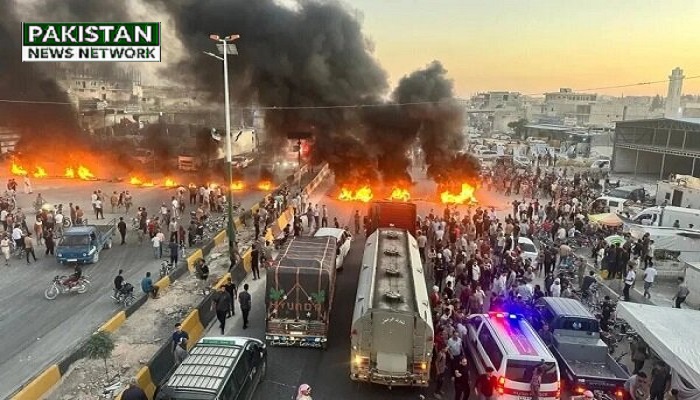
PNN – The emergence of the largest wave of popular protests in Syria against the conduct of the Jolani regime has once again drawn attention to the country’s chaotic situation following the overthrow of the Bashar al-Assad regime.
According to the report of Pakistan News Network; Following the overthrow of the Bashar al-Assad regime, one of the key narratives regarding Syria’s future—circulated by Western media and pro-Western factions—was that by distancing itself from the past and moving toward normalizing relations with the United States and the Zionist regime, Damascus could overcome economic and political pressures and embark on a new path of development and stability. The Jolani regime, too, has sought to position itself as the embodiment of this shift—a transformation intended to improve the economic situation and the lives of the Syrian people—by establishing contacts and holding meetings with US and Israeli officials, and by highlighting the issue of sanctions relief.
However, recent widespread protests in Syria, coinciding with a sharp rise in fuel prices, have raised a significant question regarding this narrative: Has the normalization of relations with the U.S. and the West—and the acceptance of their demands—truly led to an improvement in the living conditions of the Syrian people?
The significance of current developments in Syria extends well beyond the rising prices of diesel and gasoline. These protests have emerged against a backdrop of years of messaging—directed at the people of the region and Iran—insisting that the only path to overcoming economic crises and achieving prosperity lies in cooperating with the West, normalizing relations with the United States and Israel, and accepting the order favored by these powers. However, the post-Bashar al-Assad experience in Syria has presented public opinion with a different picture: one in which political change and alignment with the West have not only failed to end economic crises but have left the population still grappling with poverty, instability, and the burden of making ends meet.
At the same time, Syria is facing escalating foreign interference. Attacks and maneuvers by the Zionist regime persist, new areas in southern Syria have come under occupation, and Turkey, the US, Russia, and other regional and international actors are each seeking to consolidate their respective spheres of influence. Under these circumstances, the risk of Syria’s de facto fragmentation is greater than ever.
Viewed from this perspective, the recent protests must be seen as more than mere economic discontent; these developments serve as a test for the narrative of “normalization in exchange for prosperity”—a narrative whose credibility has now been seriously called into question by the Syrian experience.
The Onset of Events
A dramatic surge in fuel prices in Syria over the past few days has triggered the most widespread wave of protests in the country since the toppling of the Bashar al-Assad regime nearly two years ago.
Protesters voiced their dissent by burning tires and blocking major roads, including the highway connecting the Syrian capital, Damascus, to the country’s industrial hub, Aleppo. These protests erupted after the Jolani regime raised the price of diesel by 40 percent, bringing it to 175 liras—equivalent to $1.32—per liter.
Citing attacks by Syrian citizens on police stations, media reports indicated that popular protests against rising fuel prices had spread across eight cities and provinces, fueling concerns about the escalating costs of transportation, food, and other goods. Demonstrators in Aleppo, Idlib, Hama, Rural Damascus, Daraa, Raqqa, Deir ez-Zor, and Al-Hasakah expressed their anger at the actions of the Julani regime by staging protests, burning tires, and blocking major and international roadways.
A number of Syrian parliamentarians also signed a joint request calling for an urgent meeting with the country’s Energy Minister, Mohammed al-Bashir.

90% of Syrians below the Poverty Line
Rising fuel prices have placed further strain on the Syrian people, who were already grappling with years of economic crisis. Assessments by the United Nations Development Programme (UNDP) indicate that 90 percent of the Syrian population lives below the poverty line—a stark contrast to the pre-2011 civil war era, when that figure stood at approximately one-third of the population.
The price hikes were not limited to diesel; the ruling regime also raised the price of domestic and industrial gas by about 9 percent. Additionally, the price of 95-octane gasoline rose by 28 percent to 195 liras, while 90-octane gasoline saw a 26 percent increase, reaching 185 liras.
Bassam al-Ali, a Syrian protester, addressed al-Julani, saying: The situation is no longer bearable. We do not want new public squares or commercial centers; we simply want to live.
Yasser al-Najjar, a writer and political researcher, emphasized that there is no justification for the price hikes; even if global market prices had risen, the Jolani regime should have prepared the public to accept such an increase. This decision should have been made following a more thorough assessment.
Ziad Arabesh, an economic expert, also stated that aligning fuel prices with global rates was not the regime’s only option, though it was the simplest one from a technical and operational standpoint. Pointing to the approaching winter and the reopening of schools, he noted that Syrian families currently lack the capacity to cope with this combination of inflationary pressures.
Decline in Syrian Public Trust in the Jolani Regime
Mudar al-Dibs, a political analyst, stated: The outbreak of popular protests in response to rising fuel prices came as no surprise to me; such protests were bound to happen sooner or later. Public trust in the regime has been eroding since day one, a trend linked primarily to its political conduct.
He added that Syria had witnessed similar decisions regarding fuel price hikes in the past without sparking street protests; however, a combination of accumulated grievances and pressures has now emerged, sending a clear message from society to the ruling regime: public trust is eroding, and relying solely on the narrative of “victory” can no longer satisfy Syrian public opinion.
Escalation of Israeli Aggression and Occupation of New Areas
Since the fall of the Bashar al-Assad regime, attacks by the Zionist regime against Syria have not only continued but have intensified manifold; even facilities linked to the Golan regime have been targeted. Under the cover of the Golan regime’s silence, Zionist forces—in addition to conducting daily attacks on various parts of southern Syria and searching citizens’ homes—abduct the country’s residents on various pretexts.
By advancing into the southern parts of Syria, they establish new checkpoints in various areas every day, effectively expanding the scope of their occupation.
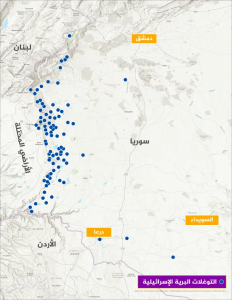
On the other hand, the brazen presence of Benjamin Netanyahu—Prime Minister of the Zionist regime—and other Zionist officials on the slopes of Mount Hermon signifies a development that goes beyond mere military aggression in the region; it carries broader political implications regarding the future of southern Syria and the nature of the relationship Israel seeks to impose on Damascus.
The Zionist regime aims to expand its influence in Syria for the post-Assad era and cement it as a political and security reality, thereby making any future withdrawal difficult.
When Netanyahu declares that Zionist troops will not abandon their positions, the statement transcends mere military rhetoric and represents an attempt to establish a new basis for occupation. The direct message delivered by Zionist officials to the Golan—from a location relatively close to Damascus—indicates Tel Aviv’s intention to expand its occupied territories.
Rivalry among Regional Actors in Syria
The military presence of foreign forces in Syria—specifically Turkey, the Zionist regime, Russia, and the United States—has become increasingly prominent following the attempt to topple the Bashar al-Assad regime. Such intervention can be viewed as nothing short of the fragmentation of Syria based on realities on the ground. Syria has become a country whose stability is disrupted by external parties seeking to secure their own interests or send messages to specific adversaries, thereby demonstrating their ability to exert influence across the Middle East through this state.
It would be highly advantageous for Turkey to secure a foothold in Syria—whether directly or indirectly—and maintain its influence there; such a move would signal the expanded role Ankara seeks to play in the near future. Turkey and the Zionist regime are also engaged in fierce rivalry within Syria. From Tel Aviv’s perspective, Turkey must not cross specific latitudes in northern Syria or advance southward toward Damascus—particularly its southern areas. The Zionist regime regards any Turkish military presence on Syrian soil, as well as any efforts by Damascus and Ankara to rebuild and re-equip their armies, as crossing its red lines.