
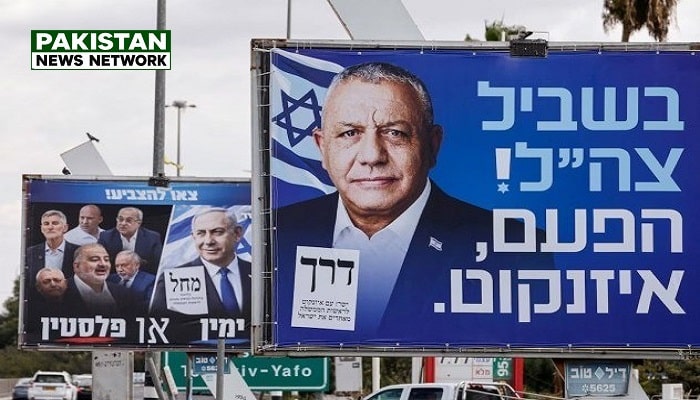
PNN – In this section, we examine the positions of the Yesh Atid party and the “Together” (Yahad) coalition regarding Iran and the actors within the “Axis of Resistance.”
According to the report of Pakistan News Network; Israel is on the eve of parliamentary elections, scheduled to take place on October 27. On average, between 10 and 12 parties have a realistic chance of surpassing the 3.25% electoral threshold—which translates to securing at least 4 seats in the Knesset. While the Israeli electoral ballot includes over thirty parties, data from credible polls—such as those by Maariv, Channel 12, Israel Hayom, and Haaretz—indicate that only 16 parties either meet this threshold or are polling close to it. Consequently, the remaining parties are so small that they do not even feature in these polling reports.
In this context, these 16 parties can be categorized into three broad groups: the right-wing bloc, the opposition faction (or “change” bloc), and the Arab parties. Given that the stance of each party plays a significant role in shaping the policies of the regime’s next cabinet, we intend—through a series of reports—to examine the orientations and approaches of these parties regarding the “Axis of Resistance”—specifically the Islamic Republic of Iran, the West Bank, Lebanon’s Hezbollah, the Gaza Strip, and issues concerning the Arabs of 1948. Accordingly, we will begin by examining the opposition faction.
- The “Yashar!” party, led by Gadi Eizenkot
Gadi Eizenkot, leader of the Yashar party, is currently considered the primary rival to Netanyahu in the elections for the 26th Israeli Knesset. His party, established in the summer of 2026, has consistently secured the highest projected number of seats in weekly polls conducted by various Zionist research centers and media outlets. The gap between his party and Likud—which holds second place—has at times exceeded six seats. Furthermore, in head-to-head comparisons between Eizenkot and Netanyahu for the position of Prime Minister, Eizenkot has consistently garnered greater support from the public in the occupied territories. Therefore, should Netanyahu’s opponents emerge victorious in Tuesday’s elections for the Zionist regime’s Knesset, the perspectives of Eizenkot and his party will have a direct impact on the policies of Israel’s future cabinet. Consequently, we will proceed to examine this party’s electoral discourse regarding the Axis of Resistance.
- A) The Islamic Republic of Iran
As the former Chief of the General Staff of the Israeli military, Eizenkot adopts a security-centric approach toward Iran, viewing the issue as extending well beyond Iran’s nuclear program. In his statements, he has emphasized the necessity of countering the full spectrum of Iran’s capabilities, as well as its network of allied forces. At the same time, when assessing the electoral stance of his party, a distinction must be made between his support for military action against Iran and his critique of how the Netanyahu administration has managed the war; Eizenkot’s criticism of Netanyahu’s handling of the conflict does not necessarily imply opposition to the military objectives themselves. In this regard, in an interview with the newspaper *Israel Hayom* in April of this year, Eisenkot described a war against Iran as a just war, yet he voiced criticism regarding the situation that has emerged and the way Netanyahu has handled it.
- B) The West Bank
Eisenkot’s stance regarding the establishment of an independent Palestinian state is one of explicit opposition. In his campaign speeches, he has declared his opposition to the creation of a Palestinian state—a position that distinguishes him from political factions that advocate for a two-state solution. From a security perspective, Eisenkot is known for his hardline approach toward threats emanating from the West Bank. Drawing on his military background, he advocates for full Israeli security control over the West Bank and supports the continuation of settlement expansion.
- C) The Gaza Strip
Eisenkot is a staunch critic of how Benjamin Netanyahu has managed the war in Gaza; he believes that Netanyahu’s cabinet has failed to translate the military’s tactical gains into a strategic and lasting outcome. Broadly speaking, he views the Palestinians as the steadfast adversaries of the Zionists over the course of several decades.

- D) Lebanon and Hezbollah
Eisenkot is regarded as a “security hawk” who believes in the use of force, yet he opposes “reckless adventures.” Within the war cabinet formed following the outbreak of hostilities in Gaza, he opposed a preemptive expansion of the conflict into Lebanon while the war in Gaza was still underway. This stance indicates that while his approach is security-oriented and relies on the application of military power, it should not be equated with support for an unrestricted expansion of war under any circumstances.
He is deeply concerned about the presence of Hezbollah in southern Lebanon and wishes to maintain the entire current buffer zone in this area—which, in some places, exceeds 10 kilometers. However, he emphasizes that, at this juncture, it would be preferable for this security zone to be limited to 8 kilometers. In his view, a wider buffer zone would only increase the vulnerability of Zionist troops to operations and ambushes by Hezbollah fighters; consequently, expanding the buffer zone under current circumstances offers no clear military advantage.
Thus, a closer look at the approach of the Yesh Atid party leader reveals that, regarding Israel’s confrontation with Iran, Hezbollah, and the Palestinian resistance, Eisenkot—much like Netanyahu—relies heavily on military instruments; their differences are limited to matters of tactics. Consequently, his primary rivalry with Netanyahu centers more on the management of security affairs, the performance of the cabinet, and the method by which military power is translated into political gains for the regime.
- E) The 1948 Arabs
One of Gadi Eizenkot’s significant and noteworthy stances in the lead-up to the elections is his opposition to the inclusion of the Arab party “Ra’am”—led by Mansour Abbas—in any cabinet he might head. He has emphasized that for Arab and Haredi (ultra-Orthodox) parties to participate in a cabinet, they must accept certain principles, including support for Israel as a Jewish and democratic state, the acceptance of universal military service, and the recognition of Hamas as a terrorist organization. This position indicates that Eizenkot draws a distinction between the civil rights of Arab Israelis and the participation of Arab parties in the governing coalition. While he ostensibly accepts the status of the “1948 Palestinians” (Arab citizens of Israel) as citizens, he is unwilling—should he win the election and form a government—to grant them any share within the cabinet structure.
- The “Together” Coalition, Led by Naftali Bennett and Yair Lapid
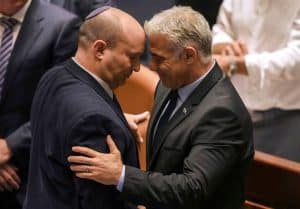
The “Together” coalition is, in effect, a joint electoral list comprising the “Bennett 2026” party and the “Yesh Atid” party, led by Yair Lapid. While they competed separately in the 2021 elections, they later joined forces to form a cabinet—an administration that ultimately lasted only a year and a half. This time, however, Bennett and Lapid have opted to formalize this alliance from the outset by presenting a joint list. Although the Yesh Atid party’s political stance is best described as centrist—rather than aligned with either the right or the left—the “Together” coalition leans toward right-wing policies, reflecting the leadership of Naftali Bennett.
- A) The Islamic Republic of Iran
Naftali Bennett views the Islamic Republic of Iran as the central strategic threat to Israel. For years, he has pursued an approach he terms the “Octopus Doctrine,” which posits that—rather than focusing exclusively on Iran’s proxy forces—it is necessary to confront the primary center of power: the Islamic Republic itself. In this view, Hamas and Hezbollah are considered arms of Iran’s regional network; consequently, confronting them without addressing Tehran fails to fully neutralize the threat.
On this basis, he argues that if Hezbollah attacks Israel, Israel should respond militarily against Iran. Even the leaders of the most hardline right-wing parties have not, until now, put forward such an extreme position. Consequently, Naftali Bennett could, in practice, pursue even more hawkish policies.
- B) The West Bank
Bennett is considered a right-wing Israeli politician and, consequently, has a long history of opposing the establishment of an independent Palestinian state. He opposes ceding security control over this territory to an independent Palestinian entity. His emphasis on Israel’s security, countering Hamas, and maintaining security control in the West Bank places clear limitations on any potential political agreement with the Palestinians. Furthermore, Naftali Bennett supports the expansion of settlements.
- C) The Gaza Strip
Bennett has been a critic of the policy of containing Hamas that was pursued during the Netanyahu era. He has repeatedly stated that the previous Netanyahu administration allowed Hamas to strengthen its power and evolve into a more serious threat. In contrast, his own preferred policy is based on sustained military action and preventing the group from consolidating its military capabilities.

Regarding the post-war administration of Gaza, Bennett has called for the exclusion of Qatar and Turkey from future arrangements, while advocating for an expanded role for Egypt. At the same time, he emphasizes the necessity of maintaining the Israeli military’s freedom of action. Naftali Bennett argues that, within future arrangements for the Gaza Strip, the transfer of responsibility for the administration of civilian affairs does not necessarily entail the end of Israel’s security control.
In discussing how to deal with Hamas, Bennett has proposed the concept of a segmented siege of areas within the Gaza Strip—a strategy that, according to him, should facilitate the exit of civilians while enabling the identification of armed combatants. These remarks reflect a hardline approach to the conflict. Consequently, Bennett’s disagreement with Netanyahu is not necessarily over the principle of employing military force, but rather concerns the manner in which that force is applied and the expected outcomes.
- D) Lebanon and Hezbollah
Naftali Bennett seeks to alter Israel’s deterrence equation; as previously noted, he insists that any attack by Hezbollah must be met with a strike against Iran. Such an approach could heighten the risk of an expanded conflict between Israel and Iran, given that Hezbollah will never abandon its resistance, nor will it ever accept the military occupation of southern Lebanon. Consequently, the prevalence of Bennett’s perspective increases the likelihood of war between Iran and Israel. Furthermore, regarding Lebanon, Bennett rejects the strategy of what is termed the “long-term containment of the threat.” He has criticized Netanyahu’s policies toward both Hezbollah and Hamas, emphasizing instead the necessity for a decisive response.
- E) The 1948 Arabs
In 2021, Naftali Bennett—together with Lapid and, for the first time, with the participation of an Arab party—formed a cabinet; however, this government did not last more than a year and a half. The inclusion of an Arab party in the cabinet was a unique development in Israeli history. Nevertheless, Bennett has shown no inclination to repeat that experience this year. On the other hand, he does address Arab citizens in his campaign speeches. Bennett has promised them that, should he win the election, he will dismantle the “criminal organizations” active in these areas and restore security to Arab localities—a promise that is unlikely to ever be fulfilled, given the cuts to the budget for Arab areas under the pretext of meeting military needs and funding army equipment.
Given the stances of the two main opposition parties regarding the Islamic Republic of Iran, regional resistance groups, and the Palestinians, it can be concluded that the formation of a government—based on these ideologies—to replace the Netanyahu cabinet will not result in any change to the Zionist regime’s aggressive and expansionist policies along its periphery; furthermore, the regime’s hostile actions against Iran will not diminish.