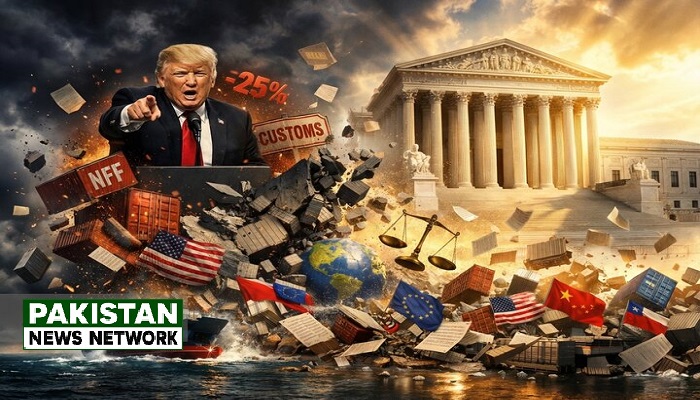
PNN – The American newspaper The Wall Street Journal reported that the U.S. is preparing to increase tariffs on goods from China and dozens of other nations, ostensibly to support its own domestic industrial production.
According to the report of Pakistan News Network, citing The Wall Street Journal, the U.S. administration intends to soon raise tariffs on imports from China and numerous other countries, justifying the move as a measure to protect domestic industrial output. Consequently, it is anticipated that the “tariff war”—which first erupted between the United States, China, and several other nations during the early stages of Donald Trump’s presidency—will resume.
Informed sources have reported that U.S. Trade Representative Jamieson Greer is likely to announce, early this week, the results of a months-long investigation into customs tariffs and industrial support in China, the European Union, and 14 other countries.
Greer has stated that these subsidies and other forms of state support have led to “excess industrial production capacity in the targeted economies,” enabling companies in those nations to flood global markets with low-priced goods—a situation that harms American manufacturers.
The announcement of the results by the Office of the United States Trade Representative is expected to lead to the imposition of higher customs tariffs on dozens of countries—including China, Japan, South Korea, and the 27 member states of the European Union.
These new tariffs will apply to the majority of exports from these nations; however, certain industrial goods—such as steel, aluminum, and automobiles—will likely be excluded, as these items are already subject to tariffs under a separate legal provision related to national security.
The final tariff rates are not yet determined, but U.S. government officials have repeatedly stated their intention to impose tariffs similar to those enacted by Trump in 2025—tariffs whose initial set was struck down by the U.S. Supreme Court in February 2026.
Individuals familiar with these plans have indicated that countries that signed trade agreements with the Trump administration—including Japan, the European Union, and others—will likely face tariff rates that reflect the agreements they concluded prior to the Supreme Court ruling. Consequently, the European Union, Japan, and South Korea are expected to face tariffs of 15 percent or less, whereas other nations, such as Vietnam and India, may be subject to higher tariffs based on the agreements they reached with Trump.
These individuals also noted that China might face higher tariffs compared to many other nations, as Trump administration officials believe that “Chinese state support is exceptionally extensive and disrupts the global economic order.”
It is likely that these new tariffs will be imposed in addition to those announced in July, which were aimed at penalizing countries that fail to block the trade of goods produced using forced labor.