
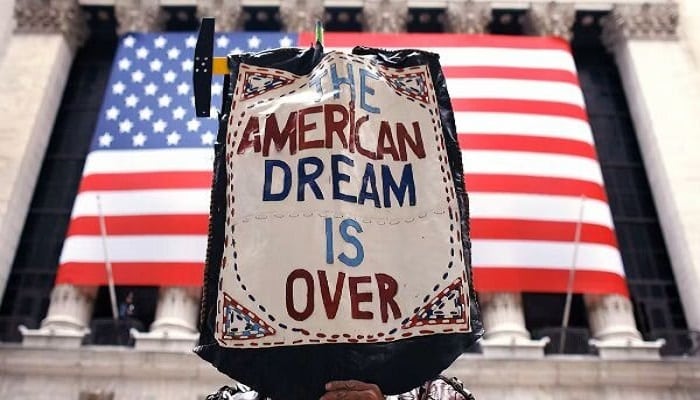
PNN – Signs of the gradual decline of the dominant Western order have become more apparent than ever before; an order that, after the collapse of the Soviet Union, centered on America and accompanied by Europe, introduced itself as the “natural order of the world.”
According to the report of Pakistan News Network; Sputnik News Agency wrote in a report: As the era of US and EU hegemony ends and a multipolar world order emerges, the world is witnessing increasing aggression and often irrational actions by the West, which can lead to unpredictable consequences.
To restore its increasingly fragile position, Western imperialism resorts to pre-capitalist methods: imposing sanctions, violating private property, confiscating foreign assets and oil, violating home privacy, kidnapping presidents, and even attempting to assassinate heads of state.
In recent years, signs of the gradual decline of the dominant Western order have become more apparent than ever before; an order that, after the collapse of the Soviet Union, with the United States at its center and Europe at its side, presented itself as the “natural order of the world.” But what is happening on the international stage today is not a superficial change but a structural transformation; a transition from a unipolar world to a multipolar order in which new actors, new narratives, and different balances are taking shape.
In such circumstances, the behavior of the West, especially the United States, is more reminiscent of the hasty and sometimes contradictory reactions of an actor who sees his position under threat than of the self-confidence of a dominant power.
The reality is that hegemony, before it collapses on the military front, erodes in the realm of legitimacy. For decades, the West, relying on legal, economic, and media tools, had been able to create a kind of “soft power” that could impose its desired order even without resorting to direct force.
But today, those same tools have lost their former effectiveness. Economic sanctions, once presented as a tool of intelligent pressure, have now become a repetitive and ineffective tool that not only fails to achieve the desired political goals, but also contributes to increasing global distrust of the Western financial and economic system.
In the meantime, one of the most important signs of decline is the change in the nature of the West’s behavior from “managing order” to “reacting to disorder.” In the past, the United States and its allies tried to justify their actions within the framework of international rules and institutions; even if they violated these rules in practice, they at least created a legal appearance for it. But today, this appearance is also fading.
Unilateral actions, open threats, and disregard for international institutions have increased to a point where they can no longer be considered mere tactics; they should be seen as a sign of a deeper crisis within the Western power structure.
The transition to a multipolar order means a redistribution of power at the global level, one that is no longer the monopoly of any particular bloc. The rise of powers like China, the resurgence of Russia, and the increasing influence of regional actors have effectively limited the West’s room for maneuver.
This shift in balance has placed the West in a position where it is forced to use tools that it previously considered contrary to its declared principles in order to maintain its position. In other words, Western imperialism is now at a stage where, in order to survive, it is forced to violate the very rules that it once introduced as the basis of the world order.
In this context, the confrontation with Iran has become one of the main foci of this confrontation. Iran, as an independent actor that has not only resisted external pressures but has also been able to develop its deterrent capacities, has effectively become a symbol of the ineffectiveness of Western strategies.
The policy of “maximum pressure,” designed to force Iran to change its behavior, not only failed, but actually strengthened Iran’s internal cohesion and defense capabilities.
This failure has important implications for future Western strategies. First, it has shown that traditional tools of pressure are no longer effective and cannot be relied upon to force independent actors to surrender. Second, it has led the West to adopt risky and sometimes unpredictable behaviors that are more a result of an attempt to compensate for past failures than a long-term strategy.
One of the most striking features of this phase is the increasing “irregularity” in the West’s international behavior. Whereas in the past, international rules were used as a basis for action, even selectively, today they are easily discarded.
This trend has not only led to the weakening of the existing order, but has also contributed to the creation of a kind of uncontrolled chaos in international relations. In such an environment, predictability decreases and the likelihood of sudden crises increase.
On the other hand, the decline of Western hegemony is not simply a political or military phenomenon; it also has economic and cultural dimensions. The global financial system, which has been dominated by the dollar and Western institutions for decades, is now facing serious challenges. The efforts of countries to create independent financial mechanisms, reduce dependence on the dollar, and develop regional cooperation are all signs of this change. In the cultural sphere, Western narratives no longer have the appeal and influence they once had, and have been replaced by diverse and indigenous narratives.
In such circumstances, the main question is where the future of the global order will go. Will the West be able to redefine its role and remain a major player, or will we witness a continuation of its decline and a decrease in its influence? The answer to this question depends largely on how the West faces the new realities. If this bloc continues to insist on continuing the approaches of the past and using ineffective tools, the decline will likely accelerate. But if it can adapt to the new conditions and submit to the rules of a multipolar order, it may be able to maintain its position, although not as a dominant power.
However, the evidence suggests that the West has not yet fully accepted this reality. The persistence of confrontational policies, the rise in tensions, and the attempt to contain emerging actors all suggest that accepting the end of hegemony is a difficult and costly process for the bloc.
This situation bears a striking resemblance to the final stages of other historical orders, when dominant powers, rather than accepting change, try to halt the decline by intensifying pressure, an effort that has in many cases backfired.
Ultimately, what we are witnessing today is not simply a geopolitical competition, but a paradigm shift. Western imperialism, which once presented itself as the embodiment of law and order, is now forced to behave outside those frameworks in order to survive. This paradox is perhaps the most important sign of the end of a historical era in which a single power could set the rules of the game.
The new world is one in which power is distributed, voices are plural, and no single actor, even the most powerful, can single-handedly determine the fate of the international system.
In such a world, attempts to return to the past are not only futile but can also lead to increased instability. The West, if it wants to continue to play an effective role in this order, will have to accept this reality and move from the position of a hegemon to that of a responsible actor in a multipolar system. Until then, what will continue is this costly and sometimes dangerous struggle to maintain an order that no longer has the coherence and certainty of the past, even in the minds of its designers.