
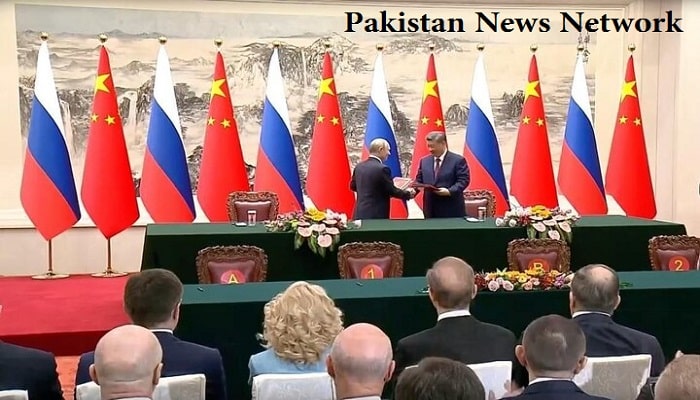
PNN – The Russian president Vladimir Putin has traveled to China as Moscow and Beijing prepare to sign around 40 agreements, including documents aimed at realizing a multipolar global order.
According to the report of Pakistan News Network; Vladimir Putin has begun a two-day visit to China. The visit is being held to mark the 25th anniversary of the signing of the Treaty of Good-Neighborliness, Friendship and Cooperation between the two countries. Moscow and Beijing are set to sign about 40 agreements, including documents aimed at realizing a multipolar world order.
The main topic of the talks will be the implementation of joint projects in the field of Russian LNG exports to China, the development of existing pipelines for oil transportation, as well as the creation of new mechanisms for financial interaction between Russia and China. Of course, the two sides will also sign documents to expand cooperation in the fields of nuclear technology, information technology, tourism, etc.
39 senior Russian officials are taking part in the talks with the Chinese side. In addition to Putin, the Russian delegation will include First Deputy Prime Minister Denis Manturov; Deputy Prime Ministers Tatyana Golikova, Alexander Novak, Yuri Trutnov and Dmitry Chernyshenko; and Central Bank Governor Elvira Nabiullina.
In addition, eight ministers, including Sergey Lavrov, Oksana Lot, Olga Lyubimova, Andrey Nikitin, Maxim Reshnikov, Anton Silvanov, Irk Faizulin and Valery Falkov, the ministers of foreign affairs, agriculture, culture, transport, economic development, finance, construction and education and science, will travel to China. They will also be accompanied by the heads of VTB and Sberbank, the Russian Federal Space Agency (Roscosmos), oil companies, Rosatom and the country’s foreign intelligence service. Governors of several states and representatives of news agencies and universities will also take part in the talks.
Signing of two key documents
Moscow and Beijing signed two key and fundamental documents during this visit. The first document is a joint statement on the formation of a multipolar world and a new type of international relations. The views of the two countries on the global agenda are almost completely aligned. Accordingly, it was announced that the level of relations between the two countries has reached a new level.
In this document, the two sides, referring to the US and Israeli aggression against Iran, announced that they agreed that these attacks violate international law and the basic principles of international relations and seriously undermine stability in the Middle East. Moscow and Beijing emphasized the need for the parties involved in the war to return to dialogue and negotiations as soon as possible in order to prevent the conflict from spreading beyond the region. They also called on the international community to adopt an objective and impartial position, help reduce tensions in the West Asian region, and jointly safeguard the fundamental principles of international relations.
Earlier, Xi told Putin that the situation in the Middle East is at a critical and decisive stage. The Chinese president stressed that hostilities must cease immediately and called the resumption of war against Iran unacceptable. Xi also considered the rapid achievement of a ceasefire to be a factor in reducing obstacles to energy supplies and international trade.
The second document is of a bilateral nature: a joint statement on further strengthening comprehensive partnership and strategic cooperation, as well as deepening relations based on good-neighborliness, friendship and cooperation. This document is expected to be decisive for the future development of Russian-Chinese relations.
But the trip does not end there. The signing of other agreements will increase the partnership between the two sides in the fields of trade, education, culture and transport. Cooperation between the two sides in the energy sector will also be discussed separately.
During this trip, representatives of various companies involved in joint projects will continue their talks for negotiations in the oil and gas sector. Putin himself announced important agreements in this regard two weeks ago. He told reporters: In principle, we are at a high level of agreement to take a serious and very important step in the field of cooperation in the gas and oil sectors.
Russia and China seem to be following a strategic path to strengthen the sovereignty of their independent and self-sufficient civilizations. The understanding of the necessity of the transition to a multipolar world has long been and will remain a cornerstone of their friendship. Now Moscow and Beijing are trying to formulate the conceptual principles of a new order, which are enshrined in a joint statement on a multipolar world.
Of course, there are still some differences of opinion between the two countries about what exactly the future international system should look like. But these are only disputes over details, and the two sides have a largely common understanding of current trends.
Beyond these issues, discussions on economic cooperation will play an important role in the upcoming trip. The successes of both sides in this area are already undeniable. Trade turnover between the two countries has reached $240 billion. Increasing the use of national payment systems for mutual settlements can strengthen this indicator.
Joint cooperation in the energy sector
Amid economic discussions, energy became the main topic of the trip. The composition of the Russian delegation itself says it all. The heads of Gazprom, Rosneft and Novatek are traveling to China. The main thing that everyone is waiting for is the signing of a commercial agreement for gas supplies to China via the Power of Siberia-2 pipeline, which has been achieved.
But why is significant attention also paid to the Power of Siberia-2 pipeline project during this trip? The reason is that the continued instability in West Asia carries the risk of creating tension in the gas market. China, as a superpower, is also trying to minimize all possible risks for itself. Cooperation with Moscow in this area guarantees stability in the field of energy supply. The Power of Siberia-2 pipeline, with a length of more than 4 thousand kilometers, starts from the gas fields of West Siberia and will reach China after passing through the territory of Mongolia.
Once completed, the project is expected to deliver 50 billion cubic meters of natural gas to China annually, making up for nearly half of the decline in Russian gas exports to Europe since the Russia-Ukraine conflict.
A legally binding memorandum of understanding for the project was signed last year, but construction will only begin after a commercial agreement is reached. If the contract is not signed this time, the parties could agree to sign it at the St. Petersburg Economic Forum.
The current international situation encourages China to accelerate these processes. Attacks on tankers, the closure of the Strait of Hormuz, and general instability in West Asia and Africa mean that Russian pipelines remain the most reliable way to deliver energy resources for the time being. However, stabilizing the situation in favor of Iran in West Asia will change the market situation.
The pipeline itself is expected to be built in five years, and by that time China’s gas shortage may become much more serious. China’s competition with the United States will also intensify by then, and the Americans will certainly make new attempts to block China’s access to resources. Therefore, Russia is trying to portray the signing of the aforementioned contract in line with Beijing’s strategic interests.
It is also expected that annual gas supplies will increase from 38 billion cubic meters to 44 billion cubic meters through the existing Power of Siberia 1 pipeline. Annual Russian gas exports to China via pipelines are expected to exceed 100 billion cubic meters.
Cooperation in the field of Russian LNG exports to China will also become more serious. Until recently, tankers related to the Arctic LNG-2 project were practically stranded off the coast of China for a year and were not accepted. It was only in 2025 that China allocated a separate terminal for receiving products under sanctions from Russia, and now it remains to be seen what the next steps will be. The task of these tankers is to store gas produced by the sanctioned project, which, due to climatic conditions and the ice-covered northern routes, is accessible only by icebreakers.
The first step is the joint construction of polar-class tankers by China and Russia, since the shortage of such ships does not allow for an increase in the volume of cargo transported by the Arctic LNG-2 project. The second step is the expansion of the reception infrastructure, and China should allocate additional terminals for the growing volume of cargo.
Another issue is the resumption of shipments of Chinese components and equipment for the expansion of Russian LNG loading centers. Previously, China assembled them at its shipyards and sent them first to the Arctic for installation at the Yamal LNG project, and then to Belokamenka (Murmansk region) for installation at the Arctic LNG-2 project, where they were installed on reinforced concrete platforms. The first and second stages of the required infrastructure were built in exactly the same way.
If China resumes this practice, it will be possible to increase the production of platforms at Belokamenka and complete the third stage of the project. Without Chinese equipment, this is not possible for Russia. If the shortage of polar-class tankers continues, Russia will probably focus on the Murmansk region, which has better conditions, to increase LNG production in the Arctic.
In relation to Rosneft, there may be a discussion of increasing oil supplies and even building a new pipeline to transport oil from Russia to China. Beijing needs additional energy volumes, and Moscow needs new sales markets, and here the interests of both sides are completely aligned.
Both sides understand that exporting oil via pipeline is significantly cheaper than by sea, as it costs more than $20 per barrel just to pay for the freight and insurance of ships. On the other hand, the land route is also safe from potential interference from the US government.
Expanding Financial Cooperation despite US Threat
Following the energy deals, there may also be a breakthrough in the financial sphere. China’s recent disregard for US sanctions against five Russian companies presents a major opportunity for Moscow and Beijing.
Previously, Chinese companies were cautious about doing business with Russia, fearing secondary US sanctions that would significantly limit bilateral cooperation. Now, this obstacle has been officially lifted, and local Chinese companies will have the opportunity to work with Russian partners without threats or concerns about foreign interference.
In this context, the presence of Elvira Nabiullina, the head of the Central Bank of Russia, as well as the heads of a number of state-owned enterprises, in the Moscow delegation in Beijing is noteworthy. It is quite possible that financial transactions and the mechanisms for their implementation in the new conditions of the two sides will be discussed. It is difficult to predict specific agreements, but the very presence of such people in the delegations of the two sides indicates the seriousness of the intentions of both sides. The direct presence of the head of the Central Bank of Russia during Putin’s foreign trip is highly unusual and demonstrates Moscow’s serious determination to resolve financial and infrastructure issues at the highest level.
Before this visit, the share of national currencies in trade settlements between the two countries had reached 95-99%. Vladimir Putin also emphasized during this visit that almost all trade transactions between them are now carried out in rubles and yuan. This huge change is a strategic need for Russia. With Russia’s access to the SWIFT system cut off by the West, the yuan-based payment system has become a vital financial tool for the country to continue international trade.
Beyond settling in national currencies, the two countries are building and developing parallel financial infrastructures to become more independent from the Western system. The goal is to establish a deep and direct connection between their payment systems. In fact, Russia is working to connect its Financial Messaging System (SPFS) to the China Cross-border Payment System (CIPS) to create a financial channel independent of SWIFT.
The agenda of the trip also included discussions on the compatibility of the two countries’ central bank digital currencies. The issue of interoperability between the Russian digital ruble and the Chinese digital yuan was raised in the talks, and the effort to end the dominance of the dollar has moved from the idea stage to the operational stage. It is worth noting that the Chinese digital yuan is leading the global competition, while the Russian digital ruble is developing at a slower pace.