
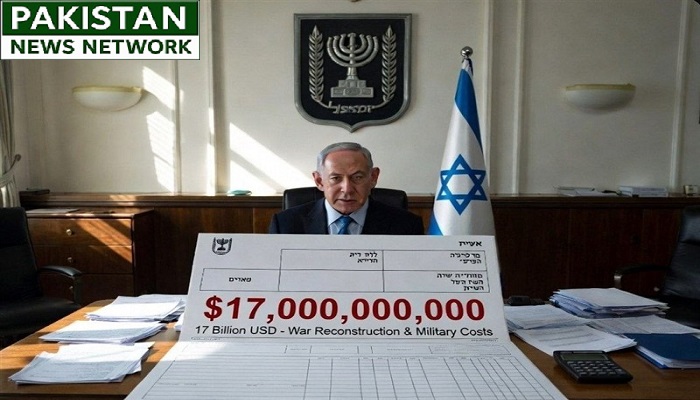
PNN – Netanyahu’s endless regional wars have led to a rise in Israel’s public debt for the fourth consecutive year.
According to the report of Pakistan News Network; the second war waged by the Zionist regime and the U.S. against Iran—which lasted 39 days—had profound economic consequences for the Zionists. Before engaging in conflict with Iran, the regime’s officials had justified the war against the Islamic Republic as an investment that would create a “New Middle East” and shift the regional balance of power; yet, by the war’s end, Tel Aviv found itself facing open fronts, depleted reserves, and strategic uncertainty.
Accordingly, when the drums of war began to beat in late February 2026 and the US and Israeli militaries launched a major offensive against Iran, a senior Israeli defense official spoke of an opportunity for a “comprehensive reconstruction” of the Middle East. When asked about the staggering costs and the financial resources required for this modernization, he claimed that the regional prosperity that will emerge in the wake of these battles will quickly offset the costs of the war.
However, when warning sirens sounded on the streets of Tel Aviv, that senior Zionist official’s visions—of a weakened Islamic Republic of Iran and its allies, the expansion of the “Abraham Accords” to include Saudi Arabia, the deepening of Israel’s ties with the UAE and Gulf states, and the billions of dollars to be generated through joint regional projects in energy, technology, and tourism—all crumbled.
According to the economic website “Calcalist,” the damage caused by this war has imposed exorbitant reconstruction costs in the occupied territories. In this context, reconstruction efforts sometimes become complicated, exceeding the budgets originally projected for them, leading contractors to abandon the work.
Statistics published by “Calcalist” indicate that since the start of the second war against Iran, these unsuccessful reconstruction efforts have cost the Netanyahu cabinet approximately 50 billion shekels (about $17 billion). This massive sum covers the bombs and missiles used by the Air Force, the cost of ballistic missile interceptors, and the Israeli army’s offensive into southern Lebanon.
Consequently, every day Israel remains trapped in this strategic and political limbo costs it over 100 million shekels (approximately $34 million), while the scope for further expanding the defense budget for 2026 remains open. The latest request from the Israeli military and the regime’s Ministry of War—seeking an additional 44 billion shekels (about $15 billion) to raise the military budget to a staggering 188 billion shekels (over $62 billion)—aims to cover a portion of these ceaseless expenses.
This situation unfolds as Israel faces a stalemate on all fronts, while Bezalel Smotrich—Netanyahu’s Finance Minister—continues to beat the drums of war as usual, insisting that “the Iran-US deal is bad, and we must press on with the campaign against Iran.” Yet, he fails to explain how the costs of this military campaign will be covered after nearly a year of continuous, grueling warfare. The existence of multiple active fronts necessitates a high level of military readiness; consequently, it is doubtful that the request to raise the defense budget to 188 billion shekels will be the Ministry of Defense’s final demand, implying continued strain on the Israeli economy.
Even prior to the request for a 44-billion-shekel increase, the Zionist regime’s military budget (including intelligence agencies) accounted for approximately 7.8 percent of its GDP—a significant rise compared to the 4.2 percent recorded in 2022. Driven by assessments regarding the continuation of hostilities and the ongoing deployment of military reservists, 2026 is expected to mark the fourth consecutive year of rising public debt for the Israeli government. While Netanyahu’s cabinet has repeatedly claimed each year that it would be the “last year of the war,” the realization that the conflict will extend into a longer period has now brought the issue of a widening budget deficit to the forefront. According to the Ministry of Finance, if revenue projections materialize, Israel will end the current year with a 4.6% deficit. Notably, this figure exceeds the deficits recorded in 2023 and 2025—years also marked by war. Furthermore, the initial plan for 2026 envisaged a budget with a 3.2% deficit. Consequently, one option facing the Netanyahu cabinet is to allocate any revenue surplus toward reducing the budget deficit rather than increasing defense spending.
The next issue concerns the impact of wars and military operations that suddenly erupt or intensify at a given time. These military actions are launched without regard for Israel’s economic conditions; the escalation of conflict in southern Lebanon serves as an example. The consequences of these trends were reflected in the decline in Israel’s annual GDP growth rate, as reported by the Central Bureau of Statistics (CBS). According to the organization’s report, the 39-day war with Iran and intense conflict with Hezbollah caused significant sectors of the economy to shut down, led many workers to join the IDF reserves, and resulted in a decline in domestic consumption. Consequently, the annualized GDP fell by 3.8 percent in the first quarter of the year. Annualized private sector consumption also dropped by 5 percent, while annualized investment in the construction sector declined by 12.8 percent.
Consequently, the Netanyahu cabinet’s policy of militarism and its strategy of relying on endless wars have imposed severe economic pressures on both the residents of the occupied territories and the cabinet itself; these pressures are evident in the regime’s military repeatedly demanding budget increases, as well as in the costs associated with reconstruction, compensation payments, and a decline in Gross Domestic Product (GDP). Crucially, this trend is expected to persist for at least the coming year.