
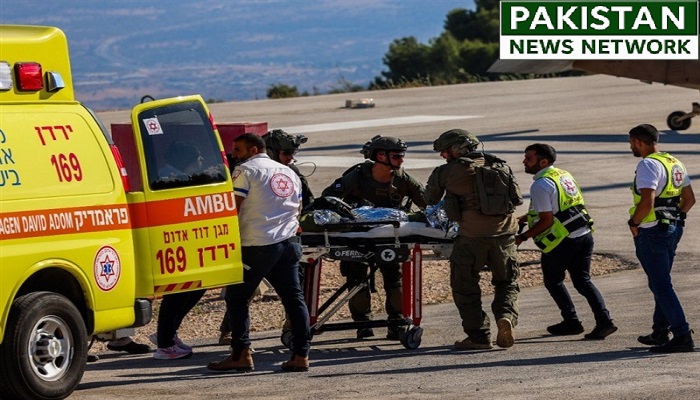
PNN – A Hebrew media outlet reported that the Israeli army is scrambling to address a manpower shortage of 12,000 troops.
According to the report of Pakistan News Network; Yossi Yehoshua—a military correspondent for the Yedioth Ahronoth newspaper and the Ynet news site—stated in a report published Friday evening that intense efforts are underway behind the scenes by the Israeli army to resolve the critical issue of manpower shortages.
The primary and central objective the Israeli army is currently scrambling to achieve is addressing a shortfall of approximately 12,000 military personnel; meanwhile, the deployment of additional troops to combat fronts and the mobilization of tens of thousands of reservists are also on the agenda, with repeated emphasis placed on the fact that—despite the severe exhaustion and fatigue of the forces—it is impossible to forgo their deployment at this time.
According to this Hebrew-language media outlet, the Israeli army is currently facing a major challenge in this regard: senior military officials state that since the October 7 (Operation Al-Aqsa Flood) setback, the scale of combat formations—across both active-duty and reserve components—has expanded by tens of percentage points.
In practical terms, this translates to an increase in the number of reserve battalions, brigades, and units, as well as a rise in the number of troops deployed across various regions and along the borders.
The contradiction is striking: how is such an expansion possible when the Israeli military itself reports a shortage of approximately 12,000 troops—including around 7,500 in operational roles?
The answer is complex. It requires a completely new approach to managing existing human resources—including steering more personnel toward combat roles, massively expanding reserve call-ups, and adopting a different strategy for dealing with battle-worn troops, thousands of whom have left the military during the war.
The Israeli army has realized that the primary challenge facing it is not necessarily recruiting new troops, but rather retaining them and employing them effectively (as it lacks the capacity to recruit additional forces).
Prior to October 7, the Gaza Division consisted of two regional brigades and four battalions. Today, however, two division headquarters, five brigades, and sixteen battalions are operating along the borders and inside the Gaza Strip.
In the north (occupied Palestine) as well, on the eve of the war, the Galilee Division comprised two regional brigades and four battalions.
However, today, two divisions, eight brigades, and fifteen battalions are deployed in this region. Prior to the war, only a single brigade was stationed at the Syrian border; today, three brigades are present there, operating not only on this side of the border (occupied Palestine) but also deep within Syrian territory.
Along the eastern border, the “Gilad Division” has been formed; comprising five new reserve brigades, it is tasked with securing a line in the Jordan Valley—an area where concerns regarding infiltration are high and which appears vulnerable to such incursions.
Another section of the report highlights that there are currently over 100,000 reservists serving in the Israeli military, enabling the force to establish and organize a number of its units.
As the author—himself a military affairs expert—acknowledges, even these substantial figures do not resolve the issue of attrition within the Israeli military. Prior to the war, reserve units were activated on a limited basis, serving in rotations that might last a few weeks over the course of several years.
In contrast, within the “Iron Swords” battalions today, there are reservists who have clocked 600 days of service in less than three years—a figure considered extraordinary by any standard.
This prolonged service takes a toll on a reservist’s life in various ways: from the impact on their family to the loss of income and damage to their career or educational standing—all quite apart from the psychological and physical costs borne by the soldier.
In another part of this lengthy report, the author also points to a statistic that is described as interesting and noteworthy.
In this regard, he writes: Over the past three years, the number of psychological exemptions issued prior to conscription has declined. After reaching approximately 10,000 young men and women classified under “Category 21” in 2023, the figure dropped to around 9,000 in 2024 and further to about 8,200 in 2025. However, there is another side to this equation: the Israeli military is witnessing a rise in the number of soldiers who are discharged and leave the ranks during their service; following months of prolonged warfare, approximately 8,000 career soldiers leave the service annually due to “unsuitability.”
Meanwhile, the Israeli military is seeking to alter this situation and is attempting to curb the widespread trend of personnel leaving the service.
According to this media outlet, the Israeli military is restructuring itself, yet it is premature to speak of a resolution to the manpower shortage crisis; this deficit cannot be remedied simply by another program or a fresh recruitment drive.
Ultimately, it is impossible to understand the efforts to expand the size of the Israeli military without considering the economic dimension. The cost of reserve duty since the war began has reached 100 billion shekels, and in the absence of sufficient regular forces, this expenditure will continue to mount.
At the same time, the army is being asked to increase its forces, deploy to new battlefronts, expand infrastructure, and modernize its personnel, yet its financial framework has not been adjusted to meet these needs. In other words, the IDF command has been tasked with building the post-October 7 army, but has been provided with an October 6 budget.