
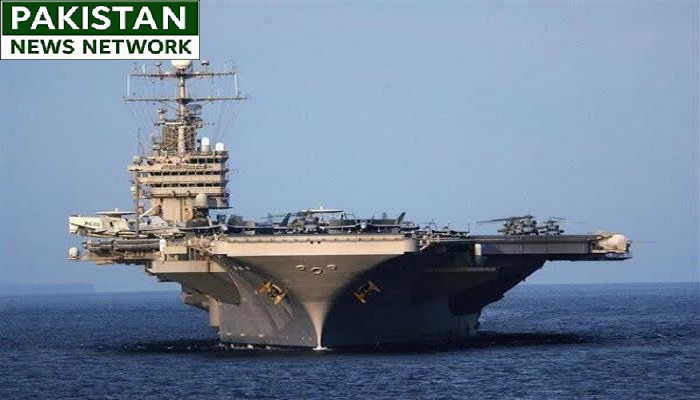
PNN – The USS Abraham Lincoln was intended to be part of the U.S. pressure campaign against Iran, but it has now become a symbol of the cost of that pressure.
A war between the U.S. and Iran was supposed to be a brief demonstration of Washington’s military superiority—a strike, a surrender, and an end. Yet, months later, the signs point to something entirely different: instead of imposing a war on Iran, the U.S. military finds itself mired in a war of attrition—a conflict whose toll is measured not merely in the expenditure of ammunition and equipment, but in the impact on the sleep, morale, focus, and mental health of American service members. In this context, the saga of the USS Abraham Lincoln may well serve as an indicator of the hidden human cost of this war.
The Core Issue: 250 Days Away from Land
According to The Guardian, the aircraft carrier USS Abraham Lincoln—home to approximately 5,000 sailors and Marines—is facing a serious crisis regarding the well-being of its crew after nearly nine months at sea. Reports indicate the ship has spent about 250 consecutive days at sea without docking, with incidents even reported of sailors attempting to jump overboard. Crew families and several members of Congress have raised alarms regarding extreme fatigue, psychological stress, long working hours, shortages of essential supplies, and health-related issues.
Published reports also point to issues with sanitary and laundry facilities, shortages of hygiene products such as soap and toothpaste, and disruptions in the hot water supply. The U.S. Navy has acknowledged the strain caused by extended deployments, although it has disputed some reports regarding the severity of the crisis and the rise in self-harming behaviors. Crucially, even the official U.S. military account reveals a fundamental reality: prolonged missions place significant strain on crew members and their families—a strain that, under combat conditions, can evolve into an operational problem.
When Military Power Turns into Attrition
The significance of the Abraham Lincoln incident lies not merely in the crew’s poor living conditions, but in something deeper: how a war of attrition can gradually transform the advantages of a major military power into liabilities. While the U.S. military possesses the capability for rapid, high-intensity operations—driven by advanced technology, firepower, mobility, and logistical superiority—these advantages retain their value in protracted conflicts (spanning months or years) only if personnel, equipment, and supply chains can withstand the accompanying strain. A long war targets precisely this vulnerability.
In a short conflict, crew fatigue, equipment wear and tear, and psychological stress may be temporary costs that dissipate once operations conclude; however, in a war of attrition, these costs accumulate. A naval vessel can remain on mission for weeks or months, yet every additional day increases the likelihood of equipment degradation, diminished crew focus, disrupted rest cycles, and heightened psychological strain. Thus, the issue is not merely the number of ships and fighter jets at the United States’ disposal, but rather how much of that power it can sustain at full readiness—and for how long.
Insanity: The Final Stage of Human Exhaustion
When discussing the psychological strain experienced by the crew of a warship, the issue should not be reduced merely to a matter of welfare. In a military environment, mental health is directly linked to operational effectiveness. A sailor living for months with sleep deprivation, grueling work schedules, separation from family, and constant stress may still wear the uniform and perform their duties, but their mental and physical capacity is not necessarily the same as it was during the early days of the mission. Prolonged exposure to these conditions can impair concentration, reaction speed, and the quality of decision-making.
This issue is of particular importance for an aircraft carrier, as the slightest human error in an environment where dozens of aircraft are constantly taking off and landing can result in a deadly accident. Consequently, when media reports mention sailors attempting to jump overboard or suffering from severe psychological stress, the matter goes beyond the mental state of a few individuals; it must be viewed within the context of a major unit’s combat readiness. An army intent on sustaining a prolonged war must be capable of preserving not only its weaponry but also its personnel for that conflict.
Washington’s Main Problem: A War Where Time Works against It
Washington could deploy additional troops and equipment to the region to maintain pressure on Iran, but this solution creates a significant paradox. The more forces deployed to sustain military pressure, the greater the strain placed on the cycle of deployment, maintenance, resupply, and rest. Increasing troop numbers does not necessarily equate to an unlimited increase in operational capacity, as the military must balance active units against those returning, as well as manage maintenance, training, and personnel rotation. A protracted war places this cycle under strain, and the associated costs become increasingly apparent over time.
In effect, a war of attrition alters the simple equation of “who possesses greater firepower,” transforming it into the question of “who can endure the longest.” The United States undoubtedly holds a significant advantage in terms of financial resources, technology, and weaponry, yet none of these resources are limitless. Ammunition is expended, equipment wears out, troops grow exhausted, and military families feel the toll of this prolonged conflict. Consequently, with each passing day that the war continues without a clear political outcome, the issue of attrition becomes increasingly critical for Washington.
The Abraham Lincoln: A Single Ship or a Sign of a Larger Crisis?
Viewed from this perspective, the story of the Abraham Lincoln should not be seen as an isolated incident. The ship may well be a visible manifestation of a broader problem that gradually reveals itself during a protracted conflict. An aircraft carrier—intended to symbolize American power, mobility, and sustained operational capability—now finds itself at the center of reports warning of crew fatigue, psychological stress, and deteriorating living conditions. This picture stands in stark contrast to the initial vision of a short, decisive operation.
More importantly, such a situation cannot be resolved simply by injecting more money or equipment. While Washington might be able to deploy another naval vessel to the region, it cannot just as easily undo the loss of time or eliminate the psychological strain and personnel exhaustion. Sustaining the war effort requires the U.S. military to maintain a continuous cycle of fresh troops, ready equipment, and logistical infrastructure; the longer the conflict drags on, the more difficult and costly it becomes to sustain this cycle.
The War Meant to Wear Down Iran
Ultimately, the most critical strategic question is who benefits from the passage of time and who bears the greater cost. If the United States initiated the war calculating that intense military pressure would quickly force Iran to abandon its resistance, then the prolongation of the conflict itself signifies the failure of that calculation. In such a scenario, Tehran does not necessarily require a lightning victory to succeed; it need only maintain its capacity to resist, regroup, and continue the fight, while the cost of the U.S. presence steadily mounts.
This is the very logic of a war of attrition—a conflict in which time itself becomes a weapon. If the war drags on, the pressure does not fall solely on Iran; the United States, too, must bear the costs associated with maintaining a massive military presence, the continuous deployment of troops, ammunition expenditure, equipment wear and tear, and the psychological strain on personnel. The Abraham Lincoln incident is significant in this regard. While this aircraft carrier may represent just one of countless instances of hidden pressure not yet reflected in official statistics, it serves as sufficient evidence that the costs of war extend far beyond the battlefield.
Ultimately, the issue for Washington is not merely whether it retains the capability to launch an attack; rather, it is whether it can sustain a prolonged conflict without eroding the human and operational foundations of its military power. The USS Abraham Lincoln was intended to be part of the U.S. pressure campaign against Iran, yet it has now become a symbol of the costs associated with that very pressure. Should this trend persist, the very concept of “victory” for the United States will likely shift; for in a war of attrition, defeat does not always occur when an army loses the ability to fight, but rather when the cost of continuing the conflict outweighs the value of its outcome.