
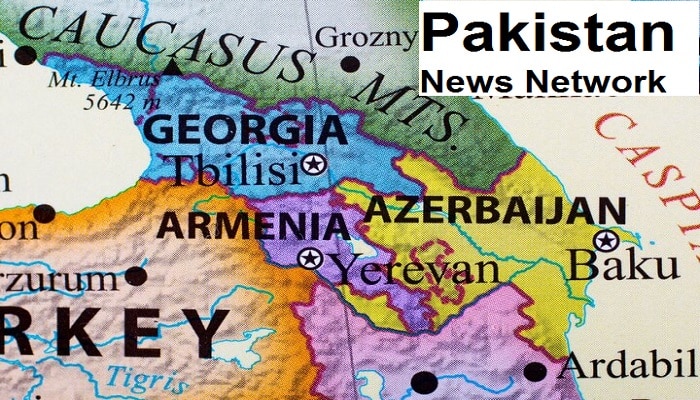
PNN – An examination of the behavior of the authorities of the Republic of Azerbaijan, Armenia, and Georgia in recent weeks shows that the South Caucasus countries have exhibited three different behavioral models.
According to the report of Pakistan News Network; In the South Caucasus, three different trends have emerged simultaneously over the past week that require Iran’s attention and vigilance. The Republic of Azerbaijan is using the opportunity to hold the UN World Cities Forum in Baku as a platform to gain international legitimacy and negotiate energy transfers to Europe at a time when the energy crisis in the Persian Gulf region is intensifying. Armenia, on the eve of critical parliamentary elections, must make a strategic choice between moving closer to the European Union and the Eurasian Economic Union, each of which will have serious and different consequences for the country, and Russia is also deeply angered by the Pashinyan government’s Westernization trend. The independent government of Georgia, in a different approach from the Armenian government, pursues the path of orientalism and strengthening the Georgian Orthodox Church, while simultaneously exerting legal pressure on the Western-leaning opposition.
Based on this overall picture, the South Caucasus region continues along three different paths – Baku wants to be at the center of attention on the energy market, Yerevan seeks to maintain a fragile balance, and Tbilisi rearranges the domestic political arena in its own way.
Baku: From Energy Diplomacy to Soft Power Demonstration
The 13th session of the United Nations World Cities Forum was held in Baku from 17 to 22 May, coordinated by the United Nations Human Settlements Programme and the Government of Azerbaijan. The official theme of the meeting was “Housing for All: Safe and Sustainable Cities and Communities”. The UN has linked the event to the global housing crisis: nearly 2.8 billion people in the world live in inadequate housing, more than 300 million are homeless, and by 2050, about 70% of the world’s population will live in cities.
For Azerbaijan, the WUF13 was not just a forum about urban development. Baku heavily promoted its experience in rebuilding the territories it had taken control of after the Karabakh conflict, including “smart villages” projects, some of which Israel had helped build, green energy projects, new infrastructure, and resettlement. More than 40,000 participants from 182 countries registered to attend the forum, and Baku also used the opportunity to promote the idea of a “Western Azerbaijan.” The Aliyev government has used this title for part of Armenian territory, especially the Syunik province on the Iranian-Armenian border, and claims that some of the country’s citizens previously resided in this region and should return to it, a claim that should be interpreted as facilitating the creation of the fake Zangezur corridor and the geopolitical strangulation of Iran.
But along with this political propaganda, advancing Baku’s energy projects was also on Aliyev’s agenda. Ilham Aliyev met with Serbian President Aleksandar Vucic and stressed the need to further strengthen the strategic partnership between the two countries. At a business meeting with Azerbaijani entrepreneurs, it was emphasized that Azerbaijani gas exports to Serbia from January 2024, in the form of a joint gas power plant project in the Serbian city of Niš, have already yielded practical results. The Serbian side also spoke about the possibility of increasing trade turnover with Azerbaijan fivefold.
But Baku’s energy pipeline will also extend to Slovakia. On the sidelines of the WUF13 summit, Slovakia’s Deputy Prime Minister Tomas Taraba announced that Slovakia intends to sign a gas import contract with Azerbaijan for at least 10 years. According to him, there will be no discussion about the pipeline routes and supply volumes, and Baku has been active during the recent disruptions in gas supplies via Ukraine. For the EU, this means greater participation of Baku in the alternative gas supply system to meet the needs of Central and South-Eastern Europe. A market that has traditionally been in the hands of Russia, and Iran, if conditions were normal, could also play a role in meeting the needs of the countries in the region and earn a lot of income.
If these plans are realized, Baku will gain an important political position. On the one hand, the European Union expects positive results from the WUF13 summit and emphasizes the reduction of global problems in the housing sector. On the other hand, European countries come to Azerbaijan to receive gas, create related infrastructure and conclude long-term contracts. In this regard, the UN forum has become for Baku a tool for combining the soft international agenda with hard energy diplomacy. Of course, it is obvious that Baku alone does not have the capacity to supply gas in this volume to European countries and will definitely use the capacity of countries such as Turkmenistan and Kazakhstan for this purpose. The important point is whether Iran will be able to play a role in the European gas market and take over a part of this lucrative market in the near future.
Armenia: Wandering between East and West
In Armenia, the main event in recent weeks has been the recognition by government officials of the impossibility of maintaining an eternal balance between the European Union and the Eurasian Economic Union. Russia’s patience ran out after Zelensky’s visit to Yerevan and the Armenian government’s attempt to distance itself from Russia and move closer to the European Union. In retaliation, Russia has resorted to restricting exports of flowers, fruits, mineral water and some other items from Armenia. Mehr Grigoryan, Deputy Prime Minister of Armenia, announced last week that Yerevan understands that Armenia cannot be a member of the European Union and the Eurasian Economic Union at the same time. At the same time, he emphasized that the final decision should be made by the citizens of Armenia and that, according to the government, there is currently no urgent need for such a choice.
These statements are important. Yerevan does indeed acknowledge the existence of a strategic dilemma, but it is postponing a decision on it. Until the parliamentary elections on June 7, the government is not interested in abruptly severing ties with the Eurasian Economic Union, as this would immediately hit Armenia’s trade, labor market, remittances, energy imports, and logistics services, all of which are dependent on Russia. At the same time, the Pashinyan government continues to move toward the European Union, using the perceived European agenda as a source of political legitimacy at home and a safeguard against dependence on Russia.
The election campaign in Armenia has become increasingly tense. Instead of discussing security, economic programs, and a major foreign policy approach, the general election campaign has degenerated into personal attacks between Nikol Pashinyan and his opponents, such as Samvel Karapetyan and Robert Kocharyan. This shows the weakness of substantive political debate: the fundamental issue is the future direction of Armenia, but the current campaign is largely based on mobilizing and inciting people through personal animosity, stirring up old grudges, and fighting to control dissenting voters, which is superficial.
Georgia: The End of Blind Westernization
In Georgia, the main domestic political event was the celebration of the Holy Day of the Family last week, on May 17. The highest authority of Orthodox Christians in Georgia, Patriarch Shio III, appeared with a new message, describing the current demographic situation and the decline in the birth rate in Georgia as a threat to the Georgian people. He called for strengthening the country’s laws against “harmful gender theories and ideologies.” According to him, such laws should not only be repealed, but also laws should be enacted and consolidated to strengthen and protect the institution of the family and the people.
The ruling party supported the request. The Speaker of the Parliament, Shalva Papuashvili, stated at the Samba Cathedral that it was necessary not only to strengthen Georgia economically, but also to strengthen Georgia spiritually, and this attitude should be passed on to the next generation. As a result, the Holy Family Day did not become a purely church event, but a joint signal from the government and the church institution to society.
The state, the church, and the conservative part of society have formed a common ideological front around the family, population, national identity, and resistance to the supporters of the liberal and Western agenda that once dominated the mainstream discourse in Georgian society. However, their failure to fulfill the Western promises of prosperity and idealism, and the lessons Georgians learned from what happened in Ukraine and some other countries around the world, have led them to return to their original identity roots.
This process of returning to oneself that we are witnessing in Georgia is completely different from the flight from the roots of authentic Islamic and Christian identity that we are witnessing in Azerbaijan and Armenia. In both countries, some of the main identity-building and civilization-building institutions, such as the structures of Shiite Islam and the Armenian Apostolic Church, are being suppressed, and of course, the seditions in both countries are being led by Britain and Israel.
The Georgian authorities’ emphasis on returning to the Eastern spirit has angered the Western-leaning opposition and human rights organizations, which have created a media atmosphere about the threat to social justice, with headlines such as the Georgian Young Lawyers Association reporting increasing pressure on the LGBT community, intensifying censorship, hateful literature from the church and state, and the expulsion of these groups from the public sphere. Of course, Georgian officials deny these claims, and among them, Gia Volski, the Deputy Speaker of the Georgian Parliament from the ruling party, has stated that no one in Georgia violates the rights of LGBT people.
Overall, the Georgian government has been mobilizing domestic forces around traditional values and orientalist political goals in recent days. Unlike Armenia, where the main issue is the choice between the European Union and the Eurasian Economic Union, and Azerbaijan, where power and energy diplomacy dominate, Georgia is currently focused on consolidating its domestic ideology.