
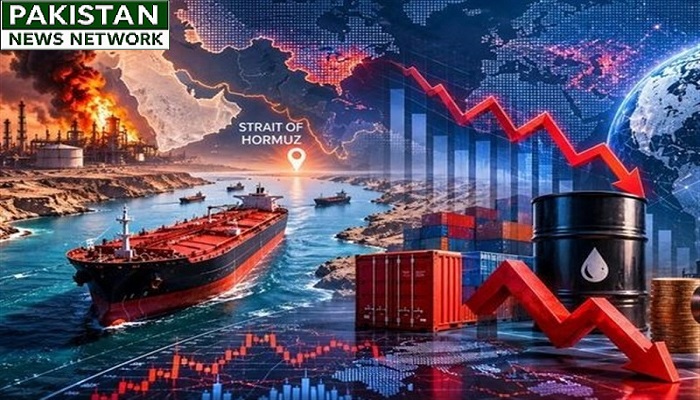
PNN – International economic sources have warned that the repercussions of the US economic war against Iran will spread across the globe.
According to the report of Pakistan News Network; amidst ongoing analyses regarding the US economic war against Iran—launched following Washington’s humiliating failure in a military confrontation despite exhausting all available options—the Qatari website Al-Araby Al-Jadeed published an article examining the war’s far-reaching global consequences. The article noted that the US effort to isolate Iran—which entered a new phase with the initiation of this “economic war”—has extended the scope of economic pressure well beyond Iran’s borders.
The consequences of this economic war launched by the United States have impacted inflation, interest rates, production and transportation costs, and global growth. Meanwhile, the International Monetary Fund (IMF) has warned that the energy shock is not yet over, and a renewed rise in oil prices could force central banks to maintain tight monetary policies for a longer period.
The global energy shock resulting from the war against Iran has not yet fully subsided.
Kristalina Georgieva, Managing Director of the International Monetary Fund, stated at a press briefing on Tuesday—ahead of the G20 finance ministers’ meeting scheduled for next week in Asheville, North Carolina—that the global economy has weathered the energy shock stemming from the war against Iran better than initially anticipated. However, the global economy still faces risks associated with rising prices, deteriorating financial conditions in certain countries, and climbing bond yields.
She added: The energy shock is not over. A renewed rise in oil prices could exacerbate inflation and force central banks to maintain a tight monetary policy stance, with subsequent repercussions for debt-servicing costs and economic activity.
Georgieva explained that several countries have mitigated the initial impact of the crisis by drawing on oil and gas reserves, increasing supplies from outside the Gulf region, reducing energy consumption, and expanding renewable energy capacity. Some economies have also reverted to using coal for electricity generation. However, these measures have not put an end to price pressures.
Unprecedented Inflation Surge and Slowing Global Economic Growth
The Managing Director of the International Monetary Fund (IMF), pointing to stalled progress in curbing inflation, rising bond yields, and mounting financial burdens, warned that central banks might be forced to continue tightening monetary policy to control prices, despite the resulting slowdown in growth.
In July, the IMF lowered its global economic growth forecast for 2026 to 3 percent and warned of additional risks stemming from war, trade fragmentation, and uncertainty surrounding artificial intelligence investments. The IMF is scheduled to release its updated forecast in mid-October during its annual meetings with the World Bank in Bangkok.
This warning was issued after the yield on 30-year U.S. Treasury bonds hit a 19-year high, prompting Treasury Secretary Scott Bessent to double the size of the country’s long-term bond buyback program.
Meanwhile, inflation has become a major concern for central banks. This pressure is particularly evident in the Eurozone, where Isabel Schnabel, a member of the European Central Bank’s Executive Board, stated on Wednesday that interest rates need to rise further as the war continues and the risk of inflation exceeding the target level grows.
“At current interest rates, it is unlikely that inflation will return to the target level in the medium term; therefore, further policy tightening will be necessary,” Schnabel said in an interview with Bloomberg.
He predicted that consumer price inflation—driven by rising energy costs—would remain above the European Central Bank’s 2% target for an extended period, and warned that delaying action until the rise in prices feeds through to wages would leave policymakers lagging behind price developments.
In June, the European Central Bank raised borrowing costs for the first time in nearly three years to prevent the surge in energy prices from spreading to other sectors of the economy.
Reuters reported on Tuesday, citing three sources, that policymakers are inclined to raise interest rates at their September meeting to counter the inflationary impact of the war, but do not wish to announce further hikes in advance.
Heavy Burden on Businesses and Households
Persistently high interest rates translate into higher financing costs for governments, businesses, and households at a time when economies are grappling with simultaneous burdens, including rising import, energy, and transportation costs. The Managing Director of the International Monetary Fund warned that monetary tightening would impact debt servicing and economic activity, particularly in countries with high levels of borrowing and fiscal deficits.
Meanwhile, rising prices have also spread to economies far removed from the conflict zone. Data released by the Australian Bureau of Statistics on Wednesday showed that the Consumer Price Index (CPI) rose by 1 percent in July compared to the previous month—surpassing analysts’ expectations of 0.8 percent—after fuel prices climbed 7.5 percent following three months of decline.
At the same time, Australia’s annual inflation rate reached 3.5 percent—contrary to expectations that the growth rate would slow to 3.3 percent—while core inflation remained steady at 3.6 percent. These figures revived market expectations that the Reserve Bank of Australia (RBA) would raise interest rates for the fourth time this year.
Additionally, the probability of an Australian interest rate hike in September—as priced in by markets—rose from 17% prior to the release of these figures to 38%. A rate hike by next February is now considered a certainty.
According to Reuters, Adam Boyton, Head of Australian Economics, stated that these figures signal strong upside risks to short-term inflation expectations, and the acceleration recorded in July could raise concerns for the central bank.
It is evident that rising energy costs are passed on to consumers through various channels, including fuel and electricity prices, land and air transport, shipping, insurance, and warehousing. These costs are embedded in the prices of food, manufactured goods, and services, thereby exacerbating the shock and making it harder to contain—even if crude oil prices temporarily decline.
Higher transportation and production costs also affect companies’ ability to invest and hire, as they are forced to choose between absorbing the increased costs, passing them on to consumers, or scaling back operations.
In all cases, economies face a combination of higher prices and weaker growth, while the ability of governments to provide extensive support is constrained by rising budget deficits and borrowing costs.
The market’s reaction to the new U.S. sanctions indicates that investors are weighing the likelihood of increased supply pressure against Washington’s efforts to avert a broader shock.
The U.S. government had threatened countries and companies continuing to trade with Tehran with secondary sanctions and the loss of access to the U.S. financial system, yet its initial announcement did not impose direct sanctions on major financial institutions.
In a note published on Tuesday, commodity analysts at ING Bank stated that markets have not yet been significantly affected by the announced measures; however, Tehran’s capacity to disrupt shipping remains, keeping supply risks alive.