
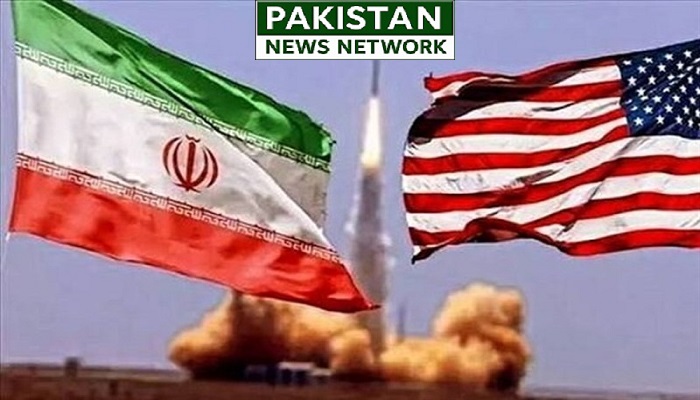
PNN – Al-Quds Al-Arabi, referring to the victory of the resistance, announced that Iran imposed a new regional deterrence strategy.
According to the report of Pakistan News Network, within the framework of continuing regional and international analyses of the results of the US and Zionist regime’s war against Iran and the agreement recently concluded between Tehran and Washington, the London-based Al-Quds Al-Arabi newspaper examined the new strategic deterrence equation that Iran imposed in the region in an article, which is described below.
Iran is Making History in the Region
Over the past twelve months, Tehran has developed a regional deterrence strategy, transforming itself from a last line of defense to a first line of offense in the confrontation with Israel. Under this new strategy, Iran has carved out a deep line in the seas that stretches from the Black Sea to the Balkans and the Eastern Mediterranean, to the Red Sea, the Horn of Africa and the Persian Gulf, and from the north to the Caspian Sea.
This new deterrence strategy surrounds Israel from the west, east, north and south, and outlines a new and achievable regional security strategy based on the principles of justice, equality, mutual respect, cooperation and stability.
Now, after announcing an agreement to end the US-Israeli war against Iran, lift the naval blockade, open the Strait of Hormuz for safe navigation, and restore Iran’s rights that were violated by previous US, UN Security Council, and IAEA resolutions, it is the right of the Iranian people to celebrate the victory of the will of resistance based on peace and stability through military power, not only in confronting US and Israeli arrogance, but in all conflicts in the region.
Today, Iran is making history in the region after its victory in the Strait of Hormuz. After these equations, the path is clear and obvious that the only solution is the will to resist. The Islamabad agreement, which is to be officially signed in Geneva on Friday, is merely the beginning of a journey, not its end, a journey that combines will with astute diplomacy, flexibility and military retaliation.
Iran’s Regional Deterrence Strategy against the Zionist Project
Analysis of the statements of Iranian leaders in recent days shows that Tehran’s strategic regional deterrence begins in the west with Lebanon (the red line due to its presence on the front line with Israel), extends from the south to the Red Sea, Yemen, and the Horn of Africa, and from the north to Azerbaijan and the Caspian Sea (which form the perimeter of this deterrence zone). Therefore, this scope contradicts the principle of Israel’s decisive military superiority and the Zionist strategy of regional hegemony.
These containment zone boundaries create a complex relationship between security in the Eastern Mediterranean and the Persian Gulf. The Horn of Africa and Central Asia require an effective regional policy and astute diplomacy. To this end, Iran must forge alliances of a political, not ideological or sectarian, nature to help it and its allies fulfill their responsibilities for maintaining regional security.
In this context, strengthening Tehran’s relations with China and Russia is crucial, as is developing relations with Turkey to prevent Israeli influence in Central Asian countries through Azerbaijan. Given Turkey’s historical influence in Central Asia, establishing deep political relations with it will help Iran maintain its national security and play a more effective role in maintaining regional security.
Such cooperation is essential for the interests of both countries (Iran and Saudi Arabia). Israel should not be allowed to operate with impunity in the Red Sea, as in the Eastern Mediterranean, and it is essential that Saudi Arabia participate in creating a strong buffer zone to prevent Israeli expansion eastward through Lebanon, Syria, and Jordan.
Iran’s Imposition of Political Will on America through Military Power
The Islamabad Agreement between Tehran and Washington is the first tangible embodiment of a new strategy of regional deterrence, both diplomatically and militarily. According to the available evidence and according to the Iranian Foreign Ministry and Supreme National Security Council, Tehran achieved almost everything it wanted, within the overall framework of the strategy, in terms of not waiving its fundamental national rights, not jeopardizing the gains it had made during the war, and not allowing any future restrictions on its freedom of will and decision-making independence.
The deal, as announced by Tehran, includes an end to the war on all fronts, especially the Lebanese front, which puts Trump in direct conflict with Netanyahu. The significant concessions that Iran gained in the deal relate to the end of sanctions, the lifting of the naval blockade, access to frozen assets, and arrangements to link the fulfillment of obligations to the implementation of the agreement itself.
On the other hand, Washington’s recent concessions to Tehran to persuade it not to retaliate for the second Israeli attack on the Beirut suburbs have exposed a deep rift in US-Israeli relations over the deal. The rift reached such an extent that Trump personally insulted Netanyahu in his phone call on Sunday, during which he informed him of the deal, and accused him of stupidity and ignorance in his assessment of how to manage the conflict in the region.
Trump said he had insisted in his conversations with Netanyahu that the war in Lebanon must end and that Israel must permanently cease attacking Beirut or any other part of Lebanese territory. Following the call, Trump issued a presidential order to end the war in the Strait of Hormuz, begin lifting the naval blockade of Iran, and open the Strait of Hormuz to safe navigation “for all.”
The truths that Iran revealed; Israel’s troubles for America to humiliation of the Arabs
It is noteworthy that despite receiving significant concessions from the United States, Iranian officials continue to emphasize that accepting this agreement does not mean trusting the enemy and that Tehran will carefully monitor the implementation of the United States’ commitments.
Accordingly, during the 60-day negotiation period, several issues will be discussed, including the lifting of the United States’ primary and secondary sanctions against Iran, as well as the lifting of UN Security Council and IAEA Board of Governors resolutions against Iran.
The nuclear issue will also be discussed, along with a mechanism for Iran’s economic reconstruction and development after the imposed war, and Iran stressed the need to establish a monitoring and control system to ensure the proper implementation of commitments by both sides.
The Iranian side also stressed that its armed forces “will remain on high alert to confront any hostile plot” and that Tehran’s fingers will remain on the trigger.
According to the new equation of regional strategic deterrence, Iran has shown that US military bases in the Persian Gulf countries have become a defensive burden, not an offensive asset, for the United States and its host Persian Gulf countries.
This equation has also shown that Israel is gradually becoming a burden that drains US military resources and threatens its strategic interests. Iran has recognized the role of sea lanes in the strategic deterrence equation and has changed its position in applying the principle of united fronts of resistance, from defense to the front line of attack if necessary.
Another certain point after the creation of the new Iranian deterrence equation is that the Arabs remain the absent party in the regional strategic deterrence equation, content with a marginal role in a conflict that primarily targets them.