
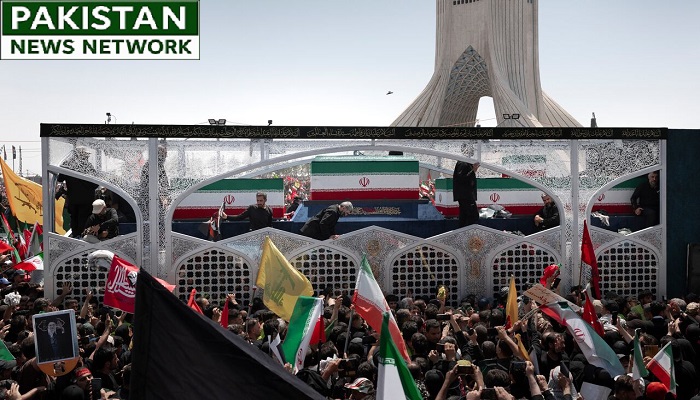
PNN – A New York Times reporter described the experience of being among the mourners at the farewell ceremony for the late leader as joining a surging human tide of mourners across the streets of Tehran.
According to the report of Pakistan News Network; Abdi Latif Zohr, pointing to the massive public turnout at the funeral procession of the martyred leader, wrote: They poured in from all directions, streaming toward the heart of Tehran—rivulets that gradually swelled into a river and then into an even more colossal phenomenon; a surging flood of mourners possessing a collective force that seemed driven by a singular will.
A New York Times reporter wrote: On Monday morning, I joined the crowds that had gathered to bid farewell to Iran’s late Supreme Leader. Following two days of public mourning ceremonies in the capital, this was the final day for paying respects. Afterward, the body was to be transported to Qom—the center of religious learning in Iran—and then to neighboring Iraq, a country where, as in Iran, the majority of the population is Shia Muslim.
With ceremonies held across Tehran, people gathered around the city’s iconic Azadi Square—home to an arch-like tower featuring white columns that evoke various eras and epochs, spanning from kings and revolutions to triumphs and sorrows.
Around Azadi Square, a glimpse of the lives of the Iranian people was visible. Parents carried their children on their shoulders or pushed them in strollers. Young women constantly chanted slogans and recorded video, sweeping their phones in slow, sweeping arcs over the banners and the moving crowd. Older individuals carried portraits of the martyred Ayatollah. A group of women marched beneath a large Iranian flag, chanting “Death to Israel” and “Death to Trump.” At least one banner bore a vow of revenge written in Hebrew.
Funeral marches and elegiac chanting never ceased. Verses from the Quran could be heard blaring from loudspeakers. Every now and then, slogans would erupt from somewhere; the shouts sounded like a distant roar—indistinguishable at first—before sweeping like a wave from one section of the crowd to the next.
We forced our way forward through the throng. At times, I wondered if the staggering density of the crowd had finally become unbearable. A glance ahead revealed only more people, fading into the heat and haze. There seemed to be neither beginning nor end to the crowd; there was simply the sensation of moving through a landscape almost entirely composed of human beings.
After a three-hour march, we finally reached Azadi Square. We asked the person in charge of the water tanker if we could go up the tower, and he immediately agreed. From up there, the size of the crowd was more apparent, and its sheer magnitude was undiminished.
We spotted it very quickly: a vehicle moving slowly along a wide, circular path in the square. The moment the crowd saw it, their energy shifted instantly. Shouts and chants filled the air, and people tossed whatever they were holding—scarves, shawls, or even parts of their own clothing—toward the truck, hoping the items would touch the coffin and be blessed. Some succeeded; their belongings were caught and handed back by someone standing atop the vehicle. Others did not. For many, this was the closest they had come to the body.
The man atop the water tanker began to weep. The flag-bearer beside me waved his flag more vigorously. Those nearby fell silent, as if trying to preserve the moment.
For many around me, this moment marked the end of an era—a farewell to a man revered by his fans.
I returned to Azadi Square on Monday evening; the crowds were gone, sanitation workers were busy on the sidewalks, and life had resumed its normal course.