
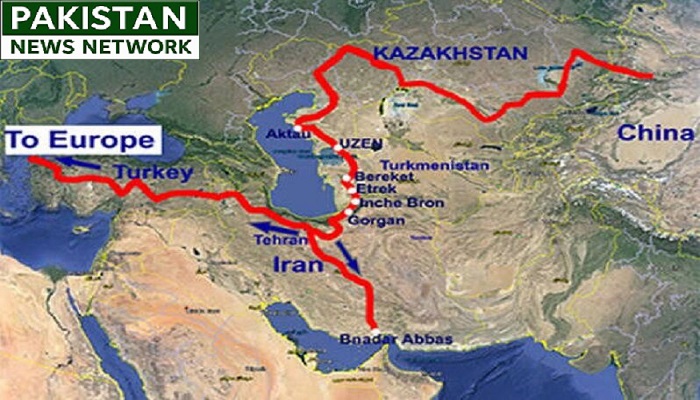
PNN – In a report highlighting recent US strikes on certain Iranian rail and coastal infrastructure, the Central Asia Times news outlet noted that, despite security pressures, Iran’s southern routes retain a strategic position in Central Asian trade dynamics; for countries such as Kazakhstan and Turkmenistan, these routes remain an irreplaceable option due to the access they provide to the Persian Gulf and open waters.
According to the report of Pakistan News Network; citing the Central Asia Times, Kazakhstan and Turkmenistan have spent years developing routes through Iran to reach the Persian Gulf, the Sea of Oman, and markets beyond Russia, striving to expand these corridors through cooperation and coordination with Iran, China, and Russia.
The operation of a trial container train in 2024 along the China–Kazakhstan–Turkmenistan–Iran route—traveling from Xi’an to Tehran—reduced the delivery time for goods from China to Iran to 15 days, once again highlighting the significance of this route.
The Gorgan-Incheh Borun railway, inaugurated in December 2014, connects Iran to Turkmenistan and Kazakhstan along the eastern coast of the Caspian Sea; this route spans over 900 kilometers, extending from western Kazakhstan through Turkmenistan to northern Iran. It links the rail networks of Kazakhstan and Turkmenistan to Iran’s rail system—and onward to the Persian Gulf and Asian markets—thereby highlighting the security of these southern corridors.
The security situation at the Shahid Rajaei port in Bandar Abbas also impacts these nations; on June 28, Kazakhstan and Iran signed a 27-year Build-Operate-Transfer (BOT) agreement for a Kazakh transport and logistics terminal.
The Embassy of Kazakhstan in Tehran announced that the agreement grants Kazakhstan a plot of land for the terminal; the project allocates two years for construction and 25 years for operation, with commercial activities scheduled to begin in the third year.
Chabahar offers Kazakhstan another reason to closely monitor Iran’s coastal security; the Central Asia Times reported in June that Iran had offered Kazakhstan the opportunity to operate at Chabahar, a deep-water port on the Gulf of Oman.
Iranian officials have described Chabahar as a key international transport corridor along the North-South route, noting that the Chabahar-Zahedan railway is over 90 percent complete; upon completion, the line is expected to link Chabahar to broader regional freight networks.
For Central Asia, the issue now extends beyond the Strait of Hormuz; Kazakhstan and Turkmenistan are seeking southern routes that would reduce their reliance on Russia, alleviate pressure on the Caspian Sea, and provide exporters with access to markets in the Persian Gulf and the Indian Ocean.
The Middle Corridor provides Kazakhstan with access to Europe via the Caspian Sea, Azerbaijan, Georgia, and Turkey, whereas Iran offers Kazakhstan and Turkmenistan a southern outlet to the Persian Gulf and South Asia.
Kazakhstan has denied damage to its facility at Shahid Rajaee Port and has issued no public statement regarding the suspension of the Kazakhstan-Turkmenistan-Iran route.