
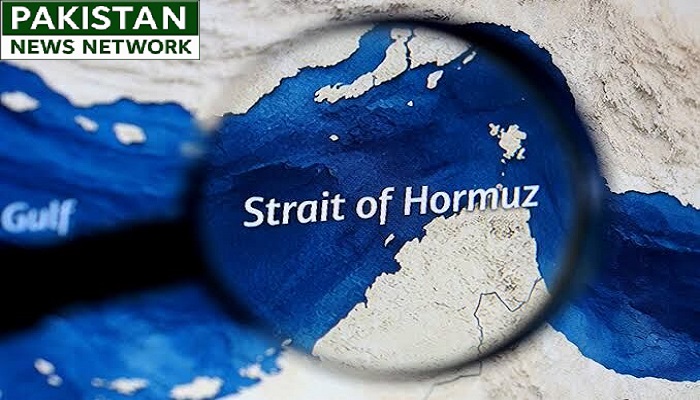
PNN – Although the war of aggression waged by the United States and the Zionist regime against Iran took place in West Asia, its repercussions were felt most acutely in East, South, and Southeast Asia—a region that stands as the world’s largest energy consumer and sources the bulk of its oil and gas from the Persian Gulf. From China and Japan to South Korea, India, and the member states of the Association of Southeast Asian Nations (ASEAN), these economies view the security of the Strait of Hormuz not merely as a regional issue, but as a matter directly linked to their economic growth, national security, and supply chain stability.
According to the report of Pakistan News Network; the outbreak and continuation of this conflict—driven by repeated U.S. breaches of the ceasefire and the Islamabad Memorandum—have made this issue a central focus of Asian media reports and analyses, diplomatic meetings, and even regional financial markets. Reputable Asian media outlets—including Japan’s Nikkei Asia, Singapore’s The Straits Times, India’s The Hindu, Hong Kong’s South China Morning Post, and Channel News Asia (CNA)—have highlighted in their coverage the heavy reliance of Asian economies on oil and gas from the Persian Gulf region, as well as their vulnerability to any disruption in the passage of oil tankers through the Strait of Hormuz.
Hormuz: Asia’s Energy Artery
The deep concern among Asian nations regarding any potential military conflict in the region stems from the vital and irreplaceable dependence of their economies on energy transiting the Strait of Hormuz. Data from authoritative sources, such as the U.S. Energy Information Administration (EIA), indicate that the flow of energy through this waterway is disproportionately directed toward Asian markets; notably, in the first quarter of 2025, Asian countries collectively imported 89.2 percent of the total crude oil and gas condensate passing through the strait, whereas the U.S. share stood at just 2.5 percent. Among Asian nations, China is the largest importer with a 37.7% share, followed by India (14.7%), South Korea (12.0%), and Japan (10.9%); this dependency extends beyond oil, as approximately 20% of global liquefied natural gas (LNG) trade—83% of which is destined for Asia—also passes through this strait.
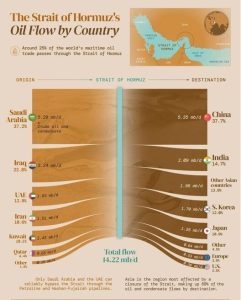
Given these figures, any disruption in the Strait of Hormuz would entail immediate and severe consequences for Asian economies—most notably, an energy price shock. The closure of this waterway, or even the threat thereof, would trigger a surge in oil prices and drive up transportation and insurance costs, directly fueling inflation and challenging economic growth. Furthermore, export-oriented economies such as China, Japan, and South Korea—which rely heavily on affordable and stable energy—face rising production costs and declining competitiveness; meanwhile, data from the Joint Organisations Data Initiative (JODI) indicates that countries like the Philippines, Thailand, and India possess very low strategic oil and gas reserves, rendering them highly vulnerable to any sudden disruption in imports.
China: Energy Security a National Strategic Priority
As the world’s largest oil importer, China sources a significant portion of its energy needs from Persian Gulf nations. In recent days, Chinese media outlets—including the Global Times and China Daily—have emphasized that stability in the Persian Gulf is vital to China’s economic growth.
Chinese experts believe that any rise in oil prices or disruption to energy supply routes would not only increase production costs but also directly impact Beijing’s exports, economic growth, and industrial plans.
Japan: The Most Vulnerable Developed Economy
Japan imports over 90 percent of its oil from the Middle East; consequently, it is consistently among the first nations to react to any tensions in the Persian Gulf.
Japanese media outlets, including Nikkei Asia and Yomiuri Shimbun, have reported that the Tokyo government is considering increasing strategic energy reserves, diversifying import sources, and strengthening cooperation with energy-producing nations.
South Korea: Concerns among Export-Oriented Industries
South Korea’s economy, anchored by the petrochemical, automotive, and semiconductor industries, relies heavily on stable oil and gas imports.
The Korea Herald and Yonhap News Agency have warned that rising energy prices could undermine the competitiveness of South Korea’s export industries and negatively impact the country’s economic growth.
India: Between Economic Growth and Energy Security
With over 80 percent of its oil consumption met through imports, India is considered one of the Asian economies most vulnerable to crises in the Persian Gulf.
In an analysis, The Hindu newspaper noted that every $10 increase in oil prices adds billions of dollars to India’s energy import costs and could impact the country’s inflation rate, the value of the rupee, and economic growth.
ASEAN: A Shared Concern in Southeast Asia
Although ASEAN includes some energy-producing nations, the region’s collective economy relies heavily on maritime trade and energy imports.
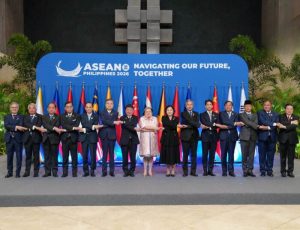
At the recent ASEAN foreign ministers’ meeting in Manila, energy security and freedom of navigation were key topics of discussion. Many foreign ministers warned that continued instability along energy transit routes could pose a serious challenge to the region’s economic recovery following recent years.
Channel News Asia (CNA) reported that the security of the Strait of Hormuz has become a major concern for Southeast Asian nations, as a significant portion of their oil and gas imports is supplied via this route.

Asian Strategies for Risk Mitigation
An analysis of the policies adopted by Asian nations reveals that they have pursued four key strategies in recent years:
* Increasing strategic oil and gas reserves.
* Diversifying energy import sources to include the United States, Africa, and Latin America.
* Making extensive investments in renewable energy, hydrogen, and nuclear power.
* Expanding regional cooperation to enhance the security of shipping lanes and supply chains.
However, experts believe that none of these measures can eliminate Asia’s dependence on energy from the Persian Gulf in the short term.
Asia’s Economy: The First Casualty of Any Crisis
Analysts from the Institute of Southeast Asian Studies (ISEAS), the Institute of Energy Economics, Japan (IEEJ), and the National University of Singapore believe that, contrary to popular belief, the initial impact of any crisis in the Persian Gulf manifests not in Europe or the United States, but in Asian economies.
Rising maritime transport costs, increased tanker insurance premiums, surging energy prices, supply chain pressures, and a slowdown in economic growth are among the consequences that will most heavily affect the economies of East and South Asia.
A review of the stances taken by Asian governments, media outlets, and research centers reveals that the concerns of East, South, and Southeast Asian nations regarding the US-Zionist war against Iran stem more from economic and energy security considerations than from political factors. For these countries, the security of the Strait of Hormuz signifies more than just the safety of an international waterway; it is a guarantee of sustained economic growth, financial market stability, continued industrial operations, and the security of supply chains.
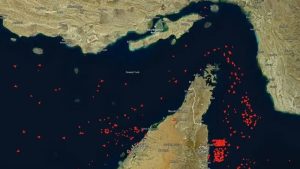
Consequently, any development in the Persian Gulf—regardless of whether it is military or political in nature—rapidly reverberates through the energy markets, economic policymaking, and strategic calculations of Asian nations; a reality demonstrating that the link between Asia’s economy and Persian Gulf energy security remains one of the world’s most critical geopolitical equations.
While Europe and the United States also suffer from instability in the Persian Gulf, the intensity and depth of this dependency are unique to Asia. A vast portion of the region’s vital energy supplies flows through a single chokepoint and finding an alternative in the short term is virtually impossible. Consequently, the security of the Strait of Hormuz is viewed not merely as a political or regional issue, but as a fundamental pillar of economic and national security for Asian nations; thus, any threat against Iran—a key player in this waterway—directly challenges that security.