

PNN – Ansarullah’s attack on a Saudi oil tanker in the Red Sea has further complicated the security of routes serving as alternatives to the Bab al-Mandab Strait.
According to the report of Pakistan News Network; Ansarullah’s missile strike on the Amzan—an oil tanker owned by the Saudi shipping company Bahri—in the northern Red Sea serves as more than just an operation against a single vessel; it sends a clear message regarding the fate of alternative Saudi oil export routes in the event of the Strait of Hormuz being closed.
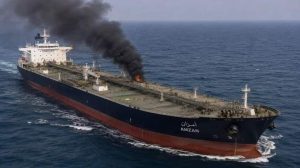
In this context, Yahya Saree, spokesman for the Yemeni Armed Forces, announced today that a Saudi-flagged oil tanker had been targeted; reports indicate that the vessel sustained damage. The significance of this operation lies in the fact that the tanker—Amzan—was struck while returning from Egypt’s Ain Sokhna port, a route upon which Saudi Arabia has become increasingly reliant to maintain its oil exports, particularly following intensified pressure on the southern Red Sea shipping lanes.

Saudi Arabia is facing a situation where its access to conventional energy export routes is severely constrained. Energy flows through the Strait of Hormuz are under pressure, and the unique conditions of this waterway have seriously disrupted Saudi oil exports via the Persian Gulf. Under these circumstances, westward routes have become increasingly critical for Riyadh; the more difficult it becomes to transport oil from the Persian Gulf, the greater the importance of the Red Sea, Saudi Arabia’s western ports, and transit routes through Egypt.
It is precisely here that Ansarullah’s actions take on strategic significance. In recent weeks, by announcing restrictions on the transit of Saudi oil shipments via the Bab al-Mandab Strait, Sana’a has intensified pressure on Saudi oil exports in the southern Red Sea. In response to this situation, Saudi Arabia has been compelled to divert a portion of its export capacity to alternative routes. Utilizing western ports and transporting oil via Ain Sokhna and the Sumed pipeline is one option that could reduce reliance on direct passage through the Bab al-Mandab Strait. Furthermore, the operational history of the Bahri Company indicates that the Ain Sokhna route and the Sumed pipeline have previously been utilized for transporting the company’s oil.
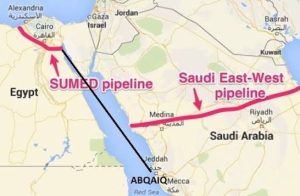
The Sumed pipeline originates at Ain Sokhna on the Red Sea coast and transports oil to the Sidi Kerir terminal on the Mediterranean coast. From there, shipments can be reloaded onto tankers for transport to foreign markets. Thus, for Saudi Arabia, this route is not merely an alternative transport option; it is part of Riyadh’s capacity to maintain oil exports when eastern and southern maritime routes face disruptions.
The targeting of a Saudi oil tanker on its return journey from Ain Sokhna specifically takes aim at this very capacity. With this move, Ansarullah has demonstrated that it does not view the pressure on Saudi oil exports as confined to a single geographic location. If Saudi oil bypasses the Bab al-Mandab Strait and is transported via the northern Red Sea route toward Egypt, that route, too, could fall within Sana’a’s military calculations. Thus, for Riyadh, altering the route does not necessarily mean escaping the pressure exerted by Ansarullah.
This point is also significant from an economic perspective. In such a scenario, the issue extends beyond damage to a single oil tanker; shipping companies, tanker owners, and insurers assess route security based on a range of risks. When a Saudi tanker is targeted on a route chosen to bypass the pressures associated with the Bab el-Mandeb Strait, the risk involved in transporting Saudi cargoes along that route rises. The consequences can include higher shipping and insurance costs, as well as greater reluctance among shipping companies to accept Saudi oil shipments.
This is the point where Ansarallah’s strength in the Red Sea shifts from a purely military capability to an instrument of economic leverage. Exerting effective pressure does not necessarily require a total halt to all shipping; it suffices to make the route for Saudi oil transport so costly—in terms of both security and economics—that companies operating in the sector are compelled to factor that risk into their decision-making. Under these circumstances, even an open route can no longer serve the same function it did prior to the emergence of the threat.
The significance of the recent attack becomes even more apparent when the Red Sea equation is viewed alongside the situation at the Strait of Hormuz. Recent reports indicate ongoing disruptions to maritime traffic and energy transport in the Strait of Hormuz. Under these circumstances, Saudi Arabia cannot rely on a single route to offset disruptions to its exports. While pressure at Hormuz enhances the value of westward routes for Riyadh, the pressure exerted by Ansarullah in the Red Sea subjects those very routes to increased costs and risks.
In fact, these two pressures have a complementary effect for Saudi Arabia. The more difficult it becomes to export Saudi oil via the Persian Gulf, the greater Riyadh’s reliance on the Red Sea grows; conversely, as Saudi Arabia’s dependence on western routes increases, so does Ansarullah’s capacity to influence Saudi oil calculations. For this reason, recent operations must be viewed within the framework of a broader equation—one in which the geography of Saudi oil exports has become a critical vulnerability for the Kingdom.
This situation also demonstrates that Ansar Allah follows a specific logic in selecting its targets. Targeting a Saudi oil tanker in the northern Red Sea—rather than attacking Egyptian facilities or vessels—maintains pressure on the primary party to the equation: Saudi Arabia. While Ain Sokhna and Egyptian infrastructure are relevant here as components of the oil transit route, the direct target of the operation is the Saudi tanker. This distinction allows Sana’a to intensify pressure on Saudi interests without unnecessarily expanding the scope of the action into a direct confrontation with Egypt.
On the other hand, the message behind this attack is not directed solely at Riyadh. Companies involved in transporting Saudi oil now face the reality that rerouting alone does not guarantee the security of their cargoes. Ansar Allah had previously targeted Saudi oil tankers in the Red Sea, declaring that it would continue its attacks in response to Saudi oil shipments and violations of maritime restrictions. International reports have also indicated that several Saudi oil tankers have been targeted and that some oil shipments have been rerouted toward the Suez Canal.
Therefore, the operation against Amzan must be analyzed within the context of this ongoing trend rather than as an isolated incident. The core challenge for Saudi Arabia is that its alternative options are incurring mounting costs one after another. The Bab al-Mandab route is under pressure from Ansar Allah, the northern Red Sea routes can no longer be utilized without significant security risks, and to the east, energy flows through the Strait of Hormuz face conditions that have seriously disrupted Saudi exports from the Persian Gulf.
In such a scenario, the true power of the Ansarallah equation lies not merely in targeting a few oil tankers, but in the ability to alter the cost-benefit calculus of transporting Saudi oil. If transporting an oil shipment along a specific route entails accepting heightened risks for the vessel, crew, insurer, and cargo owner, that route ceases to be a standard commercial option. This is the very pressure that can gradually shift from the maritime domain to the level of political decision-making.

For Saudi Arabia, the message of this operation is clear: the pressure on oil exports cannot be neutralized merely by altering shipping routes. If Riyadh seeks to circumvent the restrictions at the Bab al-Mandab Strait by rerouting shipments to the northern Red Sea, it must also accept the associated security costs. With the Persian Gulf route already under strain, such a scenario further limits Saudi Arabia’s options.
From this perspective, the attack on the Amzan oil tanker is a calculated move to bolster Ansarullah’s leverage against Saudi Arabia. Sana’a seeks to signal to Riyadh that the Kingdom’s oil exports are no longer insulated from the equations of war and political pressure. As Saudi Arabia becomes increasingly dependent on western routes to maintain its energy flow, the Red Sea gains greater significance in its security calculations—thereby enhancing Ansarullah’s capacity to influence this dynamic.