
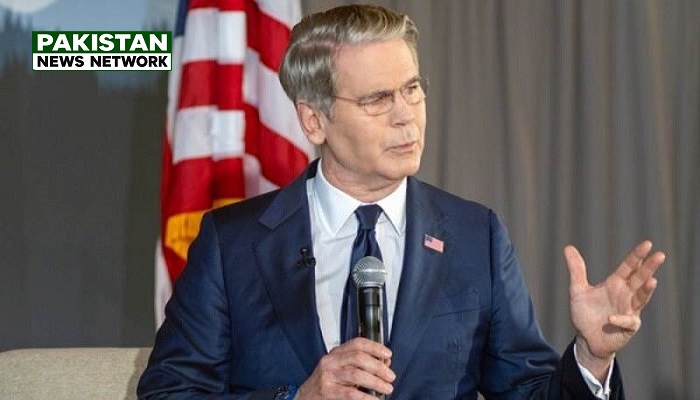
PNN – The U.S. Treasury Secretary stated: The publication of an image of my home enabled Iran to identify where I live.
According to the report of Pakistan News Network citing Fox News, U.S. Treasury Secretary Scott Bessent—whom some Republicans blame for the Trump administration’s defeat in the congressional midterm elections, citing his incompetence in managing the economy (evidenced by rising inflation and energy prices)—expressed his frustration today, Sunday, regarding Tehran’s increasing resilience, declaring: Between March 2026 and March 2027, the value of the rial will plummet by 25 percent over the course of a single year.
He then referred to his own escape—along with that of several other American officials—to a military base. In response to the question, has there ever been a direct attempt by Iran to assassinate you? He stated: We are not going to discuss that… However, Tucker [Carlson] confirmed in The Wall Street Journal that a photograph of our home—taken on the day of its purchase and containing geolocation data—had been published. Anyone can find our house in Washington, D.C., on the internet; this is the result of reckless and irresponsible journalism.
Regarding Nvidia and the allegations concerning Chinese espionage, Scott Bessent remarked: It makes no difference to me whether or not he is a spy. I want to return to the core issue: what was the prevailing culture at Nvidia? Did they insist on carrying out these seemingly illicit sales in order to artificially inflate their revenue and profits?
Recent developments surrounding Nvidia—including the potential departure of Jensen Huang, the company’s founder and long-standing CEO—carry implications that extend well beyond a mere management crisis within the chip industry. Over the past few years, Nvidia has evolved from a manufacturer of graphics processing units (GPUs) into a pivotal player in the development of artificial intelligence infrastructure, extending its influence into investment, financing, technology policy, and international relations. Consequently, the current crisis must be examined through the lens of its potential impact on the global competitive landscape of artificial intelligence. The significance of this issue lies in the fact that any weakening of Nvidia’s position could simultaneously strain the competitive capacity of the United States and create new opportunities for rival firms and other technological powers.