
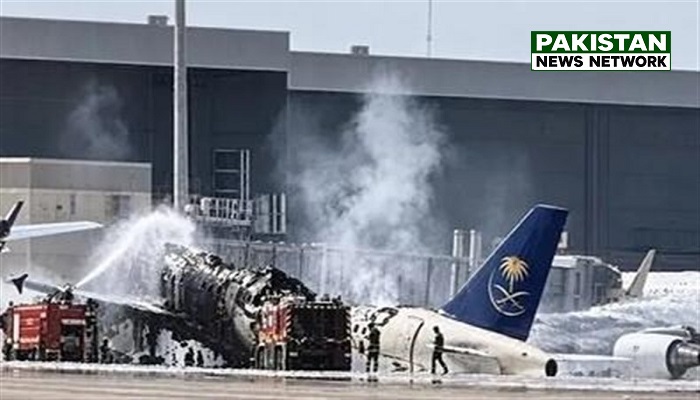
PNN – A war against Iran has transformed one of the most significant economic advantages of the Persian Gulf states into security vulnerability.
According to the report of Pakistan News Network; The Wall Street Journal reports that a war against Iran poses a serious challenge to the aviation industry and the economic model of the Persian Gulf states. Key points from this report are as follows:
- A Precarious Geography
By investing hundreds of billions of dollars, the Persian Gulf states have sought to leverage their geographical location to become major air transport hubs connecting Europe and Asia. The region lies within a four-hour flight radius of one-third of the world’s population; yet, this same location also places its airports within range of missiles and drones launched by Iran and its regional allies.
- A Blow to Security Credibility
The significance of attacks on airports extends beyond mere physical damage. Michael Ratney, the former U.S. Ambassador to Saudi Arabia, notes that while strikes on energy infrastructure can inflict severe economic losses, targeting airports carries a distinct psychological impact—as it disrupts a nation’s ability to connect with the outside world.
According to him, the credibility of airports and airlines in the region hinges on the perception that host nations are safe and desirable travel destinations. Persistent drone and missile attacks threaten to shatter this very image.
- Suspension of International Flights
Foreign airlines—particularly those from Europe and North America—have refrained from flying to airports in the Persian Gulf region throughout the war. Some have extended the suspension of direct flights into next year, thereby impacting the region’s lucrative winter tourism season.
- The Multi-Billion Dollar Evacuation of Aircraft
Attacks on Riyadh International Airport rank among the deadliest strikes against aviation infrastructure during the conflict. Following these assaults, a major effort was launched to evacuate aircraft stationed at the airport—a fleet with a combined value of approximately four billion dollars.
Even after the airport reopened, many passenger airlines refrained from using it. According to Andy Blackwell, an aviation security analyst and former head of security at Virgin Atlantic, the fact that an airport has been declared open does not necessarily mean it is safe to fly there.
- The Hidden Costs of Insecurity
The increased risk associated with flying to countries in the Persian Gulf has driven up insurance costs, necessitated changes to flight schedules, forced the adoption of longer routes, and led to the relocation of aircraft away from airports vulnerable to attack.
Some foreign executives and business professionals have opted for long overland journeys between regional capitals to mitigate the risks associated with air travel. Last month, a group of executives based in Riyadh chose to travel to Damascus by road—an 18-hour journey across the desert involving the crossing of two international borders—rather than flying.
- Stalling of Development Projects
The war has also cast uncertainty over the ambitious airport development plans of countries in the region. Dubai is continuing with its $35 billion expansion of Al Maktoum International Airport; the first phase is scheduled to open in 2032 and upon completion, the facility is set to become the world’s largest aviation hub, with an annual capacity exceeding 260 million passengers.
In contrast, the King Salman International Airport project in Riyadh has encountered difficulties. In 2022, Saudi Arabia announced the construction of this airport, with a projected capacity of 120 million passengers by 2030. However, according to informed sources, certain activities related to the project have been halted following recent attacks by Yemeni forces, and their resumption remains uncertain pending clarification of the security situation. Furthermore, parts of the existing King Khalid Airport have sustained such damage that repairs will require several months.
- Damage to the Persian Gulf’s Economic Model
Countries such as the UAE, Qatar, and Saudi Arabia have not relied solely on revenue generated from transporting passengers. Instead, they view aviation as a tool to transform themselves into global hubs for trade, tourism, entertainment, technology, and finance.
Andreas Krieg, a senior lecturer in security studies at King’s College London, notes that the governance and development model of these nations is built upon connecting global flows—including financial capital, goods, logistics, supply chains, and the movement of people—much of which transits via air transport. Consequently, insecurity at airports could undermine a fundamental pillar of these countries’ economic strategies.