
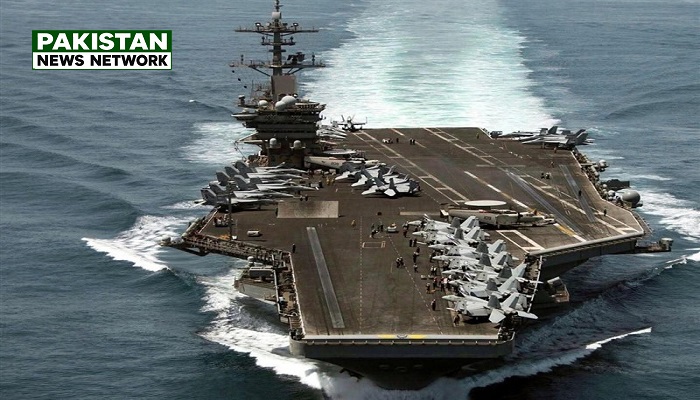
PNN – Families of service members aboard the USS George H.W. Bush raised concerns regarding a potential war with Iran during a meeting with U.S. Navy officials.
According to the report of Pakistan News Network; the news outlet “MSN” has obtained an exclusive audio recording of a meeting between U.S. Navy officials and the families of personnel serving with the USS George H.W. Bush carrier strike group. During the meeting, families were informed that the ship would not return home before the year-end holidays. Family members also voiced complaints regarding equipment malfunctions, dwindling supplies of fresh food, and a lack of mental health services for the crew.
During a tense meeting attended by approximately 500 family members of personnel from the USS George H.W. Bush carrier strike group, U.S. Navy officials stated that Iranian attacks continue to target American vessels deployed to enforce a naval blockade against Iran.
They also informed the families that the sailors would not return home before the year-end holidays. This information is based on an exclusive audio recording of the November 9 meeting at Naval Station Norfolk, which was provided to the news network “MSN” by an attendee and subsequently reviewed by the outlet.
This marked the second time since the start of the strike group’s mission that its deployment in the region had been extended. The strike group had departed Naval Station Norfolk, Virginia, on March 31, originally scheduled for a routine six-to-seven-month mission. However, Navy officials have now advised families to prepare for a worst-case scenario: a one-year deployment in the region.
One of the attendees described the war against Iran as an “unauthorized war.” Another individual, addressing the officials present, stated: Trust among military personnel and their families has been severely damaged—due to unprecedented, back-to-back deployments without rest, constant schedule changes, and the perception that official communications downplay the reality of conditions on the ground. Families are being worn down under the immense pressure of this situation.
At points during the meeting, family members raised their voices to protest against Navy officials, accusing them of failing to answer questions and repeatedly evading accountability. One attendee asked what steps the Navy is taking regarding Donald Trump to ensure that this conflict does not devolve into yet another endless, protracted war.
In April, approximately 7,000 military personnel attached to the USS George H.W. Bush carrier strike group deployed to the Middle East to replace the USS Gerald R. Ford—a vessel that had been stationed in the region since the commencement of joint U.S.-Israeli airstrikes against Iran on February 28.
Why are we even there?
During the meeting, Navy officials sought to explain to the families why the USS Bush must remain on its combat mission against Iran, and why it will not be returning home before the year-end holidays.
Addressing the families of the service members, Hung Cao said: I know you’re asking yourselves: Why are we there? Why are we doing this? The reason is that we have been at war with the Iranians for 47 years—we just didn’t know it.
Cao also claimed that the USS Bush has, to date, protected 3,000 vessels from attacks and bombardments.
Defending the U.S. President’s decision to continue the war, he stated: This is one of those difficult decisions a president must make. He is a businessman and knows that war is bad for business. But the point is, based on all the intelligence at our disposal, had we not stopped the Iranians right then, a year later they would have possessed so many cruise missiles and drones that we would never have been able to penetrate their defensive systems—and Iran would have become a nuclear-armed state.
Trump has repeatedly stated that his decision to launch an attack on Iran in February prevented the country from acquiring nuclear weapons.
In a letter sent to the United Nations in May, Iran’s ambassador to the organization stated that Iran has “consistently rejected the acquisition of nuclear weapons.” Abbas Araghchi, Iran’s Foreign Minister, also remarked in March that Iran’s stockpiles of enriched uranium were buried under rubble following the strikes—referred to as “Operation Midnight Hammer”—which Trump ordered in June 2025.
Defending Ships against Iranian Drones
Admiral Karl Thomas, commander of U.S. naval forces, who was present at the meeting, told the families of the USS Bush crew that the sailors deployed in the region face a difficult task and that their mission lacks a clear definition. He added that a naval blockade would require time to exert an impact on Iran.
Thomas said: The Iranians have a large number of one-way attack drones and unmanned systems. They have, to some extent, learned how to consistently target our ships. Defending against these attacks is difficult, yet this is exactly what our sailors are doing—it is what we have asked them to do.
He also stated that he does not know exactly what the next phase of the conflict will entail.
Ultimately, Navy officials told the families that the decision regarding when to bring the military personnel home rests with Pete Hegseth, the U.S. Secretary of Defense.