
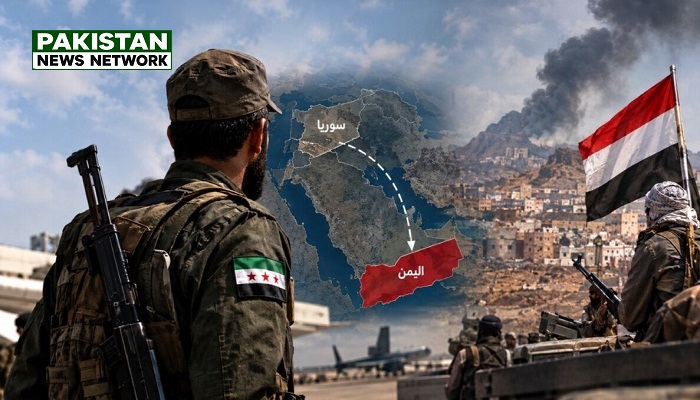
PNN – Mohammed bin Salman’s request to deploy Syrian forces to Saudi Arabia signals Riyadh’s scramble for an honorable exit from Yemen.
According to the report of Pakistan News Network; the more Saudi Arabia struggles, the deeper it sinks into the quagmire of the endless war in Yemen—a conflict that, in recent weeks, has been marked by unexpected advances by Ansarallah. Appeals for assistance from various European, American, and Asian nations, along with the formation of numerous pacts and coalitions, have failed to deliver a decisive victory for Riyadh.
Now, the situation has reached a point that, until recently, was almost unimaginable: Syria. This resort to a “last-ditch option” serves as the clearest evidence of the impasse in which Riyadh finds itself trapped.
It is only a slight exaggeration to say that there is hardly a government left in the world from which the Saudis have not sought assistance in their war against Ansarallah—ranging from the United States, the United Kingdom, Turkey, Pakistan, Egypt, and Israel, to various regional alliances that Riyadh itself helped establish. The Arab coalition was launched in 2015 with the participation of Saudi Arabia, the United Arab Emirates, and Qatar; however, its composition underwent fundamental changes over the years. Qatar withdrew from the coalition in 2017, and the UAE—following years of involvement—gradually pulled its forces out of Yemen. This withdrawal occurred as tensions escalated between Abu Dhabi and Riyadh, specifically regarding the advances of the Southern Transitional Council (STC) forces—a movement that seeks to accelerate the secession of southern Yemen, a goal opposed by Saudi Arabia.
The Associated Press reported earlier this week that the Damascus-based government is preparing to deploy approximately 600 Special Forces troops to Saudi Arabia, where they will be stationed along the border with Yemen. According to the report, Riyadh has stipulated that all these troops must hold exclusively Syrian citizenship, and that foreign forces currently present in Syria are not to participate in this mission. Furthermore, a Syrian military delegation—led by Khaled Khattab, commander of the 82nd Division—has completed a two-week visit to Saudi Arabia, during which they toured the joint Saudi-Yemeni operations center in Jeddah.
Reuters, citing two Syrian military sources and a senior U.S. official, reported that Syria is providing military advice and training to Saudi Arabia and has dispatched a limited number of its own military personnel to the country. Agence France-Presse (AFP), citing Yemeni military officials, has also claimed that Syria has begun deploying hundreds of soldiers along the Saudi-Yemeni border, with plans to send 3,000 troops in an initial phase, followed by another 10,000 in subsequent stages.
On the other hand, Syrian Foreign Minister Asaad al-Shaibani—speaking at a joint press conference in Damascus with his Jordanian counterpart, Ayman Safadi—categorically rejected these reports, stating: “No forces have been deployed to Yemen, nor are there any plans for such a deployment in the near future.” He emphasized that the military cooperation agreement with Saudi Arabia focuses on “rebuilding the Syrian army” and collaboration within the “defense industry,” and does not entail the deployment of troops. This discrepancy between reports from the field and official denials gives rise to a central question: Why has Riyadh reached a point where it must turn to Syria to compensate for its own setbacks?
The answer to this question can be seen in the developments unfolding on the battlefield. Despite multi-billion dollar purchases and access to Western weaponry, the Saudi military has thus far failed to prevail over Ansarallah; indeed, severe blows have even been dealt to Aramco’s oil facilities. Analysts emphasize that Riyadh’s primary problem is the lack of an effective ground force, rather than a shortage of equipment.
Instead of deploying its own ground forces to the conflict, the Saudi military has relied on foreign mercenaries—a fact some interpret as a sign of the army’s structural inability to conduct warfare. Furthermore, Saudi Arabia’s stockpiles of interceptor missiles have been severely depleted. Reports indicate that Riyadh has exhausted approximately 86 percent of its Patriot missiles; consequently, in September 2026, it requested air defense assistance from France, the United Kingdom, Pakistan, and Egypt. The United States—Riyadh’s primary arms supplier—is itself facing a shortage of interceptors following six months of war with Iran, leaving it with little capacity to provide significant aid. This situation has rendered Saudi Arabia’s high-value oil facilities increasingly vulnerable to missiles launched by Ansarullah.
Having failed to secure support from the United States, the United Kingdom, Pakistan, Turkey, Egypt, and Israel, Riyadh appears to have turned to Damascus—perhaps in an effort to mitigate the weight of its defeat and find a dignified exit strategy. Unlike its other allies, the current Syrian government is, in a sense, “indebted” to Saudi Arabia; throughout the years of conflict in Syria, Riyadh provided financial and political backing to the opposition against Bashar al-Assad, and it is now viewed as a significant potential contributor to Syria’s reconstruction. This very dependency has made Damascus an “accessible” option for Riyadh. Although the Syrian Foreign Minister has categorically ruled out the deployment of troops to Saudi Arabia, reports indicate that Syrian advisors have been sent to Riyadh—a move that allows Damascus to assist the Saudis while maintaining a public stance of non-interference in the war in Yemen.
Nevertheless, Syria is considered an “unreliable” option in this crisis. While Syrian fighters may possess combat experience, their political motivation and loyalty to Riyadh cannot be compared to those of the Yemeni forces defending their own homeland. Saudi Arabia itself does not fully trust these multinational Syrian forces; according to an Associated Press report, during negotiations with the Damascus government, the Saudis stipulated that any deployed troops must hold Syrian citizenship. Furthermore, Mohammed al-Bukhaiti of Ansarullah has emphasized that “the arrival of any forces from Syria—even Takfiri elements—will have no impact on the outcome of the battle,” noting that the Yemenis already have experience in confronting groups like ISIS and Al-Qaeda.