
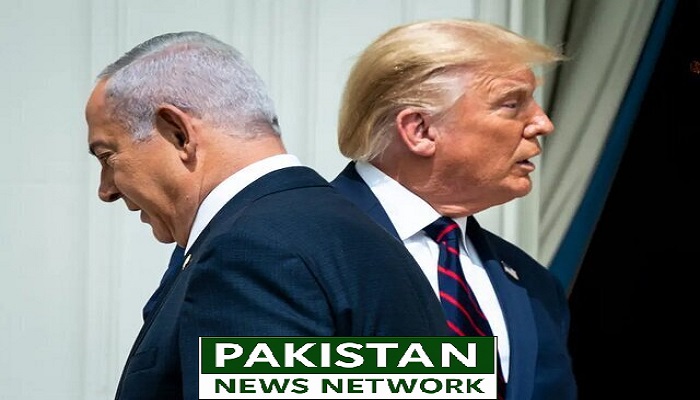
PNN – If Washington and Tehran reach an agreement to end the war, Benjamin Netanyahu will need Donald Trump’s support more than ever, because the possible outcome of the negotiations will not only fail to achieve many of the declared goals of the war, but could also weaken the Israeli Prime Minister’s political position on the eve of the elections.
According to the report of Pakistan News Network, the American magazine “Foreign Policy” wrote with this introduction: A possible agreement between the United States and Iran could become a serious challenge for Israeli Prime Minister Benjamin Netanyahu, because in the current situation, he needs the support of US President Donald Trump more than ever to maintain his political position.
Foreign Policy, referring to Trump’s influence over Netanyahu, noted that Trump recently said on the issue of Iran that Netanyahu “will do whatever I want.” However, according to the report, the real test of Trump’s influence will be when the US-Iranian talks approach the final stages of drafting a memorandum of understanding.
The note states that based on available information, a possible agreement would be a “lose-lose” situation from the perspective of Netanyahu and even his domestic opponents, because in such a scenario, the structure of Iranian rule would remain intact and there would be no basis for regime change.
Far from collapsing after the war, Iran has become more cohesive, Foreign Policy writes. Tehran retains the ability to close the Strait of Hormuz as a strategic lever of pressure, and there is no sign of serious restrictions on Iran’s nuclear infrastructure.
The note goes on to say that if the memorandum of understanding between Tehran and Washington is finalized, the cessation of hostilities will pave the way for further negotiations on other issues and reduce the likelihood of renewed joint US-Israeli attacks.
Foreign Policy writes that after the opening of the Strait of Hormuz and the end of the US naval blockade, the competition to blame the other party will begin. The American media writes that Trump will not allow Netanyahu to disrupt the agreement to end the war and may even, in order to avoid domestic criticism in the United States, accuse the Zionist regime of being partly responsible for the problems and the escalation of tensions.
The analysis also refers to developments in Lebanon and says that Hezbollah has not only not been disarmed, but is also recovering its strength faster than initially estimated. Meanwhile, Hezbollah’s critics are also reluctant to directly confront this resistance movement.
But now the situation is changing. According to the authors, Trump, in response to Iran’s decision to suspend negotiations until the Israeli regime accepts a ceasefire, called Netanyahu and asked him to stop the attacks in the Beirut area.
Another part of the note states that Trump has tried to link the agreement with Iran to the Gulf Arab countries joining the so-called “Abraham” agreements, but the authors assess this idea as lacking real support in the region.
According to the report, except for the United Arab Emirates, other Arab countries, especially Saudi Arabia, are not willing to expand public relations with the current Israeli government.
The note concludes by emphasizing that Trump has so far failed to reach a final agreement with Iran, has not offered a solution to the issue of Iran’s enriched uranium reserves, and at the same time is faced with the fact that Tehran still has the leverage to pressure the Strait of Hormuz.
According to Foreign Policy, if an agreement is reached with Iran and criticism of the outcome of the war increases, Trump may shift some of the responsibility for the failures to Netanyahu in order to ward off domestic political pressure; an issue that could further weakens the position of the Israeli Prime Minister.