
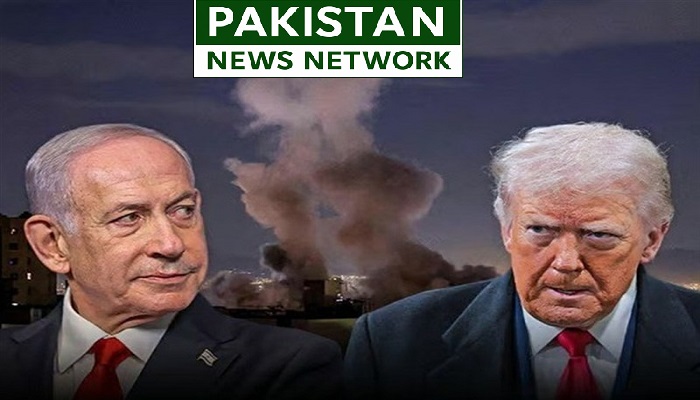
PNN – A Hebrew media outlet admitted that Trump ended the war with Iran, leaving Israel with unanswered questions.
According to the report of Pakistan News Network, the Yedioth Aharonot newspaper, in a note published by Colonel Eldad Shavit, a senior researcher at the Tel Aviv University Security Institute, admitted that despite trying to cover up Israel’s strategic failure in the war against Iran, Israel has emerged weaker than before, or at least with more limited capabilities than before the war began.
The memo states: The understandings reached between the United States and Iran, which are scheduled to be signed at a ceremony next Friday, are a historic agreement and certainly not a new nuclear deal.
According to the Hebrew media outlet, what we are witnessing is in fact an attempt by the United States to escape a war that Trump no longer wants to be in.
After months of escalating tensions, a sharp drop in energy prices, increasing domestic political pressure and fears of regional conflict, the US president was looking for a way out of this war, and he is now portraying it as a victory.
From Trump’s perspective, he now has a narrative to present to the American people, claiming that he used force, Iran was scared, the Strait of Hormuz will be reopened, Tehran has promised not to pursue nuclear weapons, and, most importantly, the war is over. But behind this grand declaration and show, lies a much more complex reality. Most of the thorny issues remain unresolved. The nuclear program has not been dismantled. The fate of enriched uranium remains in dispute. Monitoring is unclear. Sanctions and frozen assets are at the heart of the negotiations. And the issue of Iran’s (allied) forces, led by Hezbollah, is both ambiguous and dangerous.
According to Yedioth Aharonot, the 60-day window of negotiations that is now set to begin does not guarantee an agreement (desired by the US and Israel).
This is while Trump, who has already declared victory, will find it difficult to quickly return to a full-scale war that would jeopardize his desired political achievement.
In another part of the note, it is stated that despite the heavy joint attacks carried out by the US and Israel, the most important question is not just how to fight together, but how to end the operation together. And this is where the gap appeared.
According to the analyst, at the regional level, the countries of the region have also recognized the limits of American and Israeli power, Iran has been damaged, but not defeated. Its nuclear program has not been dismantled, the uranium issue has not been abandoned, and Tehran is expected to gain economic concessions. The Strait of Hormuz, which has been effective as a tool for exerting pressure on the global economy and Washington, will remain largely under its control. The regime has not fallen either. On the contrary, it has endured and its survival will serve as proof of its resistance to the United States and Israel.
According to the author, Israel’s main concern now is its freedom of action. This freedom is expected to be significantly restricted against Iran itself. Any Israeli action against Iranian facilities, senior officials, or strategic assets could be seen in Washington as an attempt to undermine the deal that Trump touts as a personal achievement. In Lebanon, Israel may still have greater operational freedom, but even there, any major attack on the southern outskirts of Beirut or against Hezbollah’s reconstruction plans would be subject to a fundamental question: Would such an attack jeopardize understandings with Iran?
The Zionist expert then tried not to portray Israel as a complete loser, claiming that what had failed Israel in this war was that it did not have the military capabilities to replace the strategy of ending the war or a long-term policy towards the United States.
At the same time, he also pointed to Israel’s wandering in the American political scene and emphasized: In recent years, Israel has given its entire center of gravity and credibility to Trump and the Republican camp, while its relations with the Democrats, the liberal camp and some segments of the Jewish community have deteriorated to the point of collapse.
Therefore, whenever a disagreement arises specifically with Trump, the extent of Tel Aviv’s reduced room for maneuver is also revealed in Washington.
He also acknowledged that the war brought Israel only a limited scope of activity, while he concluded that superior military power could not guarantee political success.