
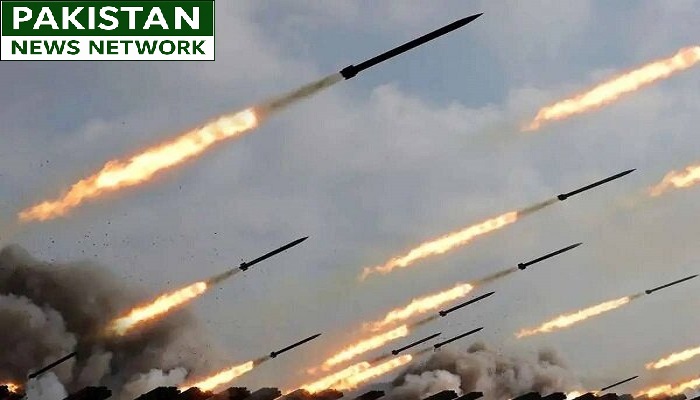
PNN – Iran’s missile response to the Zionist regime’s aggression against the southern suburbs of Beirut should be evaluated as more than a military operation.
According to the report of Pakistan News Network; Iran’s missile attacks on the occupied territories in response to the Zionist regime’s aggression against the southern suburbs of Beirut can be considered one of the most important strategic developments in recent years in West Asia. The importance of this operation is not limited to its military dimensions, but rather its main consequence lies in the consolidation and objectification of a concept that had been proposed by the resistance movement in recent years as “unity of fields”.
Unity of Fields; Reality on the Ground
Until now, unity of fields has been understood more as a political and theoretical strategy; a strategy according to which the various resistance fronts in Palestine, Lebanon, Yemen, Iraq and Iran are considered part of a single system and the security of each of these sides is linked to the security of the others. However, recent operations have shown that this concept is no longer just a political slogan or a theoretical framework, but has become an operational and deterrent reality.
The Israeli attack on the southern suburbs of Beirut was defined from Tel Aviv’s perspective within the framework of a procedure that the regime had implemented many times over the past years; namely, targeting resistance actors in different countries without facing a direct response from other members of the resistance axis. Israel thought that it could target Lebanon without paying a price beyond the Lebanese front. But Iran’s missile response completely changed this calculation.
For the first time, an attack on one of the main pillars of the resistance axis was met with a direct response from the most powerful side of this axis. This development in practice means that geographical boundaries have become less clear in the resistance deterrence equations and any attack on one member of the resistance axis can be accompanied by a response from other members.
A Clear Message to Tel Aviv
In fact, Iran sent a clear message to Tel Aviv with this action: Lebanon’s security is not separate from Iran’s security, and the attack on Beirut’s southern suburbs cannot be considered merely an internal Lebanese issue or a limited conflict between Israel and Hezbollah. This is the essence of the strategy of unity of fields; a strategy according to which the enemy cannot separate the resistance fronts from each other and pressure each front separately.
Along with Iran, Yemen’s response was also of particular importance. The announcement of restrictions on Israeli ship traffic in the Red Sea and the Bab al-Mandab Strait showed that the response to the Zionist regime’s aggression is not defined solely in the form of direct military operations. The axis of resistance has a variety of tools to apply pressure, and each side of this axis can enter the field according to its position and capacity.
The action of Yemen’s Ansarullah movement is important in that it shows that the unity of the fields is not only a political coordination, but also an operational division of labor. While Iran used its missile capacity, Yemen also took advantage of its special geopolitical position to put pressure on the Zionist regime. This indicates the increasing maturity of the resistance axis structure and the increasing level of coordination between its components.
Shared understanding of threats and interests among members of the resistance axis
On the other hand, the widespread response of Palestinian and Lebanese resistance groups to Iran’s operations also indicates the formation of a shared understanding of threats and interests among members of the resistance axis. The Palestinian groups’ welcome of Iran’s missile operations and their emphasis that this attack has established the “equation of unity of the fields” shows that this strategy has now moved from the level of discourse to the level of action.
One of the most important consequences of consolidating the unity of the fields is the increase in the strategic costs of the Zionist regime. In the past, Tel Aviv tried to manage the resistance fronts separately. The war in Gaza, attacks on Lebanon, pressure on Syria or the threat to Iran, each were examined as independent cases. But now the situation is changing. Iran’s response showed that action against one front can have consequences on other fronts.
This development means that Israel can no longer embark on military adventures with the certainty that the scope of the conflict will remain limited. Any military decision in Lebanon may have consequences in Iran, Yemen, Iraq or Palestine. This will significantly increase the computational and security costs for the leaders of the Zionist regime.
The political dimensions of this development are also very important. In recent months, the United States has tried to manage the regional crises separately through negotiations and diplomatic pressure. But the consolidation of the strategy of unity of fields could change these calculations as well. Now, the end of any regional crisis is more tied to other files than before.
For example, the recent move by Yemen’s Ansarullah movement has shown that the issue of lifting restrictions on the Red Sea is no longer just about Yemen, but has become linked to the situation of the entire axis of resistance. This could pose new complications for the process of negotiations and diplomatic efforts to end wars and crises in the region.
From a deterrence perspective, the recent operation is also a turning point. The most important feature of successful deterrence is convincing the enemy that the costs of an offensive action will outweigh its benefits. Iran’s missile response can be assessed precisely in this context. Tel Aviv is now faced with a new reality; a reality according to which an attack on any part of the axis of resistance may be accompanied by a direct or indirect response from other members of this axis.
That is why many analysts see the recent operation as the beginning of a new phase in the region’s security equations. A phase in which the concept of “costless aggression” has been challenged more than ever. What was proposed for years as a unity of fields has now been demonstrated in practice and has transformed from a political theory into an operational mechanism.
Conclusion
In summary, Iran’s missile response to the Zionist regime’s aggression against the southern suburbs of Beirut should be evaluated as more than a military operation. This operation showed that the axis of resistance has entered a new stage of coordination and synergy; a stage in which the security of the members of this axis is tied to each other and any aggression against one of them can lead to a collective reaction from the other sides. For this reason, perhaps the most important achievement of this operation is not the number of missiles fired, but rather the consolidation of an equation that for years was referred to as “unity of areas” and has now become an undeniable reality in the equations of the region.