
PNN – Yemeni sources, pointing to the scenario of closing the Bab al-Mandab Strait, warn that Saudi Arabia has no choice but to end the blockade.
According to the report of Pakistan News Network; following Saudi Arabia’s targeting of Sana’a Airport and the violation of Yemeni airspace—which was met with a reciprocal response from the country’s armed forces—attention has shifted to the possibility that Yemeni forces might move beyond a mere “eye-for-an-eye” approach toward a strategy of “retaliation” for eleven years of aggression and blockade, launching a comprehensive escalation across various fronts and axes in accordance with the plans for the “Promised Battle and Holy Jihad.”
Yemen’s Successful Experience in Targeting Saudi Energy Infrastructure
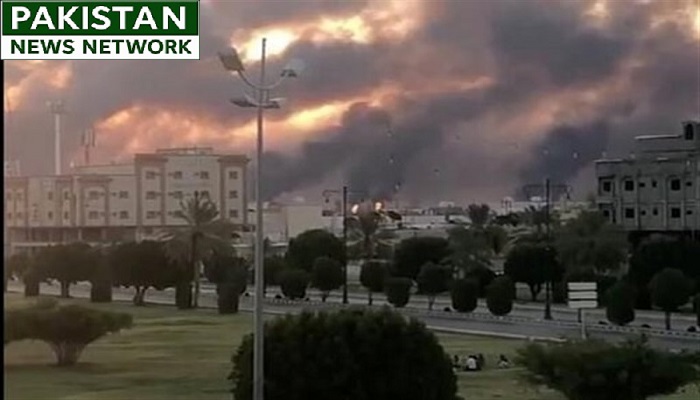
Prior to the 2022 ceasefire, Yemeni armed forces demonstrated their capability to strike Aramco facilities in Abqaiq and Yanbu, as well as power plants; these actions resulted in a reduction of Saudi oil production by 5 million barrels per day and facilitated the liberation of vast areas in Nihm, Al-Jawf, Al-Bayda, and Ma’rib.
Given the vital role that energy and infrastructure sectors play in financing wars, they serve as a primary target set within Yemen’s deterrence strategy, aimed at imposing an economic equation that compels the Saudi side to accede to Yemeni demands.
During the battle to support Gaza, Yemen demonstrated a diverse range of military capabilities—ranging from striking the heart of occupied Palestine and disrupting enemy navigation in the Red Sea to neutralizing international maritime coalitions and air defense systems.
According to analysts, this will lead to the inclusion of oil and power facilities—alongside airports—in a unified target package, compelling the Saudi side to withdraw from Yemen and lift the blockade according to a specific timeline.
Yemen’s Military and Technological Capabilities
Yemen’s current capabilities are anchored in ballistic, cruise, cluster, and hypersonic missiles, as well as drones, a ground force with combat experience accumulated since 2004, and a naval force. This naval force demonstrated its effectiveness during Operation Al-Aqsa Flood, forcing the world’s most powerful nations to withdraw their aircraft carriers and fleets—fearing they would be sunk in the Red and Arabian Seas—and effectively blocking Israeli maritime navigation through the Red Sea.
Saudi Arabia’s Strategic Blunder and Grim Scenarios for Oil Facilities
Brigadier General Mujib Shamsan, a Yemeni military and strategic expert, stated that future operations by Yemeni armed forces would involve combined attacks—specifically, drone strikes designed to confuse enemy radar systems, followed by waves of cruise and hypersonic missiles targeting enemy power plants, oil refineries, ports, airports, and command-and-control centers.
Meanwhile, Brigadier General Nidal Zahwi, Director of the Yemeni Center for Anthropological and Strategic Studies, stated that targeting Sana’a Airport was a strategic error committed by Saudi Arabia; Riyadh itself is aware that its oil facilities lack genuine protection against Yemeni attack tactics, and the Saudi air defense system has demonstrated its failure in this regard.
Yemeni sources emphasize that Yemen’s list of targets includes 13 Saudi airports—most notably King Khalid International Airport in Riyadh and King Abdulaziz International Airport in Jeddah—as well as dozens of oil facilities, petrochemical plants, and seven major ports.
Yemen’s decision to break the blockade is irreversible.
In this context, Ali al-Imad, a member of the Ansarullah political bureau, stated that the battle to break the blockade represents a national and moral responsibility toward millions of Yemenis, rather than merely a tactic of military pressure.
Al-Imad added that Yemen’s leadership has acted wisely over the past years, yet Riyadh’s arrogant mindset has hindered the establishment of peace. The people of Yemen are determined to reclaim their rights, and the continuation of the blockade will only strengthen their resolve to triumph in this battle.
Meanwhile, political writer and analyst Abdulrahman Al-Abed stated that the “de-escalation” phase was merely a stalling tactic employed by the Saudis, and its conclusion signals a fundamental shift. The Yemeni armed forces’ operation against Abha Airport in Saudi Arabia was a response to that country’s aggression against Sana’a Airport and the ongoing blockade of Yemen.
He emphasized that Yemen today possesses significant strengths and strategic plans, and is fully prepared to assert its sovereignty and put an end to its long-standing suffering. The enemy recognizes this reality and now fears the consequences of the situation—particularly Yemen’s potential leverage over the Bab al-Mandab Strait.
The success of this deterrence equation established by Yemen has left the Saudis facing a dilemma; continuing the blockade exposes Saudi infrastructure to costly attacks that could trigger the collapse of the kingdom’s economic stability, and the cost of maintaining the blockade has come to far exceed the cost of lifting it.
Saudi Energy Infrastructure: Targets for Yemen
Aramco and SABIC facilities—including major refineries in Abqaiq and Yanbu, as well as energy infrastructure such as power plants and petrochemical complexes—along with seven major Red Sea ports, are considered highly sensitive strategic targets.
Any disruption to these facilities threatens the global oil supply by 6 million barrels per day; consequently, any escalation of the conflict in Yemen places the international economy on high alert and exerts global pressure on Riyadh to end the war, lift the blockade and occupation, and prevent further escalation of hostilities in the Bab al-Mandab Strait.
The Scenario of a Simultaneous Closure of the Strait of Hormuz and the Bab al-Mandeb Strait: A Global Economic Catastrophe
Following the recent regional conflict, the energy supply equation currently faces two simultaneous risks affecting traffic along major maritime routes. The Strait of Hormuz is the world’s most critical chokepoint, with approximately 20.9 million barrels of oil and 11.4 billion cubic feet of natural gas passing through it daily.
Meanwhile, although the Bab el-Mandeb Strait is smaller in scale than the Strait of Hormuz, any disruption there would compound the global economic crisis due to its impact on international shipping routes. Consequently, a simultaneous closure or disruption of both the Strait of Hormuz and the Bab el-Mandeb Strait would trigger a massive catastrophe for global shipping and the world economy.
For his part, Yemeni economic expert Rashid al-Haddad stated that the greatest impact would likely be on other supply chains, as the closure of the Strait of Hormuz and the Bab al-Mandab Strait would extend the time required for goods to travel from Asia to Europe. This would increase pressure on European governments from their citizens, compelling them to urge Saudi Arabia to end tensions with Yemen.
This leads us to consider the anticipated operational scenarios, which include a scenario of gradual paralysis achieved by targeting Saudi airports; should Riyadh persist in maintaining the blockade against Yemen, Yemeni armed forces might move to target Saudi power plants and command-and-control centers.
Furthermore, there is a scenario involving economic strangulation centered on major oil refineries, which would lead to a temporary collapse of Saudi oil exports. This, in turn, would drive up maritime insurance premiums and global energy costs.
Another scenario involves the Yemenis simultaneously targeting Saudi ports while blockading the Bab al-Mandab Strait; this would escalate the conflict into an all-out confrontation and result in the complete closure of Saudi ports—much like the shutdown of the port of Eilat in occupied Palestine during the Yemeni naval blockade imposed against the Zionists in support of Gaza.