
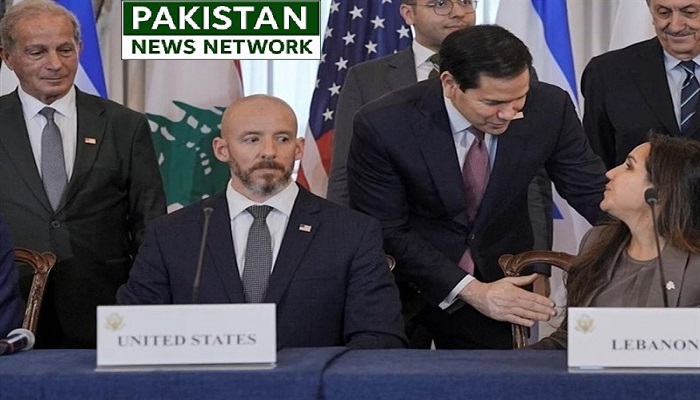
PNN – The recent agreement between the Lebanese government and the Zionist regime, brokered by Washington, confirms the continuation of Israel’s occupation of Lebanese territory.
According to the report of Pakistan News Network, forty-eight hours have passed since the signing of the security agreement between the Lebanese government and the Zionist regime—an agreement under which the Israeli army is to remain in the occupied territories of southern Lebanon until the “complete disarmament of Hezbollah” is guaranteed. Starting Thursday evening, a wave of protests erupted in the southern Dahiyeh, swept through Hamra Street, and by yesterday morning, reached the walls of the Grand Serail (the Prime Minister’s headquarters) in central Beirut. Protesters are repeatedly asking: How can a government incapable of defending its own territory entrust its security to the very force that still occupies its land?
The recent agreement, more than a diplomatic document, is a strategic mistake in Lebanon’s foreign policy. A government that has created numerous obstacles to Hezbollah’s resistance over the past 18 months, in line with Washington’s policies, has now officially tied national security to an enemy whose record of adhering to commitments is clear to all. The question is: on what basis was this trust built?
Lesson One: Syria of the Golani and the Israeli Occupation
It is enough to look at the developments in recent years on the eastern borders of this country. Ahmed al-Sharaa, the head of the interim government of Syria, who was known as Abu Muhammad al-Golani, the leader of Hayat Tahrir al-Sham, before coming to power, tried for months to gain the approval of the United States and Israel by presenting a so-called moderate and moderate image. What was the result? His pictures were installed on the streets of Tel Aviv alongside the Arab leaders present at the Abraham Accords, as “friends of Israel. But at the same time, Israeli warplanes bombed the presidential palace in Damascus. Israeli tanks entered the villages of southern Syria, arrested Syrian citizens and took them away.
Meanwhile, the new ruler of Damascus failed to even issue a strongly worded statement condemning the Zionist occupation and acts of abduction. He remained silent, hoping to preserve his self-conceived image as a “friend” of Israel. The result is that today, Israel advances at will—not only in the Golan but deep within Syrian territory—without facing any serious response from the Syrian army.
It appears that the current Lebanese government is repeating this exact pattern. It imagines that accepting a “security zone” and disarming the Resistance will serve as a trump card to win the trust of the West and Israel—oblivious to the fact that Israel has a single playbook for both “friend” and “foe”: disarming the former, occupying the latter, and humiliating both.
Lesson Two: 1982 and the Birth of Hezbollah
In September 1982, the Israeli army advanced into the heart of Beirut. The Sabra and Shatila massacre authorized by Israeli commanders and carried out by Phalange militias, killed more than 3,000 civilians, including Lebanese and Palestinian women and children.
This horrific massacre occurred before Hezbollah had officially declared its existence as an organization until February 1985. The initial cells of the Lebanese Islamic resistance were formed in response to the 1982 occupation, and the organization that is today considered the primary threat to the internal security of the Zionist regime is a direct result of the aggression that the Lebanese army simply watched as the country was occupied.
It’s a simple cause-and-effect relationship: the Zionist occupation created the resistance. But now the Lebanese government wants to remove the anti-occupation forces from the scene instead of the occupying regime, and the result of this equation is already predictable: a security vacuum, a vacuum that the Lebanese army will not be able to fill with the meager $30 million in American aid.
According to Lebanon’s 1955 Israeli Sanctions Law, any negotiation, interaction, or normalization of relations with the “Israeli enemy” is a crime. The recent agreement violates not only this law, but also the spirit of national sovereignty. But the irony is that the regime that the Lebanese government has trusted has violated this agreement thousands of times since the previous ceasefire agreement, bombing various areas of the country, advancing deep into Lebanese territory whenever it wants, and now this same covenant-breaking regime is the “guarantor” of Lebanon’s security.
In return for this favor of the Lebanese government to the Zionists, the United States has committed to providing $30 million in aid to the Lebanese army; a sum that is supposed to be the price and means of disarming the resistance that has defended Lebanese soil alone for decades. The army, which in these years has retreated whenever Israel has advanced deep into the country’s territory, and has remained silent whenever its forces have been targeted, now wants to provide “security” against the Israeli army’s war machine with $30 million by relying on advancing the policy of disarming Hezbollah.
In summary, what has happened in the streets of Beirut in the past 48 hours is not simply a political protest; it is rather a cry of historical memory, a memory that remembers the 1982 occupation, has not forgotten the bloodshed of Sabra and Shatila, and has seen the fate of Al-Jolani in Syria with open eyes. This memory knows that the Zionist regime does not adhere to any commitments, that there is no difference between “friend” and “enemy”, and that its only logic is to advance in the vacuum of power and resistance.
In such circumstances, Hezbollah is considered, from every perspective, a part of the political and social fabric of Lebanon, and as long as the occupation and threat exist, weapons will remain in the hands of the resistance. As a result, it is expected that the Lebanese government, instead of confronting this reality, while reforming its policies of recent years towards the resistance, will take the path of cooperation with Hezbollah with the aim of reviving the triangle of the government, the army and the resistance. Then, perhaps, it will be able to end the occupation of the land and return the prisoners to their homeland, not by relying on promises and promises and American dollars and the Zionist buffer zone, but by relying on the will of a nation.