
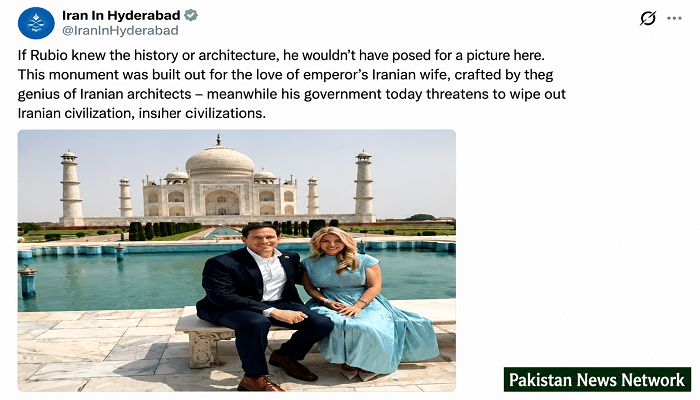
PNN – The Consulate of the Islamic Republic of Iran in Hyderabad, India, in response to the US Secretary of State’s visit to the historic Taj Mahal, announced that if he had known history, he would never have taken a photo at the Taj Mahal.
According to the report of Pakistan News Network, US Secretary of State Marco Rubio visited the Taj Mahal on Monday and took a photo with his wife, Janet Rubio, in front of the monument.
The visit prompted a reaction from the Iranian consulate in Hyderabad, which criticized Washington’s stance towards Tehran, citing the monument’s connection to Iran.
The Iranian consulate shared a photo of Rubio and his wife on social media, writing: If Rubio knew history or architecture; he wouldn’t be taking a photo here.
The consulate further emphasized the Iranian links to the Taj Mahal, stating that the monument symbolizes the role and art of Iranian architects.
The consulate’s message reads: This monument was built with the love of the king’s Iranian wife and with the genius of Iranian architects, while his government (Rubio – the US government) now threatens to destroy Iranian civilization and insults other civilizations.
Rubio, who is on an official visit to India, visited the Taj Mahal in Agra and then the Amber Fort as part of a packed diplomatic itinerary. During the visit, he described the Taj Mahal as “one of the world’s treasures of love.”
The message from the Iranian consulate was intended to highlight Iran’s influence on the history and architecture of the Taj Mahal, which was built by Shah Jahan in memory of his wife Mumtaz Mahal.
According to historical records, Mumtaz Mahal, who was born in Agra in 1593 as Arjumand Banu Begum, belonged to an aristocratic Persian family. Her father, Abdul Hasan Asif Khan, was a Persian nobleman and brother of the Mughal Empress Nur Jahan.
Construction of the Taj Mahal began around 1632 and took more than two decades to complete. Historians note that thousands of artisans and workers from India, Iran, and Central Asia contributed to the construction, decoration, and calligraphy of the mausoleum.
Iranian artistic traditions during this period greatly influenced Mughal architecture, language, and aesthetics. The Taj Mahal complex also features Quranic inscriptions in Arabic and intricate marble carvings associated with Iranian craftsmanship.
Beyond Mumtaz Mahal’s Persian ancestry, the Mughal court also had strong ties to Iran through figures such as Queen Nur Jahan and Emperor Jahangir. Nur Jahan was born into an Iranian family that had migrated to India during the Safavid era, while her father, Mirza Ghiyas Beg, became one of the most influential nobles in Jahangir’s court.
Persian art, language, architecture, and aesthetics flourished during Jahangir’s reign, leaving a lasting impact on culture and monuments, including the Taj Mahal.