
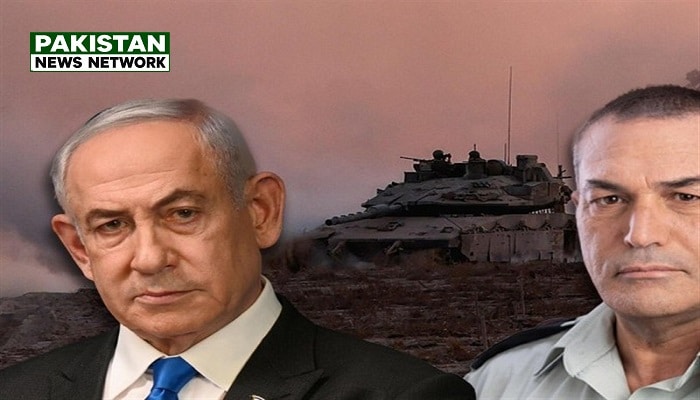
PNN – According to an Israeli analyst, the conflict between Zamir and Netanyahu that occurred prior to the elections revealed the scope of Netanyahu’s agenda.
According to the report of Pakistan News Network; Yoav Limor—an analyst for the newspaper Israel Hayom—stated in an analysis published today, Saturday, that when Eyal Zamir (a senior IDF official) stood up to Netanyahu before the elections—preventing the war from being exploited as a political tool—he partially restored his own standing; at the same time, however, this incident illustrated why Israel remains unable to regain its natural unity.
In parts of this lengthy article concerning the conflict between Zamir and Netanyahu, it is noted: There is no precedent in Israel’s history for a government—in the period following an election but prior to the formation of a new administration that has secured a vote of confidence from the Knesset—to unilaterally initiate a large-scale war.
At the very least, such a move would require a broad consensus among major political factions to ensure that the war is truly a vital necessity and is not being exploited for political ends.
Such agreements could also serve as a foundation for—or even the starting point of—the formation of a future coalition government; for in wartime, it is possible to reach an agreement quickly, secure the consent of the various parties, and move forward.
However, the likelihood of such a scenario coming to pass is slim. As previously mentioned, all indications suggest that war could resume either before coalition negotiations begin or during their very early stages. In that event, a state of emergency would prevail in Israel, and some would likely call for the postponement of the swearing-in of the new Knesset members, as well as the suspension of talks to form a new government. Beyond that, who knows what might unfold: How long would the war last? (The Americans speak of a swift and effective strike—yet they were saying the same thing at the end of February, and the war then dragged on for a month and a half.) What would the costs be (for Israel), and how would it all end?
This situation once again places the responsibility on the shoulders of Eyal Zamir, the Chief of the General Staff of the Israeli military. The public will ask him whether this is a war of choice or a war forced upon them; whether it is a conflict that must commence immediately under the current circumstances, or if it could be postponed until the political situation in Israel stabilizes and a new government—one that reflects the will of the voters—is formed.
According to this Zionist media outlet, Iran has emerged significantly more dangerous and powerful following the conclusion of the operation that ended in mid-April—a development particularly evident in the production of missiles and drones. The Israeli military also sought to inflict severe damage on Iran’s infrastructure, aiming to increase pressure on the Iranian people—and, by extension, the government—in the hope that the regime would either collapse or agree to major concessions, especially regarding its nuclear program; however, this endeavor also ended in failure.
Elsewhere in the article, it is emphasized that—contrary to the views of Netanyahu and the Mossad—the Israeli military is convinced that regime change in Iran is not feasible. Such an objective cannot be achieved, at least not through the plans proposed by Netanyahu; realizing it would necessitate a protracted war, which would ultimately prove detrimental to Israel.
Washington, too, has no desire to become embroiled in another long-drawn-out war. American counterparts note that the U.S. administration is concerned about the potential damage Iran could inflict upon its neighbors in the Persian Gulf—as well as the global oil market—particularly with the approach of winter.
Israel is paying less attention to this issue, as fuel prices—which had been kept stable in the lead-up to the elections—are expected to reach an unprecedented high next week, exceeding 9 shekels per liter.