
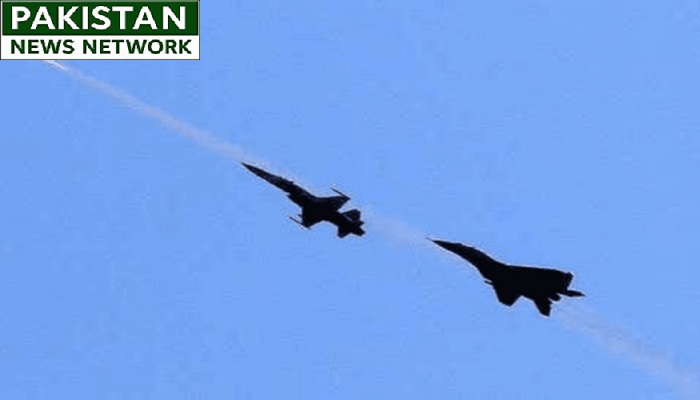
PNN – “Military Watch Magazine” stated that the presence and flight of MiG-29 fighter jets during the funeral ceremony of the martyred leader of the Islamic Revolution demonstrate the operational readiness of these aircraft and contradict Trump’s recent claims.
According to the report of Pakistan News Network; In a report analyzing images from the funeral procession of the martyred leader of the Islamic Revolution, the specialized outlet Military Watch Magazine noted that the presence of Iranian Air Force MiG-29 fighter jets escorting the aircraft carrying the body of the martyred Imam serves as one of the clearest public indications that these jets remain operationally ready—despite months of U.S. attacks on Iranian airbases. According to the outlet, this fact poses a serious challenge to Donald Trump’s claim that the Iranian Air Force had been destroyed.
According to Military Watch Magazine, images released from the final stages of the funeral procession show MiG-29 fighter jets escorting the aircraft carrying the body of the martyred leader of the Islamic Revolution to Mashhad at close range. These fighters were equipped with R-73 infrared-guided air-to-air missiles—a detail the author considers particularly significant, given the months of speculation regarding the state of Iran’s air fleet and widespread claims by Western media and officials that the Iranian Air Force had become virtually inoperable.
The report adds that by conducting this aerial escort over Mashhad, Iran’s Ministry of Defense sought to demonstrate that the country’s most capable fighter units remain fully operationally ready. According to the outlet, this show of force followed instances where older F-4 and F-5 fighter jets performed beyond expectations during high-risk penetration missions against targets deep within the territory of US-allied Arab nations—performances that prompted a reassessment of the Iranian Air Force’s true capabilities.
Military Watch Magazine considers Iran’s ability to maintain the operational readiness of its fighter jets—even amidst constant attacks—to be significant, particularly given that Tehran has confirmed the purchase of 60 Russian Sukhoi Su-30SM2 and Su-35 fighters, alongside reports of a request to acquire the stealthy Sukhoi Su-57.
The author suggests that Iran’s success in maintaining its current fleet could indicate a similar capacity to sustain the operational readiness of next-generation fighters. Reviewing the history of the MiG-29’s arrival in Iran, the report notes that Tehran acquired these aircraft between 1989 and 1991—a brief period of close defense ties with the Soviet Union that began following the passing of Imam Khomeini and lasted until the Soviet collapse.
During that same period, other significant agreements were concluded between the two nations, and the MiG-31 interceptor was even deployed to Iran to demonstrate its capabilities; however, following the collapse of the Soviet Union and Russia’s alignment with the West, the process of expanding military cooperation between the two countries stalled for years. According to Military Watch Magazine, the MiG-29—which entered service with the Soviet Air Force in 1982—was considered one of the most successful fighter jets of its generation.
In addition to Warsaw Pact nations, the aircraft was exported to Yugoslavia, India, North Korea, Cuba, Iraq, and Syria; with an annual production rate exceeding 100 units, it became the backbone of the Soviet Air Force.
The site adds that, in terms of dimensions, the MiG-29 falls between the F-16 and the F-15 and is considered comparable to the American F/A-18 Hornet. According to the author, upon entering service, the fighter outperformed all Western rivals in terms of flight performance; furthermore, its ability to operate from makeshift runways and austere airfields made it a suitable choice for dispersed air operations.
The report further notes that although Iran—unlike India—has not upgraded its MiG-29s to the advanced MiG-29UPG standard, and the aircraft continue to rely on outdated sensors, data-link systems, and weaponry, they still possess significant capability in countering drones and older fighter jets, including Israel’s F-15 C/D models.
However, the author emphasizes that the capabilities of these fighters in engagements against new-generation aircraft are limited. Military Watch Magazine concluded that the introduction of modern fighters—specifically the Su-35—could significantly alter the balance of air power in the region; furthermore, the continued operational status of Iran’s MiG-29s, despite months of heavy U.S. strikes, suggests that Tehran will likely be able to maintain and operate its future, more advanced fighters under similar conditions.