
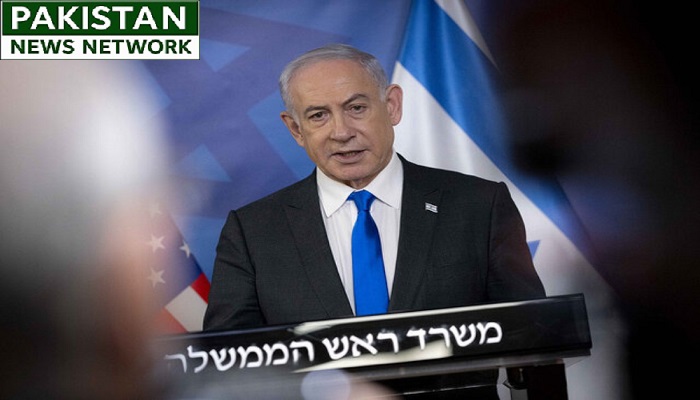
PNN – With less than four months remaining until the Knesset elections, Israeli polls indicate that Benjamin Netanyahu’s coalition is trailing in the bid to secure a majority. This situation has fueled speculation that he might exploit escalating regional tensions to shift the political landscape; however, domestic, regional, and U.S. obstacles render such a course of action costly.
According to the report of Pakistan News Network; Israel’s upcoming election may well be considered Benjamin Netanyahu’s most critical political test since the October 7 operation. Unlike in the past, when he consistently weathered crises by relying on his image as Israel’s “security leader,” that very security record has now become his greatest political liability.
Polls published in recent weeks by the Maariv newspaper and the Lazar Institute indicate that the ruling coalition remains far from securing the 61-seat threshold. In most of these surveys, Netanyahu’s coalition is projected to win between 48 and 51 seats, whereas the opposition—provided it maintains its cohesion—stands a better chance of forming a government.
These figures signal more than just a potential electoral defeat; they reflect the erosion of Netanyahu’s own political capital. In one Maariv poll, for instance, 55 percent of respondents favored his stepping down from the leadership of Likud. Such a figure is striking for a politician who has dominated the Israeli political landscape for over two decades.
But could this situation drive Netanyahu to escalate regional crises?
From a historical perspective, the answer cannot be given with a simple “yes” or “no.” Netanyahu has repeatedly demonstrated that he views security as his most important electoral asset. Whenever the political climate has turned against him, he has sought to shift the public agenda from domestic issues to external threats. This pattern has been observed time and again in his dealings with Gaza, Lebanon, and even the Iranian nuclear dossier.
However, the situation today differs from the past. First, Israeli public opinion has not yet forgotten the intelligence and security failure of October 7. Second, after months of war, Israeli society is more concerned than ever about the economic and human costs of new conflicts. Therefore, unlike in the past, there is no guarantee that a new security crisis would necessarily lead to a rise in Netanyahu’s popularity.
Amidst this, Iran remains one of the equation’s most critical variables. Any new confrontation with Tehran could offer Netanyahu an opportunity to once again cast himself as a wartime leader. However, such a scenario faces significant constraints. Iran’s response, the economic costs of war, U.S. pressure to prevent the conflict from widening, and opposition from within parts of Israel’s security establishment are all factors that complicate the decision-making process.
Alongside the Iran dossier, rivalry with Turkey has also gradually emerged as a central pillar of Israel’s regional policy. Following regional developments over the past year, competition between Ankara and Tel Aviv has intensified regarding the future of Syria, the Eastern Mediterranean, and the regional balance of power. Nevertheless, this rivalry is likely to play out primarily through information warfare, diplomatic pressure, and proxy confrontations; the likelihood of it escalating into direct conflict—at least in the short term—is considered low.
Another important point is the position of the United States. Contrary to popular belief, Washington is less concerned with the personal victory or defeat of Netanyahu than with maintaining regional stability and preventing a war that could inadvertently drag the U.S. into a new crisis. From this perspective, while the U.S. supports Israel’s security, it would not necessarily welcome any military action driven solely by domestic political objectives.
The October election is not merely a contest between Israeli parties; it also serves as a referendum on Netanyahu’s security record. Unless polling trends shift, he will be compelled to find a way in the coming months to alter the psychological climate within Israeli society. It remains unclear whether this shift will be pursued through diplomatic achievements, limited military operations, or an escalation of regional tensions.
It is now evident that, leading up to the election in the occupied territories, any security development in the region must be analyzed not only in terms of its military dimensions but also within the framework of Netanyahu’s electoral calculations.