
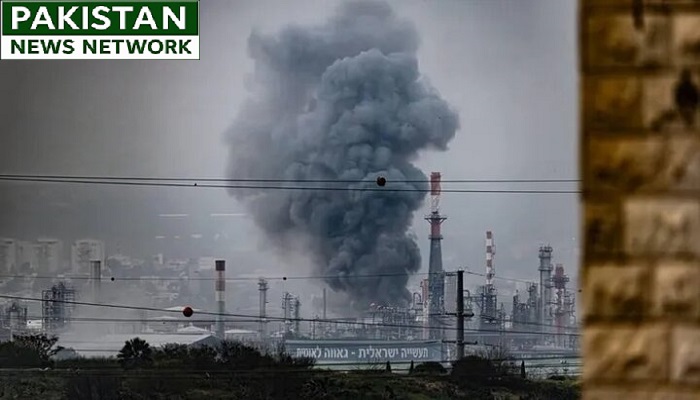
PNN – An Israeli television network has released new official documents revealing the massive scale of the disaster that struck Israel’s largest oil refinery complex in Haifa as a result of Iranian attacks.
According to the report of Pakistan News Network; a document from the Zionist regime’s cabinet—obtained by the regime’s Channel 12—contains the first official admission regarding the massive scale of the industrial disaster that befell the largest oil refining complex in the occupied territories following Iranian missile attacks during the recent war; the document reveals that the damage inflicted on the Bazan petrochemical complex in Haifa Bay far exceeds what was officially announced and that its full reconstruction will not be completed before 2028.
The Bazan Complex is considered one of the most critical components of the Zionist regime’s energy system, as it houses the largest industrial facilities specializing in crude oil refining and its conversion into various fuels and derivatives—including gasoline, diesel, kerosene, cooking gas, and asphalt—alongside industrial chemical products.
This complex was subjected to two Iranian missile attacks: the first during the June 2025 war and the second last February. Newly disclosed cabinet documents—which revealed the true extent of the damage from these attacks for the first time—indicate that the June 2025 strike was more devastating; it resulted in the deaths of three staff members and struck the complex’s main power station, causing a complete shutdown of all refining operations.
The company estimated the damage resulting from that attack at between $150 million and $200 million—a figure that reflects the extent of reliance on this facility within the local energy market.
The second attack unfolded in two stages: the first involved shrapnel from an interceptor missile, while the second consisted of a direct hit targeting the roof of a petroleum derivatives storage tank. Following the attack, the Bazan Company claimed that the damage was minimal and that production was continuing. Israeli Energy Minister Eli Cohen similarly asserted that the strike had not significantly damaged production facilities and would not affect fuel supplies; however, a new document released by the Israeli Ministry of Interior—as part of a draft planning and reconstruction order—paints a starkly different picture.
According to this document, the damage was not limited to the gas turbines but also extended to boilers, electrical rooms, and a number of backup operational systems. It was also reported that the storage tank that was struck—which had a capacity of 12,700 cubic meters—was completely destroyed and rendered irreparable, necessitating the construction of a replacement tank from scratch.
The document also confirmed that the scope of reconstruction work required has nearly doubled compared to what was approved following the initial attack, indicating the extent of the actual destruction.
According to this official report, damage to the oil reservoir directly impacts the ability to produce gasoline that meets market standards and affects its supply to consumers. The contents of this document stand in stark contradiction to the official position of the Zionist regime.
The document revealed that the complete renovation of the complex would not be finished before 2028—that is, in about three years.
This revelation sparked a wave of criticism within Zionist circles—particularly among local officials and environmental groups—who argued that making massive investments in a facility slated for eventual decommissioning made no sense.
In this regard, Haifa Mayor Yona Yahav stated that the scale of destruction caused by Iranian missiles should serve as a wake-up call for all stakeholders. He emphasized that this complex poses a strategic danger to hundreds of thousands of residents in Haifa and the surrounding areas.
He added that recent conflicts have demonstrated that concentrating petrochemical industries within residential areas turns them into prime targets in any military confrontation.