
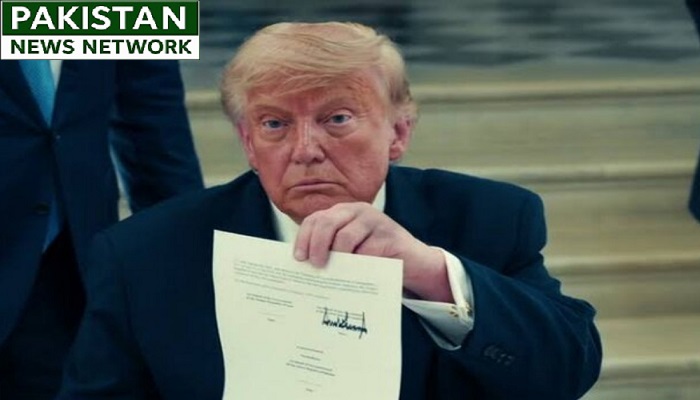
PNN – The American media emphasized that although the US President had previously claimed that the imposed war against Iran would end with “unconditional surrender,” the current memorandum of understanding he signed with the Iranian government does not indicate Iran’s surrender, but rather America’s own surrender.
According to the report of Pakistan News Network; the American newspaper The New York Times, in an analytical article, acknowledges Washington’s defeat in the war against Iran, emphasizing that it was in March that Donald Trump announced that an agreement to end the war with Iran would require “unconditional surrender,” while now we see that he was partly right and that the war ended with surrender, but with the difference that this surrender was from the United States, not Iran.
In this analytical article by columnist Nicholas Kristof, the New York Times emphasizes that the US President’s initial agreement with Iran is more of a conditional surrender on the part of the United States than a victory, and that Trump’s main mistake was not ending the war, but starting it.
The analysis states: US President Donald Trump announced in March that a deal to end his war with Iran would require unconditional surrender, but that was not very precise. The preliminary agreement he recently reached with the Iranian regime looks more like a conditional surrender – surrender by the United States.
In recent days, various Republicans and hawkish politicians, seemingly bewildered by the Trump administration’s Iran deal, have stepped forward to criticize the deal. “Trump has surrendered to Iran,” wrote conservative commentator Eric Erickson. Texas Senator Ted Cruz has also claimed that giving billions of dollars to the Iranians is not a good idea.
Christophe continued: The Iran deal is a major setback. It provides Iran with immediate aid, including the rapid release of billions of dollars in frozen Iranian assets and later a $300 billion fund to help Iran rebuild. And it appears to pave the way for Iran to gain at least some control over the Strait of Hormuz, with the ability to collect tolls from ships passing through the strait 60 days later.
Louisiana Senator Bill Cassidy also lamented the agreement, saying: This is the worst foreign policy mistake in decades.
According to the New York Times analyst, these figures condemning the US government’s deal with Iran ignore the most important point. That Trump’s fundamental mistake was not ending the war, but starting it in the first place.
Kristof argues that Trump did the right thing by backing out of the war, because he had no good options and continuing the war would have cost more lives. It would have destroyed the global economy and Republicans’ chances in the midterm elections.
Trump recently admitted that if the deal with Iran had not been reached, you would never have opened the Strait of Hormuz. I didn’t want to see an economic disaster.
The New York Times analyst acknowledges the inconvenient truth that Iran won the war, and that’s why it won the negotiations. Trump bided his time as long as he could, knowing that any deal he could hope for would be a humiliation—but losing the war left him with no viable exit.
Highlighting America’s disgraceful failure in its war-mongering against Iran, the American media states: The lesson to be learned from this disgraceful failure is to avoid starting unnecessary wars, to moderate our arrogance that everything will go perfectly, and to rely much more on diplomacy to solve global problems. In this case, the warmongers who were most determined to destroy Iran have done the most to strengthen it, and this should be a cautionary tale.
The New York Times notes that the cost of this war on Iran is “a weakened America plus a multitude of lives lost,” and Linda Bilmes, an expert on war finance at Harvard, says she believes the total final bill for the war—including base repairs, replacement ammunition, and years of benefits for wounded veterans—will likely be $1 trillion, leaving vast sums of American money that could have been spent on health insurance, college, child care, or humanitarian aid wasted in the Persian Gulf.
At the end of this article, the author acknowledges that the ones we have betrayed the most are the ordinary people of Iran, and emphasizes: But the disaster here is not Trump’s withdrawal from the war, but the war itself, and the lesson of history is that when you see a group of overconfident warmongers promising an easy victory, beware of them.