
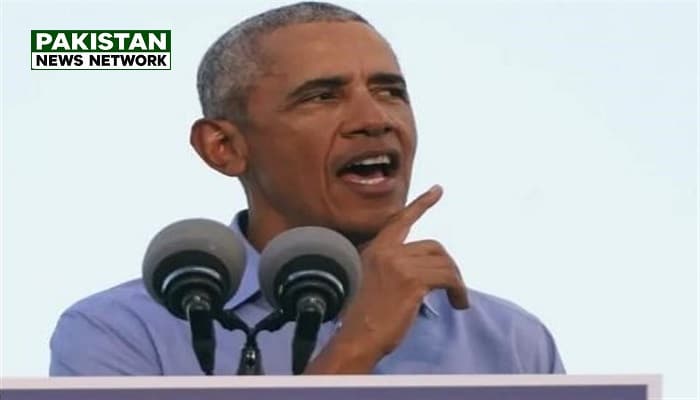
PNN – The former U.S. President has acknowledged Iran’s power in the Strait of Hormuz, stating that the conflict has left the United States more vulnerable.
According to the report of Pakistan News Network; former U.S. President Barack Obama, in a recent speech, criticized the Donald Trump administration’s campaign against Iran. He described the conflict as an unnecessary endeavor that not only failed to achieve Washington’s stated objectives but also imposed heavy military and economic costs on the United States.
Pointing to attacks on U.S. bases and personnel, the depletion of missile stockpiles, and Iran’s growing capacity to influence maritime traffic in the Strait of Hormuz, Obama emphasized that the continuation of this conflict would mean sustained pressure on energy prices and the cost of living for the American people.
Some of the key points from Obama’s remarks are as follows:
- A war that has left the U.S. more vulnerable
Obama stated that during the course of the war, U.S. bases and allies have come under attack, a number of American service members have been killed, and hundreds have been wounded. He also warned that U.S. missile stockpiles have dwindled, a development that has weakened the nation’s military capabilities and defensive readiness. According to him, these events have unfolded even as the war continues—contrary to the promises made and the repeated declarations of victory by the Trump administration.
- The Strait of Hormuz: Iran’s Leverage over the Global Economy
A former U.S. President stated that Iran currently possesses the power within the Strait of Hormuz to influence the flow of traffic through this strategic waterway. A significant portion of the world’s oil passes through the Strait of Hormuz, and any disruption along this route could place the energy market under strain. He identified rising oil and diesel prices, as well as the increasing cost of goods and services, as consequences of the conflict, emphasizing that as long as the hostilities persist, American consumers should not expect a swift easing of these pressures.
- Defending the JCPOA
Questioning the initial justification for war, Obama stated that the Trump administration claimed it had gone to war to compel Iran to abandon its weapons and nuclear program; yet, Iran possessed no nuclear weapons at the time, and the nuclear agreement signed during his own administration had, in his words, effectively contained Iran’s nuclear program. He emphasized that his administration achieved this agreement through diplomacy, without the need to fire a single missile.
- The Promise of an End to the War Is at Odds with the Reality of Ongoing Conflict
Pointing out that about seven months have passed since the U.S. administration declared repeated victories; Obama noted that the war has not yet ended. In his view, the persistence of the conflict indicates that the Trump administration’s initial promises regarding the outcome of the war diverge from the reality on the ground, and that the associated costs continue to weigh on the United States and its citizens.
Conclusion
The core of Obama’s criticism is that a war against Iran would not only fail to achieve the U.S. administration’s stated objectives regarding Iran’s nuclear program, but would also lead to a depletion of U.S. missile stockpiles, casualties among American military personnel, and increased pressure on the energy market. Contrasting this scenario with the nuclear agreement reached during his own presidency, he presented diplomacy as a path that—in his view—had successfully contained Iran’s nuclear program without resorting to a military strike.