
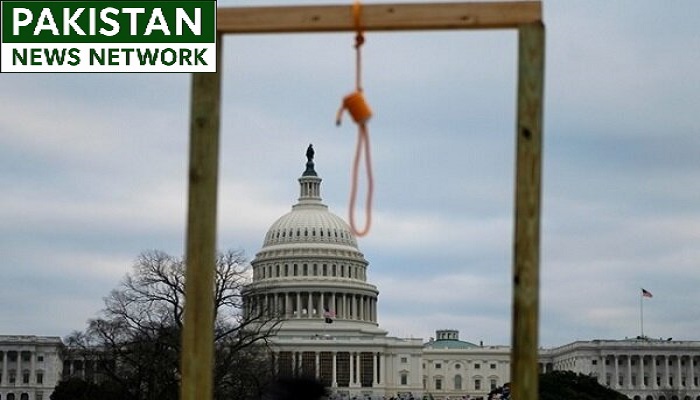
PNN – The majority of prominent American thinkers believe that American hegemony in the world is declining for various reasons, and they announced the exact year of the official announcement of the end of American dominance over the world.
According to the report of Pakistan News Network; the third decade of the twenty-first century has witnessed a radical transformation in the structure of the international order, during which the world has moved from a unipolar phase dominated by the United States into a geopolitical chaos that has reshaped the global map.
The New Statesman magazine chose the headline “The Fall of the Big bang,” an accurate description of a decisive historical moment in its latest issue. John Gray, the author of the article in the magazine, did not see the fall as the result of a passing accident or military defeat on a traditional battlefield, but rather emphasized that it was the result of long-term internal erosion and isolationist strategic decisions, the signs of which were manifested by the return of Donald Trump to the scene and the systematic dismantling of obvious alliances.
John Gray believes that America’s power did not derive its legitimacy solely from its military arsenal, but rather from its ability to lead a liberal global order that served the interests of its allies. However, by adopting the radical “America First” policy, Washington lost its role as the guarantor of global security, which led regional and international powers to seek alternatives and new alliances away from the American umbrella.
In explaining the magazine’s content, Al-Ahed adds that this development not only weakened America’s political influence, but also led to the collapse of confidence in the dollar as the global reserve currency, which is the beating heart of the economic empire. America’s withdrawal from trade and climate agreements and its constant conflict with international institutions created a huge vacuum that powers like China and Russia, with their strategic intelligence, quickly filled, turning the unipolar world into a memory in the history books.
According to the report, French thinker Emmanuel Todd offers a deeper perspective that focuses on the infrastructure and social structure of the United States. In his book, “The Failure of the West,” published in January 2024, he noted that declining levels of education, rising mortality rates, and the breakdown of the family fabric were early signs of this collapse. He pointed to the vast class divide and severe social division in America that have made it incapable of building a national consensus on any strategic issue.
American scholar John Mearsheimer warned that the United States has made a grave strategic mistake by pushing Russia and China into a close alliance. In his view, America’s failure stems from an “illusion of hegemony” that led Washington to expand its military beyond its capabilities, ultimately leading to the collapse of its military and political credibility against emerging regional powers.
In contrast, Thomas Friedman, one of the most ardent believers in globalization, wrote in his recent New York Times articles that the United States has lost its competitive advantage not because of a lack of power but because of a loss of “moral and technical compass.” He adds that overreliance on the weapon of sanctions has led to “the disintegration of the global network” that the United States operated. Friedman believes that 2026 will be the year of awakening to the fact that the United States can no longer impose its standards on the world.
Francis Fukuyama, in his 2025 study, warned that a country that prided itself on its strong institutions now suffers from political paralysis that prevents it from making decisive decisions and has made foreign policy hostage to internal partisan conflicts. This institutional weakness has created a perception in the world that America is no longer a reliable partner. This kind of instability is the silent killer of any empire, because it robs it of the ability to foresee and plan for the long term.
The fall of the American empire, from the perspective of these thinkers, is the result of the convergence of domestic and foreign crises in a single period of time. The war that brought down America was not just a war of cannons and missiles, but a war over values, institutions, and economic stability. According to the article of this American magazine, the destruction of the American empire was the embodiment of the policy of abandoning international responsibility and retreating behind borders, and it seems that 2026 will be the year of the official announcement of the end of the American era and the beginning of the multipolar era.
Iran Becomes a Regional and International Pole
The characteristics of Iran’s emergence as an active regional and international pole after recent military and political developments are revealed through a set of geopolitical and military data, showing that the country has moved from the sphere of a powerful regional state to the sphere of influencing the balance of great powers.
These components can be summarized in the following points:
Military Capability and Strategic Deterrence
Recent conflicts have demonstrated Iran’s ability to bypass traditional air defenses using drones, hypersonic missiles, and ballistic missiles. This development is no longer a mere show of force, but has imposed a new deterrence equation that has turned targeting Iran’s depth into a costly international adventure and forced major powers to reconsider their military options in the region.
Strategic Independence and Eastern Alliances
Tehran has succeeded in breaking the policy of international isolation by deepening its strategic partnerships with emerging powers, particularly within the BRICS and SCO axes. This position has transformed Tehran from a besieged country into a key link in the North-South corridor, whose stability has become a vital interest for China and Russia, and has strengthened its position as an indispensable pole in the shaping of the new multipolar world order.
Field Unit Management and Regional Depth
The recent war demonstrated Tehran’s ability to work with a complex network of allies in Lebanon, Iraq, Yemen, and Palestine, in close military and political coordination. This gave Iran the “geopolitical veto” over global trade routes and energy supplies that is characteristic of great powers.
Technological and Industrial Superiority
Iran’s military production sector, particularly in the field of drones, has become an effective player in international conflicts outside the Middle East. Iran’s ability to develop advanced, self-sufficient military technology gives it a competitive advantage, making it a reliable arsenal in international conflicts, and bolstering Iran’s reputation as an emerging industrial and military hub.
Political Stability and the Failure of Change Calculations
Iran’s political system has demonstrated a high capacity to absorb major shocks, whether severe economic pressures or direct military threats. This internal stability, coupled with Iran’s active diplomacy in complex negotiations, demonstrates the maturity of an independent state that manages its crises with patience and perseverance, and establishes its role as a partner that cannot be ignored in engineering regional and international security.