
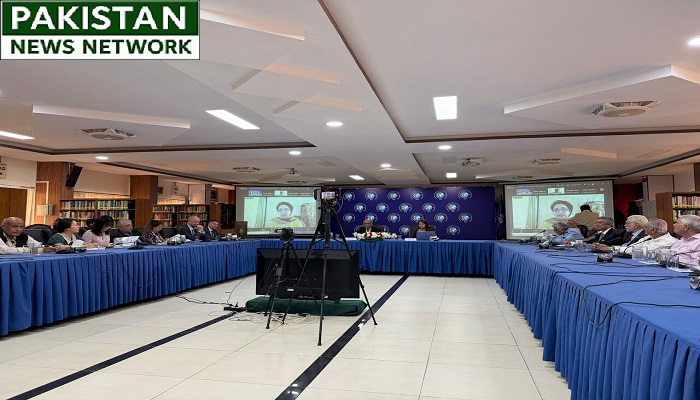
PNN – A number of political elites and strategic researchers in the Pakistani capital, acknowledging the key role of the Islamic Republic of Iran in advancing peace and stability in the region, emphasized that the US-imposed war on Iran has led to defeat and that Iran’s situation in the post-war period will be seen as much stronger.
According to the report of Pakistan News Network, the unveiling ceremony of the report “The US-Israeli Confrontation against Iran and Its Consequences” was held today, hosted by the Islamabad Strategic Studies Institute (ISSI), with the presence of a group of political elites, former Pakistani diplomats, international experts, as well as some foreign diplomats residing in Islamabad.
This report was compiled and published by the Center for Afghanistan, the Middle East and Africa at the Institute for Strategic Studies in Islamabad. Khalid Mahmood, the head of this group and former Pakistani ambassador to Tehran, and Maleeha Lodhi, a famous Pakistani strategist and former ambassador to the United Nations, the United States and the United Kingdom, were among the keynote speakers at the launch ceremony.
In her opening remarks, Amina Khan, Director of the Afghanistan, Middle East and Africa Department of the Islamabad Institute for Strategic Studies, referred to the joint collaboration of researchers from this group with a group of experts from regional countries to prepare this report, adding: The war that has now ended with the Islamabad Memorandum of Understanding remains a serious concern for the countries of the region and the world, as provocative actions are being seen in the region that could lead to weakening of ongoing peace efforts.
She emphasized: Along with the ongoing peace efforts, Israeli crimes in Gaza and Lebanon continue, however, Pakistan’s position is clear. We insist on using diplomacy, engagement, and dialogue, and we must continue on this path.
Maleeha Lodhi, former Permanent Representative of Pakistan to the United Nations, stated in the keynote speech of the program that the above report states that dependence on the outside to ensure internal security never works, so the countries of the region must establish a joint and coordinated mechanism for security issues.
She criticized the UN’s passive performance in stopping Israeli crimes in Gaza and promoting the mission of the so-called Gaza Peace Council, emphasizing: The UN was also oblivious to its responsibility in the imposed war against Iran, and we saw how the military approach led to the destruction of the diplomatic process and negotiations.
The veteran Pakistani diplomat added: The current situation in the region indicates the defeat of the imposed American-Zionist war against Iran, meaning that the period of bullying is over and no one can make other countries surrender by threatening them and setting deadlines.
She stated: Iran proved that it has high staying power. A country that has been suffering from the toughest US sanctions for decades did not allow the aggressors to achieve their goals, and today we see that the Iranian regime has sufficient power.
The former Pakistani ambassador to London and Washington emphasized: Iran challenged the bullies and proved that it has emerged stronger in the post-war period. Therefore, other regional power players or world powers should learn from the fate of America’s war.
Asked whether America’s dominance in the Middle East has ended, she said: Yes, today America has lost its dominance in the region, and the Persian Gulf countries must also understand this reality.
Khalid Mahmood, head of the Islamabad Institute for Strategic Studies, Zamir Akhtar, a prominent nuclear expert and former permanent representative of Pakistan to international organizations in Vienna, and Sarwar Naqvi, former permanent representative of Pakistan to the International Atomic Energy Agency, also spoke at the ceremony.