
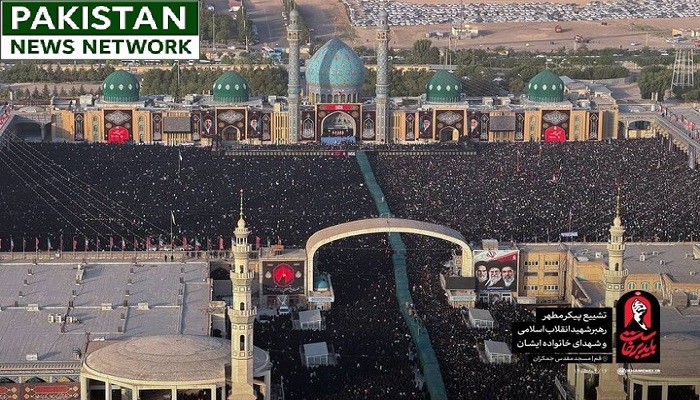
PNN – Reuters reported that the United States had envisioned the funeral procession for Imam Khamenei as a display of grief and defeat for the Iranian nation; however, Tehran used the event to challenge its adversaries for the future.
According to the report of Pakistan News Network, Reuters—reporting on the messages and implications of the massive funeral processions for the martyred leader of Iran’s Islamic Revolution in Tehran, Qom, Mashhad, and the holy cities of Karbala and Najaf—wrote that the magnificent scenes of the late Iranian Supreme Leader’s funeral went beyond a mere national farewell; rather, they served as a powerful public statement, conveying a clear message to the United States and the Zionist regime that their efforts to force the Islamic Republic into submission have failed.
Citing regional officials, diplomats, and analysts, the news agency reported that this display—fraught with challenges yet demonstrating resilience—will henceforth serve as a foundation for Tehran’s negotiating strategy; the West views the event as a moment in which Tehran successfully transformed its capacity for endurance into a lever of pressure.
Observers note that the recent conflict has starkly highlighted Iran’s influence over the Strait of Hormuz, making it difficult—in any future negotiations—to decouple the issue of the Strait from the war or Iran’s nuclear program.
Tehran’s Leverage
The report adds that Washington sought to halt Iran’s nuclear program during the 60-day ceasefire; however, recent days have demonstrated that Iran has acquired new forms of leverage that extend well beyond the nuclear issue.
According to Reuters, Tehran is leveraging the Strait of Hormuz—and striving to secure recognition of its dominant position there—to transform its wartime gains into a permanent strategic advantage, all while controlling the pace of events during the ceasefire. This control could manifest through arrangements for maritime traffic, coordination mechanisms, or the imposition of service fees along a route that carries one-fifth of the world’s oil and liquefied natural gas.
Alex Vatanka, an analyst at the Middle East Institute in the U.S., states: Despite the potential for generating massive revenue by taxing ships passing through the strait, Tehran views the Strait of Hormuz as more than just an economic asset; rather, it seeks to leverage the strait as a source of political legitimacy.
He added that the symbolic significance holds far greater importance for Iranians than the revenue itself; they essentially want the strait to be recognized as belonging to Iran, as this equates to acknowledging Iran as a power exercising sovereignty over the waterway.
Watanka considers Iran’s sovereignty over the Strait of Hormuz to be far more valuable to the country than the lifting of sanctions or the release of its frozen assets; he believes Iran maintains a firm stance on the Hormuz issue and will not yield its rights under any circumstances.
Regional sources and diplomats indicate that Iran is deliberately slowing down negotiations to consolidate what it views as “war gains” before returning to the nuclear issue.
Alan Eyre, a former U.S. diplomat and Iran expert, also writes that strengthening its position in the Strait of Hormuz is far more important to Iran than its nuclear program. According to this international affairs analyst, Iran is perfectly content to stall and prolong negotiations; the country seeks to control the Strait of Hormuz and is currently engaged in talks to institutionalize that control.
Reuters adds that U.S. President Donald Trump is constrained by domestic politics and the congressional midterm elections; consequently, the pressure he faces to secure a deal with Iran far outweighs the pressure Iran faces to make concessions.
In this regard, Alan Eyre says: The Iranians know that Trump wants to exit the crisis and that they can pressure him, because time is on their side. He added: No one will emerge victorious, but Iran’s losses will be less than America’s.
A Return to the Status Quo Is Not Possible
Aaron David Miller, a former U.S. negotiator on Middle East affairs, states: The military offensive launched by Washington failed to break Iran’s will and left U.S. diplomacy with a fragile ceasefire that requires significant effort to implement.
He added: Tehran sees no need to seriously engage on the issue of its nuclear program until it is assured that the new reality regarding the Strait of Hormuz is accepted and tangible progress is made toward unfreezing billions of dollars in assets held abroad.
Miller explained that the 60-day deadline was always a fantasy; the Iranians will not move toward addressing the nuclear file until they are certain the new status quo is cemented. They want to ensure that world leaders—foremost among them Trump—understand that a return to the pre-February 27 situation is impossible.
In concluding its report, Reuters states that Washington will likely be forced to accept the reopening of the Strait of Hormuz on terms largely dictated by Tehran.