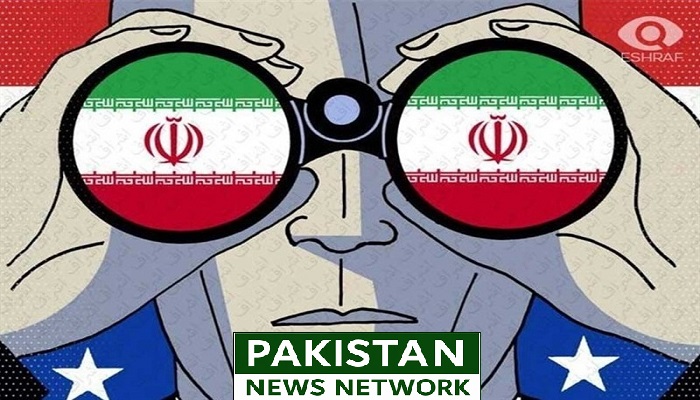
PNN – The administration of Donald Trump, the terrorist president of the United States, is considering revoking the American green card of an Iranian-born analyst.
According to the report of Pakistan News Network, Free Press claimed in an exclusive report yesterday that the US State Department has launched an investigation against Trita Parsi, one of the co-founders of the Responsive Statecraft think tank and former director of NAAC.
According to this report, senior officials in the Donald Trump administration, especially in the diplomatic structure led by Marco Rubio, are seriously considering revoking the green card of this analyst active in the American media.
The True Nature of the NYAK Movement
Although the Western media tends to portray this as Trump’s attempt to silence the voices of “Iran supporters” or “war opponents,” a careful examination of Trita Parsi’s record, connections, and intellectual foundations shows that she and her network of like-minded individuals have never been legitimate or sympathetic figures for Iran’s national interests or opponents of war against the country. Rather, they simply support a different kind of war against Iran.
To understand the true nature of this movement, one must look at the gap and at the same time the structural connection between two strands of expatriate subversives. On the one hand, there is the “hard overthrow” movement, a spectrum made up of Republican Party hardliners, Pentagon hawks, and those Iranian opposition groups that openly and blatantly call for the immediate and physical overthrow of Iranian rule through military options, bombing infrastructure, and so on.
On the other hand, there is a more intelligent movement called “soft overthrow” or the “Transformation Project,” whose prominent representatives are Trita Parsi, the NYAK structure, and the Quincy Institute.
Theorists of this movement believe that Iran’s political and ideological structure, due to its strategic depth and means of stability, will not only not collapse in the face of severe external blows, but will also become more coherent; therefore, an effective solution to contain the components of Iran’s power is to influence decision-making layers, build elite networks, and bring the country to the table for agreements such as the JCPOA, so that the anti-colonial nature and anti-imperialist character of the Islamic Republic can finally be changed.
The main goal of this strategy is to gradually change the identity, character, and internal personality of the system so that the government can transform from within and adjust its strategic behavior according to the wishes of the West without the need to fire a single missile.
Therefore, these two factions have no strategic disagreement over the ultimate goal—which is to contain, weaken, and corrupt Iran; their conflict is merely a tactical dispute over the choice of means; one seeks destruction through hard war, the other through soft war and the gradual transformation of sovereignty; a difference of the kind that also exists between the Republican and Democratic parties.
NYAK; Networking Hangout
A detailed examination of Trita Parsi’s biography and rise in Washington reveals the precise workings of this soft influence network.
Raised in Sweden, Parsi completed her higher education in international relations at Uppsala University and economics at Stockholm University, and then received her doctorate in international relations from Johns Hopkins University in the United States.
After working for a while at the Swedish Permanent Mission to the United Nations, she met Bob Nye, then a U.S. Congressman from Ohio, and worked her way into the heart of American lawmaking as his assistant.
Bab Nai, who had taught in Shiraz for some time before the revolution and spoke Persian well, supported hardline opposition groups until 1997, but after that he saw establishing relations between Iran and the United States and using diplomatic tools as a better and more efficient way to oppose the Islamic Republic government.
It was in this context of thought that Trita Parsi established the National Iranian American Council (NIAC); a 100% American lobby that was run with money from major soft war institutions such as the Rockefeller Brothers Foundation, the Carnegie Endowment, and the Open Society Foundation (owned by George Soros).
In interviews and personal writings, Parsi often mentions his close relationship with Francis Fukuyama—the famous American theorist who heralded the final victory of Western liberal democracy with his “end of history” doctrine—as a great honor, which in itself reflects his deep fascination with the project of the absorption of independent societies into the American order.
NAIK effectively became a hangout for networking with Iran’s designated enemies, and despite claiming to defend Iranian rights; it functioned behind the scenes as a tool for diplomatic channeling and directing the perceptions of Washington’s elites.
The peak of this strategy’s effectiveness was seen during the presidency of Barack Obama. When the White House focused its strategy on smart containment of Iran through nuclear negotiations, Trita Parsi and Nayak became key partners in the administration.
According to media reports, Parsi visited the White House more than 30 times during that period and, as an unofficial advisor, played a significant role in establishing the sanctions network against Iran on the one hand and in justifying and advancing the 2015 agreement (the JCPOA), on the other hand, whose overarching goal was to advance the influence project in Iran.
Ben Rhodes, Obama’s deputy national security adviser, later admitted that the White House had created an “echo chamber” of think tanks and experts to politically sell the JCPOA to the American public, reproducing and confirming information and statements injected by the Obama administration; NAAC was one of the key pieces of this puzzle.
Revenge of Hard Subversives on Soft Subversives
With this background, the fundamental question is why, at this juncture, the Trump administration has suddenly decided to initiate the deportation of soft subversives like Trita Parsi? The root of this decision must be sought in the Trump administration’s heavy defeat and strategic stalemate on the front of hard confrontation with Iran.
Numerous reports indicate that before launching the Ramadan War against Iran, Donald Trump had reached the assessment, based on information received from Mossad that launching a war would lead to the start of street riots and the rapid overthrow of the government.
But these predictions have in practice hit the rock of Iran’s strategic resistance. Iran’s persistence has not only thwarted the collapse project but also imposed heavy political, military, and security costs on the United States in the region.
This apparent failure and inability to fulfill the promises of the warmongers has created a wave of distress, despair, and extreme disillusionment among Washington hardliners and has severely shaken the Trump administration’s political position within the United States.
In such circumstances, the Trump administration, which is on the one hand extremely angry at the failure to achieve its goals in the war and on the other hand unable to direct this anger towards the main source of power, the Islamic Republic of Iran, has, with a kind of “displaced aggression,” directed the anger and desperation resulting from the defeat towards accessible targets and domestic figures such as Trita Parsi, and it can be said that it has become involved in a “self-destructive” and “self-defeating” project.
The spectrum of hard-line hawks, such as Senators Tom Cotton and Ted Cruz, who have been seeking to destroy the NYAK for years, have seized the opportunity to take revenge on the soft-liners. They accuse people like Trita Parsi of undermining America’s will to fight and eroding Washington’s military deterrence by appearing in a variety of media outlets—from Steve Bannon’s right-wing podcasts to left-wing networks like New Democracy! and CNN—and repeating the proposition that “war with Iran is a bottomless pit.”
Thus, Trita Parsi, who once had the red carpet rolled out under his feet as a golden gem of influence and transformation in the Obama White House, has today become a victim of the displaced aggression and panic of a government that has reached a complete impasse in beating the drum of war with Iran.