
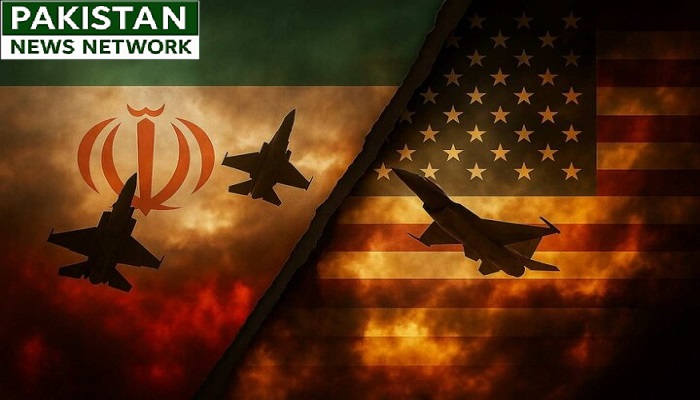
PNN – The 40-day war demonstrated that Iran’s most significant advantage lies not merely in its missile capabilities or military assets, but rather in possessing a strategic logic, the ability to adapt to circumstances, the preservation of national cohesion, and the capacity for crisis management.
According to the report of Pakistan News Network; the 40-day war and its aftermath once again revealed the reality that military superiority alone does not guarantee political and strategic success. While the United States and its allies—relying on military might, advanced technology and complex operations—believed they could quickly compel Iran to accede to their demands, the course of events demonstrated that Washington’s calculations had been based on flawed assumptions from the very beginning.
In a strategic analysis, Bloomberg attributes the United States’ failure in the conflict with Iran to six major strategic errors—mistakes that prevented tactical gains from ever translating into political and strategic victory. This analysis effectively acknowledges that America’s most significant failure occurred not on the battlefield, but at the level of strategy and decision-making. These six strategic errors are as follows: The illusion of a quick end to the war and an inability to manage a war of attrition; a failure to grasp the logic behind Iran’s decision-making and the fact that the assassination of leaders served only to intensify resistance; overlooking worst-case scenarios, such as the consequences of closing the Strait of Hormuz; the gap between maximalist objectives (Iran’s geopolitical capitulation) and limited means (an inability to deploy ground forces); weaknesses in building consensus; and, ultimately, Trump’s reliance on instinct and military might rather than the formulation and implementation of a coherent strategy.
First: The Illusion of a Short War
Washington’s initial mistake was the assumption that the war would end quickly. American policymakers believed that a series of heavy strikes and an initial shock would cause Iran’s decision-making structure to collapse, forcing Tehran to accept new terms within a short period.
Contrary to this expectation, however, Iran not only retained control over its command structure but—by rapidly rebuilding its command network, sustaining operations, and maintaining internal cohesion—transformed the conflict into a war of attrition. This shift in the nature of the war disrupted a significant portion of America’s initial calculations and drove up Washington’s political and military costs.
Second: Failure to Grasp Iran’s Decision-Making Logic
The United States lacked a proper understanding of the Islamic Republic’s decision-making logic. Washington assumed that eliminating senior commanders and assassinating leaders would cause the collapse of Iran’s political and military structures. However, the result was entirely the opposite. Far from forcing a retreat, these actions actually strengthened internal cohesion, the motivation to resist, and the resolve to continue the fight. The experience of the war demonstrated that Iran’s decision-making structure is not dependent on specific individuals; rather, it rests upon a network of institutions, accumulated experience, and mechanisms for succession and continuity.
Third: Neglecting Worst-Case Scenarios
Another error made by the United States was its failure to consider high-cost scenarios. Washington relied too heavily on the best-case scenario and was insufficiently prepared for the war’s potential consequences—such as a crisis in the Strait of Hormuz, rising energy costs, disruptions to global trade, and an expansion of the conflict.
In fact, as the war dragged on, it became evident that the economic and geopolitical costs of the crisis were not borne solely by Iran; the global economy and U.S. allies were also affected. This reality severely constrained Washington’s freedom of action.
Fourth: The Gap between Objectives and Means
Bloomberg holds the view that the United States had set objectives far exceeding its available means. Washington’s goal was to alter Iran’s strategic behavior—and even compel Tehran into a form of geopolitical capitulation—yet, in practice, the U.S. was unwilling to engage in a large-scale ground war or bear the associated costs.
This disparity between objectives and means meant that U.S. military operations lacked the capacity to achieve their political aims. Furthermore, experiences in Iraq and Afghanistan had demonstrated that a ground war would entail exorbitant costs for Washington—a factor that constrained U.S. decision-making.
Fifth: Failure to Build Consensus
Another key aspect of the Bloomberg analysis is the United States’ weakness in the decision-making process. Decisions made within a narrow circle of advisors—without rigorously testing assumptions or considering diverse viewpoints—resulted in a significant disconnect between many of Washington’s initial assessments and the realities on the ground.
Under these circumstances, U.S. policymakers relied more on optimism and their own preferred projections than on multifaceted analysis—an approach that ultimately led to major miscalculations.
Sixth: substituting military power for strategy—according to Bloomberg
The final—and perhaps most significant—mistake was an over-reliance on military might and political instinct. The notion that military superiority could substitute for strategy led the United States to fail to distinguish between tactical success and strategic victory. While military strikes can inflict damage, without a clear political and strategic plan, such damage does not necessarily result in a change in the adversary’s behavior. The war with Iran demonstrated precisely this reality.
Iran’s Might: Disrupting U.S. Calculations
What the forty-day war revealed was not merely the failure of a military operation, but the collapse of a decision-making model in Washington—a model that assumes firepower superiority can substitute for a true understanding of the adversary.
In this conflict, Iran demonstrated that national power is not defined solely by military hardware. The maintenance of political cohesion, continuity of command, rapid structural restoration, robust deterrence capabilities, the simultaneous management of the military and political arenas, and the capacity for crisis control were the combined factors that handed the initiative to Tehran.
This very factor prevented military pressure from achieving the United States’ stated objectives. Iran’s decision-making structure did not collapse, its resolve to resist did not waver, and Washington’s maximalist goals were not realized. Conversely, the U.S. faced mounting political, economic, and reputational costs, and saw its deterrent credibility called into question.
Bloomberg’s analysis effectively summarizes a key lesson from the conflict: while military power can yield tactical successes, it cannot secure lasting victory in the absence of a coherent strategy, a precise understanding of the adversary, and alignment between objectives and the means to achieve them.
The 40-day war demonstrated that Iran’s most significant advantage lies not merely in its missile capabilities or military capacity, but in its possession of a strategic logic, adaptability to circumstances, preservation of national cohesion, and crisis management capabilities. Consequently, as long as Washington disregards Iran’s geopolitical realities, strategic capacities, and decision-making logic, the risk of repeating past errors persists—errors that not only fail to achieve U.S. objectives but actually strengthen Iran’s strategic position within regional and international equations.