
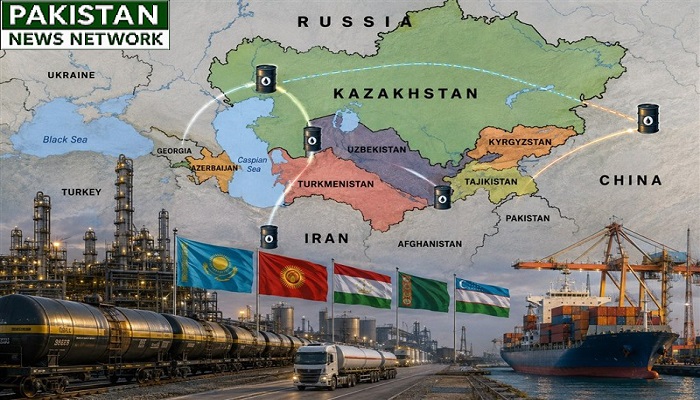
PNN – The crisis in Russian oil refineries has prompted Central Asian nations to diversify their sources and purchase oil from Iran and China.
According to the report of Pakistan News Network; recurring disruptions and shutdowns at Russian oil refineries have triggered a transformation and reconfiguration of the region’s traditional, established fuel supply routes.
Amid these new circumstances, Kyrgyzstan is coordinating the import of petroleum products from China; Tajikistan has submitted a major proposal to purchase crude oil and various fuels from Iran; and Kazakhstan has launched an extensive plan to more than double its refining capacity, aiming to meet domestic demand while simultaneously increasing product exports to its neighbors.
Kyrgyzstan: Pivoting Toward China and Modernizing the Domestic Refinery
Among Central Asian nations, Kyrgyzstan and Tajikistan have felt the impact of Russia’s fuel crisis more acutely than others, as both countries have negligible oil production and rely heavily on fuel imports.
Galiya Ibragimova, a Central Asia expert, emphasized in an interview with Al Jazeera that these two republics have suffered the most from the situation. She noted that their efforts to secure new suppliers will continue, even though alternative fuel sources will likely come at a higher cost.
For Bishkek, the traditional model of sourcing fuel from Russia has always been the most convenient and cost-effective option. As a member of the Eurasian Economic Union, Kyrgyzstan imports specific quantities of Russian fuel annually on a duty-free basis. Moscow had agreed to supply approximately 1.5 million tons of fuel for 2026—a volume roughly equivalent to Kyrgyzstan’s total annual demand for petroleum products, covering over 90 percent of the country’s needs.
However, this system faltered during the summer. Kanatbek Eshatov, head of the Association of Oil Traders and Importers of Kyrgyzstan, announced that Russian refineries had virtually no surplus volume available for supply. Consequently, fuel shipments began entering the market from new sources, such as Belarus, Azerbaijan, Turkey, and certain European countries.
Eshatov emphasized that the fuel supply situation involving Russia was not expected to improve before October.
In response to this crisis, Bishkek initiated direct negotiations with Chinese oil giants. Following consultations with Sinopec, a Kyrgyz delegation met with senior executives from the China National Petroleum Corporation (CNPC).
According to the Kyrgyz state news agency (Kabar), Kyrgyz companies have signed contracts to procure petroleum products through the “Kunlun Logistics” company.
Although road transport across mountainous borders is more expensive than rail transport—and Beijing is unlikely to replace Russia as a supplier in terms of price in the short term—these agreements have opened a new strategic channel for Bishkek.
Another option for Kyrgyzstan is to increase its domestic oil refining capacity. The country’s largest refinery, the “Junda” complex in the Kara-Balta region, has entered a new phase of a $193.75 million modernization project aimed at upgrading standards to Euro-5 and boosting output; however, the refinery remains heavily dependent on crude oil imports to operate at full capacity.
Tajikistan: Strategic Request to Import Crude Oil from Iran
The government of Tajikistan has placed a much larger-scale option on its agenda. During intensive bilateral negotiations with Iranian officials, Dushanbe formally submitted a request to Tehran for the supply of 2.55 million tons of crude oil and various petroleum products—comprising 2 million tons of crude oil, 300,000 tons of diesel, 150,000 tons of gasoline, and 100,000 tons of aviation fuel—a move announced by Tajikistan’s Ministry of Transport.
This request currently stands as a formal proposal rather than a finalized contract; furthermore, due to the lack of a shared border, it necessitates transit arrangements involving intermediary countries. Moreover, the proposal has been put forward against the backdrop of escalating threats of sanctions from U.S. President Donald Trump.
It is worth noting that crude oil accounts for approximately four-fifths of the total requested volume. This indicates that Dushanbe’s objective extends beyond merely replacing Russian gasoline with Iranian fuel; rather, Tajik officials are seeking to secure a stable feedstock supply for their domestic refineries.
Given that the volume of 2 million tons of crude oil exceeds the 1.2-million-ton nominal capacity of the Dangara refinery—Tajikistan’s largest—these shipments must either be distributed over a period of time or new processing infrastructure must be developed. Although genuine diversification entails infrastructure investment and higher costs, it could liberate Tajikistan from its absolute dependence on imports of finished products.
Kazakhstan: A Surge in Refining Capacity and Swap Arrangements with Russia
Kazakhstan is grappling with a distinct challenge. As a major oil producer, the country exports the bulk of its crude oil; for Astana, Russia serves primarily as a transit nation, given that over 80 percent of Kazakhstan’s oil exports are transported via the Caspian Pipeline Consortium (CPC) to the Novorossiysk terminal on the Black Sea.
Disruptions to the CPC pipeline once again demonstrated just how difficult it is to rapidly divert such massive volumes of oil to alternative routes.
Consequently, in addition to seeking new transit routes across the Caspian Sea, Astana aims to retain a larger share of its crude oil for domestic refining. In 2025, Kazakhstan produced 99.6 million tons of oil but refined only 18.4 million tons domestically.
Yerlan Akkenzhenov, Kazakhstan’s Minister of Energy, officially announced the government’s plan to increase the country’s refining capacity to 40 million tons per year—a target originally set for 2040 but now rescheduled for completion by 2033.
The plan entails expanding three major refineries and constructing a new facility with a 10-million-ton capacity, enabling Kazakhstan to produce greater quantities of gasoline, diesel, and jet fuel for export to neighboring countries.
The fuel crisis in Russia has even led to the establishment of a rare arrangement between Moscow and Astana; under this plan, Russian crude oil is delivered to a condensate refinery in western Kazakhstan, and following processing, up to 30 percent of the resulting fuel remains in Kazakhstan while the remaining 70 percent is returned to Russia.
The Emergence of a “Multi-Basket Policy” in Central Asia
It is difficult to predict how long Russia’s refining difficulties will persist.
While international reports suggest a likely extension of Russia’s diesel export ban—due to ongoing domestic shortages and refineries remaining offline following drone attacks—Russian officials present a different picture.
However, long queues at Moscow gas stations—alongside the oil giant’s unconventional moves to import fuel products and implement rationing—have laid bare the realities on the ground.
Despite these developments, it would be premature to speak of a complete severance of ties between Central Asia and Russia; Russian fuel remains more accessible and affordable, and once refinery capacities are restored, traditional supply routes will once again become economically viable. What has changed is how the region’s nations view the issue of “dependence on a single source.”
Jennifer Brick Murtazashvili, a professor at the University of Pittsburgh, terms this new strategy a “portfolio policy”—an approach wherein countries, rather than simply swapping one partner for another, strategically distribute their foreign relations across various sectors and partners to preserve their geopolitical room for maneuver.
In the Central Asian oil market, this logic has now materialized into reality; ties established with new suppliers such as Iran and China, alongside investments in domestic refineries, are set to remain enduring features of the region’s energy landscape.