
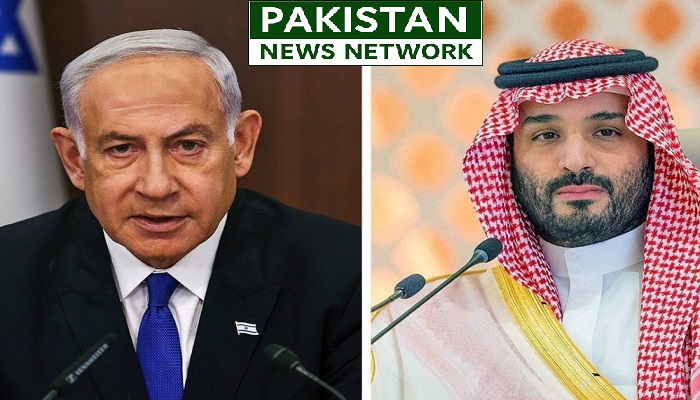
PNN – Media sources announced that the project to examine the Israel-Saudi land connection is being pursued in the form of economic and logistical cooperation with the participation of the OECD.
According to the report of Pakistan News Network; the occupation radio emphasized that the purpose of this study is to examine the logical and economic justification of this project.
This news comes as the statements of the Israeli Minister of Energy, Eli Cohen, to the Hebrew newspaper Ma’ariv on October 25 regarding the existence of a project to create an “energy corridor” with Saudi Arabia raised widespread questions in political and media circles; whether Tel Aviv is seeking to open a new door to normalize relations with Riyadh under the guise of economic cooperation and regional infrastructure projects.
Cohen said the proposed deal aims to create an energy corridor connecting Saudi Arabia to Israel to facilitate the movement of oil and goods to Europe, and that the project would be a land-based alternative to the traditional sea routes through the Suez Canal and land routes through Iran.
He added that the corridor would give Saudi Arabia direct access to European energy markets while strengthening Israel’s position as a regional energy hub in the Middle East.
Details of the proposed crossing
According to the plan leaked to the Zionist newspaper Ma’ariv, goods and energy would be transported from Indian ports to the Persian Gulf (such as the Saudi port of Dammam) and then via the Saudi-Jordanian railway to the port of Haifa in occupied Palestine and from there to Europe.
The first phase involves the construction of a railway line from Haifa to the Jordanian border, passing through Beit She’an in occupied Palestine to the city of Irbid in Jordan, with an initial investment of about $20 billion, which Saudi Arabia would finance.
The second phase focuses on a direct connection to the Persian Gulf, a project that was still in the feasibility study phase in the occupied territories until 2025.
Observers believe that Israel is trying to use this project to link its economic interests with regional normalization initiatives, especially since the passage is part of the “India-Middle East-Europe Economic Corridor,” which has been proposed with the support of the United States and the European Union as an alternative to the Suez Canal (after repeated attacks on ships bound for occupied ports in the Red Sea).
The project is based on the idea of connecting Indian ports to the European Union via two routes: the eastern route, which connects India to the Persian Gulf countries, and the northern route, which connects the Persian Gulf to Europe via Jordan and the occupied territories. Tel Aviv plans to bring Saudi Arabia into this corridor by connecting its ports and pipelines.
In April 2025, Eli Cohen and his American counterpart, Chris White, discussed the idea of building an oil pipeline from the port of Ashkelon, passing through Eilat, to Saudi Arabia, under the title of connecting the Persian Gulf to Europe and expanding the scope of the Abraham Accords.
According to the Israeli plan, an overland oil pipeline of approximately 700 kilometers will be built from Saudi Arabia to the city of Eilat, from where it will be connected to the port of Ashkelon via an existing pipeline for oil shipments to Europe.
Cohen described the new route as the shortest, fastest and safest way to transport energy to Europe, noting that the project will reduce time and financial costs and strengthen the economic justification for both sides.
Cohen wrote in a post on the social network X that the project will turn Israel into a strategic energy bridge between the East and the West and help strengthen the security and prosperity of the region.
He also noted that Tel Aviv is working to develop regional infrastructure to become the main energy transit hub in the Middle East.
Israel’s Ambition Regarding the “Neom” Project
The Zionist regime’s vision is not limited to the oil corridor; Eli Cohen, who was previously the head of the spy agency (Mossad), believes that economic normalization with Saudi Arabia could in the future include cooperation in the Saudi futuristic city project “Neom”.
In an article published in the Ma’ariv newspaper on March 27, 2025, he spoke of the prospects for economic prosperity with global implications, noting that Israel is eager to participate in the production of green hydrogen in Neom with an investment of about $8 billion.
Estimates by Israeli researcher Nitzan Cohen, published in the Israel Hayom newspaper on February 4, 2025, indicate that Tel Aviv may receive between 10 and 20 percent of the profits from the $500 billion Neom project, a figure equivalent to about $100 billion.
He explained that Israeli companies, including the consulting firm Tiffen, have begun preparations to enter future Saudi projects, either directly or through non-public partnerships, pending the formal normalization of relations.
A report published in the American magazine Business Insider last May noted that the success of the NEOM project and Saudi Vision 2030 depends on regional stability and peace in the Middle East, emphasizing that geopolitical tensions, especially the war in Gaza, have slowed the pace of regional investment plans and postponed many joint energy projects.