
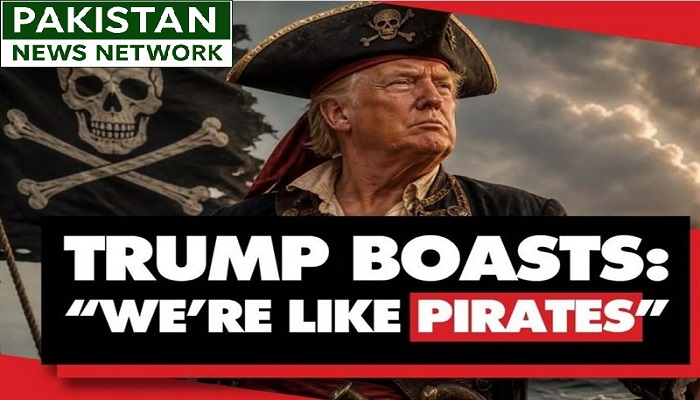
PNN – The Atlantic magazine wrote that the US Navy is currently acting like pirates.
According to the report of Pakistan News Network; Donald Trump has described his administration as “like pirates”; a phrase that, according to the Atlantic magazine, is not just a verbal joke, but a reflection of the approach that his administration has taken in the field of foreign policy and military operations; from the seizure of ships and confiscation of cargo to deadly naval attacks without a clear judicial process.
David E. Graham, author of this note in The Atlantic, referring to the history of the formation of the US Navy, writes that the United States revived its navy in the late 18th century in response to attacks by North African pirates known as the “Barbary Pirates.” At that time, American merchant ships were targeted and American sailors were taken hostage for ransom.
In 1801, Thomas Jefferson sent American ships to the Mediterranean to confront these pirates, a war that, the author argues, later became a model for American military interventions: the use of military power to defend American commercial interests and punish actors the United States described as “violators.”
But the author believes that the United States has now abandoned this tradition, as Trump openly compared the US Navy to pirates last month when he spoke about the seizure of a cargo in the Persian Gulf.
During his speech in West Palm Beach, Florida, Trump said: We got the cargo, we got the oil. The business is very profitable. Who would have thought it? We’re like pirates.
The problem, writes The Atlantic, is that the US government is now pursuing a “predatory” approach in various parts of the world.
According to the report, the US military continues to target and destroy boats in the Pacific Ocean and the Caribbean, including the attack that took place yesterday. The author emphasizes that these attacks are carried out without due process and without a clear legal basis.
Meanwhile, Republican Senator Mike Lee of Utah has proposed a bill that would allow the US government to authorize private individuals to raid and seize ships to combat drug traffickers, a move that effectively amounts to “privatizing piracy.”
The memo states that the Trump administration claims that the boats and vessels targeted belong to drug traffickers, but has so far provided no evidence to support this claim. The author says that some of these individuals may actually be involved in drug trafficking, but credible reports indicate that not all victims were involved in such activities.
Graham also emphasizes that even if the government has evidence, it does not mean a conviction, and in any case, US federal law does not provide for the death penalty for drug trafficking.
Meanwhile, the number of attacks has increased. The author says that the US military has become an invisible threat on the seas, like pirates, who bring death without warning and without the possibility of protest.
According to the report, more than 200 people have been killed in these attacks, but the New York Times reported a few days ago that the operation had no noticeable impact on the cocaine trade destined for the United States.
The Atlantic continues to address US policy towards Iran and the Strait of Hormuz, writing that during the war with Iran, Trump spoke of a “total blockade” of the Strait of Hormuz; an action that, according to Todd Huntley, an analyst for the Laufer website, is considered a violation of international law, although in practice the United States has not implemented such a blockade.
The author says that Trump often uses maximalist language without knowing or caring about its precise legal or political meaning, as when he previously called for Iran’s “unconditional surrender.”
The author questions the extent to which the United States has the right to take military action in response to the situation in the Strait of Hormuz, especially since Iran closed the strait after Trump launched a war that had neither congressional authorization nor clear legitimacy under international law.
Although Trump has ostensibly supported the position that the United States seeks to ensure freedom of navigation, the author believes that what excites him most is the financial gain from seizing ships and selling their cargo.
Trump said during a trip to China last month that he had raised the Strait of Hormuz with Xi Jinping, but he did not make it a central issue in the talks and did not get a specific commitment from the Chinese president.
The author says that Trump has previously pursued a similar approach with Venezuelan oil tankers that the United States seized last winter. But the policy has been costly and ineffective in practice, according to The Atlantic.
The New York Times reported in March that the maintenance of just one of the seized tankers cost the United States $47 million.
The article concludes by stating that Trump’s war with Iran has driven up oil prices, which has increased the value of seized cargo. However, the author emphasizes that seizing ships is not an effective way to raise revenue for the US government, and that such an approach carries not only financial costs but also widespread political and security risks.