
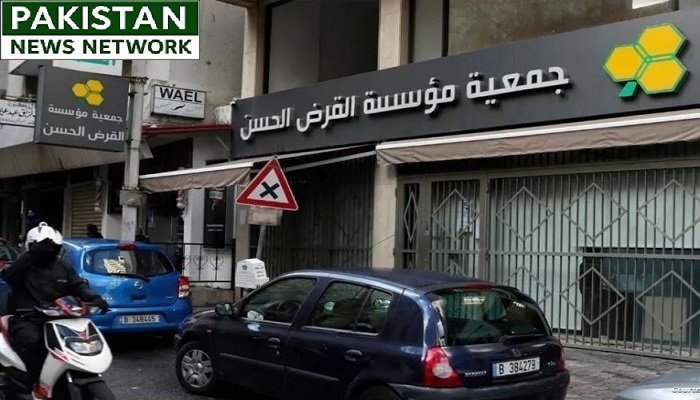
PNN – In a plot against the Resistance, the Lebanese government is this time seeking to strike a blow at the Al-Qard Al-Hassan institution, which provides financial assistance to the needy.
According to the report of Pakistan News Network; the pro-Western and subservient Lebanese government—which openly demonstrated its betrayal of Lebanon’s sovereignty and people by signing a shameful agreement with the Zionist enemy—has now targeted the livelihoods of the Lebanese people, particularly the needy, in an effort to strike a blow against the Resistance.
The targeting of economic and social institutions linked to the Resistance—carried out by the Lebanese government and factions aligned with the US and Zionists—is no longer a series of isolated actions; rather, it has become part of a comprehensive political and financial strategy aimed at pressuring the Resistance and its support base.
The Lebanese puppet government’s new plot against the Resistance, targeting the “Al-Qard Al-Hassan” institution
In this context, the case of the Hezbollah-affiliated financial institution “Al-Qard al-Hassan”—which operates over 30 branches across Lebanon and provides interest-free loans to the needy—must be viewed within the framework of a broader political struggle over Hezbollah’s status and role in Lebanon, given the institution’s social and economic significance within the “Resistance” community.
Prior to the signing of the shameful agreement in Washington between the Lebanese government and the Zionist regime, the government had already initiated a process early last June aimed at shutting down the Al-Qard Al-Hassan institution.
Sources informed the Al-Akhbar newspaper that the visit to the United States by Lebanese Justice Minister Adel Nassar early last month marked a turning point in the effort to cripple and close this grassroots financial institution; during the visit, he met with US State Department officials who called for the imposition of new sanctions against the organization.
In response to these plots, Hezbollah initiated a political move, dispatching representatives to the Ministries of Interior and Finance. Hezbollah’s representatives adopted a firm stance, emphasizing that any attempt to shut down the Al-Qard Al-Hassan institution would constitute crossing a red line; the repercussions would not be limited merely to administrative and legal matters but—given the institution’s direct connection to the community, particularly vulnerable segments of society—could extend to the political and social spheres as well.
Proving the falsity of allegations against Hezbollah’s financial institution
Meanwhile, Lebanese Interior Minister Ahmad Hajjar announced that the Governor of the Central Bank had informed President Joseph Aoun, Prime Minister Nawaf Salam, and the American side that a comprehensive review of the Al-Qard Al-Hassan institution’s operations—conducted since its inception—revealed no connection between the institution and the banking system, currency exchange firms, or money transfer companies; it was determined that Al-Qard Al-Hassan operates under the laws governing associations. Consequently, any action regarding the licensing or continued operation of the institution falls within the jurisdiction of the relevant administrative authorities—whether specific ministries or the government itself.
Lebanon’s Interior Minister stated that international parties have repeatedly raised the issue of the Al-Qard Al-Hassan institution with him; however, he maintained that anyone with a complaint or allegation regarding violations by the institution should approach the judiciary.
Meanwhile, Lebanese Finance Minister Yassine Jaber expressed his opposition to shutting down Al-Qard Al-Hassan, declaring: I will not allow this to happen, and I will pressure the Governor of the Central Bank of Lebanon not to intervene in this matter.
Following these ministers’ opposition to shutting down the Al-Qard Al-Hassan institution, the Lebanese government—which had effectively become an instrument for implementing U.S. policies—began seeking an alternative course of action against the organization and directed the Minister of Justice to pursue a judicial option. Consequently, an investigation was launched through the specialized Public Prosecutor’s Office; Judge Rami Haj—who remains in office as a public prosecutor despite proven corruption allegations against him—took charge of the proceedings against Al-Qard Al-Hassan and ordered security agencies to investigate the institution, specifically regarding the nature of its operations, financial sources, and financial affiliations.
According to information obtained by the Al-Akhbar newspaper, preliminary investigations concluded that there is no evidence establishing a direct link between the Al-Qard Al-Hassan institution and the banking systems of exchange houses or informal money transfer networks. This placed the institution’s case within the realm of legal debate, without establishing a judicial basis for taking action against it. Furthermore, investigations conducted by the Information Branch indicated that the institution was not involved in any criminal offenses.
The desperate efforts of Najib Mikati’s government to shut down Al-Qard Al-Hassan in collaboration with the Zionists
However, following the renewed failure of this plot against the Al-Qard Al-Hassan institution within Lebanon, efforts shifted toward expanding the investigation beyond the country’s borders. Lebanon’s Justice Minister leveraged the Financial Action Task Force (FATF) meeting in Abu Dhabi to dispatch a delegation to the UAE; this group comprised three judges representing the Public Prosecutor’s Office, three security officers from the Information Branch, and a representative from the Special Investigation Commission at the Central Bank of Lebanon. In cooperation with Emirati authorities, the delegation was tasked with pursuing three matters: the Al-Qard Al-Hassan institution, financial transfers linked to Hezbollah, and financial cases concerning individuals detained in Lebanon on charges of association with the institution.
However, a notable point is that it later emerged a representative from the Zionist regime was also scheduled to attend the meeting—a fact of which the Lebanese Justice Minister was aware. Consequently, the three Lebanese judges dispatched for the session expressed reservations about participating, and the officers consulted Raed Abdullah, the Director General of the Internal Security Forces; he ordered them to refrain from attending any meeting where Israelis were present.
Informed sources reported that the Lebanese Justice Minister pressured the judges to reconsider their stance and attend the meeting. Nawaf Salam and Judge Souheil Abboud, head of Lebanon’s Supreme Judicial Council, also intervened, pressuring the judges to enter the meeting room. Ultimately, two judges and a representative from the Central Bank of Lebanon’s special investigation commission entered the meeting, while three Lebanese officers remained outside.
These sources reported that the meeting in question is held periodically under the auspices of the Financial Action Task Force (FATF) in Abu Dhabi, and the Zionist regime—as a member—has consistently been eager to participate. In previous sessions, Lebanon adhered to a policy of boycotting meetings attended by the Israeli representative, limiting itself to providing written responses to inquiries via email; however, on this occasion, the intervention of Nawaf Salam led to the Lebanese delegation’s participation in the meeting.
According to information obtained by Al-Akhbar, the US side is awaiting the presentation of investigation results by the Lebanese Minister of Justice and expects the Lebanese government to take concrete steps toward implementing its decision to shut down the Al-Qard Al-Hassan institution.
These plots by the subservient Lebanese government against the Resistance—particularly following the signing of the shameful agreement with the Zionists in Washington—come just two days after the US Treasury Department sanctioned Al-Qard Al-Hassan. In making baseless allegations, the Treasury claimed that the institution—operating under the guise of an NGO—provides banking-like financial services and illegally transfers funds through shell accounts and intermediaries.
It is worth noting, however, that the Americans themselves emphasize that this institution had already been sanctioned; this implies that the new sanctions contain nothing new and will have no impact.
Over the past two years, during its acts of aggression against Lebanon, the Zionist regime has targeted the Al-Qard al-Hasan institution on several occasions, and the occupying army has brazenly declared that all branches of the institution are considered military targets for Israel.
Yet, despite plots, sanctions, and extensive military attacks against the Al-Qard Al-Hassan institution, the organization has never abandoned its humanitarian activities; far from shutting down, it has resumed operations despite numerous challenges. The people of Lebanon view it as a vast social network—reliant on public and humanitarian capital—a characteristic that renders it resilient against economic and military warfare.