
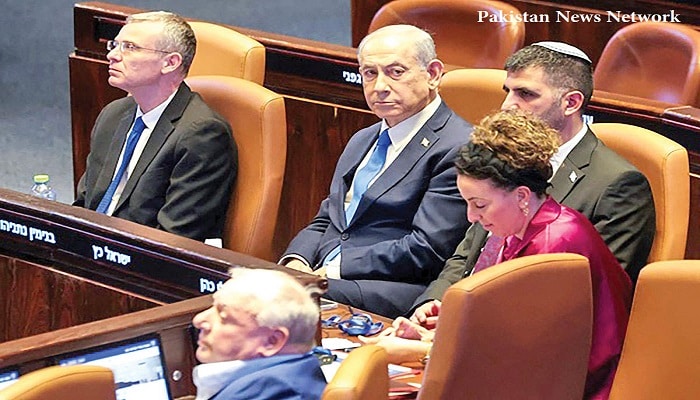
PNN – Israel’s parliament (Knesset) voted on Wednesday to dissolve itself, likely bringing forward the next general election by weeks, an election that polls predict Benjamin Netanyahu will lose. The bill to dissolve the Knesset passed its initial vote with 110 votes in favor and none against. The date for the election has not yet been set, Mayan Lobel reported in a Reuters report on Wednesday. Israel’s elections are usually held every four years, but early elections have occurred many times. The last election was in November 2022, and the next vote is scheduled to be held no later than October 27. After the Knesset dissolves, members must agree on a date. Political commentators say the election is likely to be held in the first half of September, but could also be held closer to the late October deadline because of fear of ultra-Orthodox Jewish faction.
Why is the Knesset voting to dissolve? Because an ultra-Orthodox Jewish faction, traditionally a close political ally of Netanyahu, announced this month that it no longer accepts Netanyahu as a partner and will seek early elections. Ultra-Orthodox leaders said they were doing so because the coalition’s promise to pass a law exempting their community from compulsory military service has not been fulfilled. Opposition parties have long sought to oust Netanyahu. An attempt to do so failed last June, and success this time (even if it brings the election forward by just a few weeks) could give the opposition’s campaign momentum and limit the ability of the anti-Netanyahu coalition to advance any controversial legislation until then. In an attempt to control the process, the coalition submitted its own bill to dissolve the Knesset on May 13.
Once the dissolution is approved, the bill will be sent to a committee to agree on a date for the election. The bill will then go back to the Knesset for final approval, where the third of three votes requires a majority of at least 61 of the 120 Knesset members. This process can be very quick or take several weeks. Polls have consistently shown Netanyahu’s ruling coalition falling far short of a parliamentary majority since October 7. However, there is also a possibility that the opposition parties will be unable to form a coalition, leaving Netanyahu to head a caretaker cabinet until the political deadlock is broken.
This has happened before. Before the 2022 elections, Israel was embroiled in a series of inconclusive elections, holding five in less than four years. Netanyahu’s main challenger is his former aide Naftali Bennett, who briefly ousted Netanyahu in the 2021 elections to become prime minister himself. The right-wing Bennett has joined forces with center-left opposition leader Yair Lapid to form a new party called Together, and is now running shoulder-to-shoulder with Netanyahu’s Likud party. Another contender leading in the polls is former army Chief Gadi Eisenkot. But there are a few things at play:
A: Netanyahu still faces a lengthy corruption trial and Israeli President Isaac Herzog is trying to reach a settlement in the case that could see the 76-year-old Netanyahu retire from politics as part of the deal.
B: Netanyahu’s health could also be an issue. It was recently revealed that Netanyahu has prostate cancer and will have a pacemaker implanted in him until 2023.