
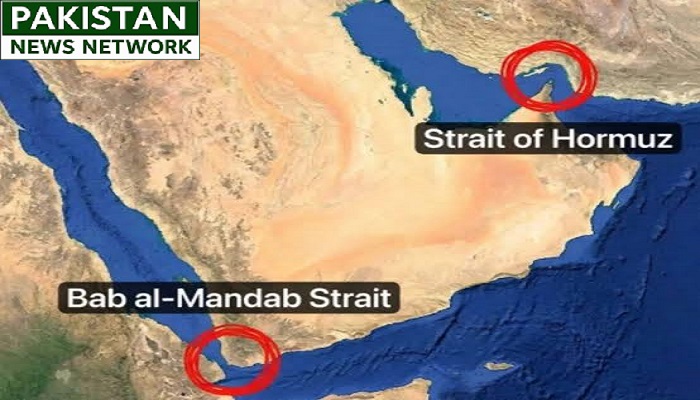
PNN – The prospect of the Bab al-Mandab Strait being closed has alarmed nations across the globe, including the Gulf Arab states.
According to the report of Pakistan News Network; and amidst reports in regional and Western media regarding Yemen’s threat to close the Bab el-Mandeb Strait, the Qatari website Al-Araby Al-Jadeed published an article titled “Fire Sets the Seas Ablaze: The Bab el-Mandeb Threat Disrupts Gulf Alternatives.” The article notes that international concern is mounting over the potential spread of conflict to the Bab el-Mandeb Strait—the southern gateway to the Red Sea and the sole entry point to the Suez Canal—at a time when the Strait of Hormuz faces near-total paralysis amidst the ongoing conflict between Iran and the United States.
Severe Consequences of the Conflict Spreading to the Bab el-Mandeb Strait
The consequences of the conflict extending to the Bab al-Mandab Strait go far beyond rising shipping and insurance costs, impacting global inflation and economic growth. According to estimates published by the Observer Research Foundation, disruptions affecting both the Strait of Hormuz and the Bab el-Mandeb Strait—in addition to blocking nearly a quarter of the global oil and gas supply—put approximately $10 billion in daily global trade at risk.
By this same estimate, forcing ships to avoid the Red Sea and instead traverse the route around the Cape of Good Hope imposes a significant logistical burden; this alternative route adds 10 to 14 days to transit times and increases fuel costs by $1.2 million to $1.8 million per voyage.
Despite efforts by Gulf States to develop alternative routes following disruptions in the Strait of Hormuz, the Bab el-Mandeb Strait remains a vital and essential artery—particularly for exports to energy-hungry Asian markets. This means that a potential closure of the strait would undermine the strategic advantage that Red Sea ports offer to Gulf nations.
The Commercial Importance of the Bab el-Mandeb Strait
According to a report published by the research platform Haptor, Unlike the Strait of Hormuz—where reliance is partially mitigated by Saudi Arabia’s East-West Pipeline, which has a capacity of 5 million barrels per day—there is no viable overland alternative for goods that would otherwise transit the Red Sea.
The impact of this vulnerability extends directly to energy sales; any tanker departing from the Saudi port of Yanbu on the Red Sea coast bound for Asia must pass through the Bab el-Mandeb Strait. It is estimated that 70 to 75 percent of Yanbu’s exports are directly exposed to disruption. Consequently, the report notes that an overland route to the west would not solve the problem but would merely shift the bottleneck to the southern Red Sea corridor.
Persian Gulf nations lack a viable alternative to the Bab el-Mandeb Strait.
Logistical initiatives in the Persian Gulf are accelerating—aimed at enhancing resilience and adaptability to dual maritime disruptions—through the expansion of land-based and multimodal transport networks. Rail connectivity projects, such as the line linking the UAE and Oman—designed to connect Omani ports located outside the chokepoints to the Gulf rail network—are particularly notable in this context.
Alongside this, flexible trade corridors—such as the Sharjah–Saudi Arabia corridor, which offers a direct link integrating land and sea transport to facilitate the flow of goods via a unified logistics corridor—are also being activated; however, according to an assessment by the Atlantic Council, these initiatives are insufficient to handle the massive volume of shipping currently moving through congested maritime lanes, thereby reinforcing the need to expand integrated network corridors as alternatives to traditional routes.
In this context, economic expert Hesam Ayesh told Al-Araby Al-Jadeed that the spread of the crisis from the Strait of Hormuz to the Bab al-Mandab Strait—whether the straits are completely closed or merely face serious risks to passage—signifies a significant escalation of the crisis affecting energy, trade, and logistics. Given the vital importance of this waterway, this development creates yet another global problem.
He added that the Bab al-Mandab Strait handles the transit of 12 to 15 percent of trade involving Europe, the Americas, and Asia, as well as approximately 25 percent of Europe’s natural gas requirements. With a volume of 55 to 60 vessels daily—totaling around 20,000 to 21,000 ships annually—carrying cargoes valued at over $700 billion, any disruption to this route deals a severe blow to a vital artery of global trade.
This regional economic expert emphasized that rerouting oil shipments increases transit time—avoiding the Red Sea—by two to three weeks, or by 31 to 41 days if transported via the Cape of Good Hope between Asia and Europe.
Economic disaster for the world and Persian Gulf states in the event of any disruption at the Bab el-Mandeb Strait
He noted that forced rerouting increases the cost for an average container ship by $1.7 to $2 million, exacerbating economic consequences for Persian Gulf nations and the global economy; furthermore, the impact is not limited solely to energy transit through Bab el-Mandeb, as the conflict could spread to a wider region and disrupt oil supplies transported via overland pipelines.
Hossam Ayesh stated that, according to energy market forecasts, a full-scale escalation of tensions would lead to a sharp drop in oil supplies and a surge in prices; depending on the duration of the crisis, prices could exceed $120, $130, or even $150 per barrel.
Gulf States stand to lose tens of billions of dollars in revenue due to the suspension or reduction of exports—including energy, petrochemicals, fertilizers, sulfur, urea, helium, aluminum, and other commodities. This new variable imposes a significant burden on economic activity and negatively impacts exports, imports, and growth rates.
Consequently, these losses—compounded by rising transportation, insurance, and additional costs—push the global inflation rate (projected by the IMF at 4.7%) even higher, making interest rate hikes inevitable despite efforts to avert them.
The closure of the Strait of Hormuz and the Bab el-Mandeb Strait, alongside traffic controls near the Suez Canal, effectively constitutes a comprehensive blockade of maritime routes surrounding the Persian Gulf states, thereby disrupting or severely impacting these shipping lanes.
A Major Crisis for the Gulf States
In reality, land-based transport fleets cannot fully meet the needs of the Persian Gulf states—even regarding trade with countries such as Jordan, Syria, and Turkey.
This regional economic expert noted that these requirements extend beyond food and services to encompass the demands of major projects, infrastructure, and leisure and tourism activities; this situation entails a significant drain on financial resources and, given the crisis’s sudden onset and rapid escalation, makes it difficult to manage unplanned scenarios.
In this context, Mahmoud Dagher, a professor at the University of Baghdad’s College of Administration and Economics, told Al-Araby Al-Jadeed that the crisis surrounding the closure of the Strait of Hormuz demonstrated to the world that the Persian Gulf region is not merely a zone for oil and gas exports; rather, it is a major industrial hub supplying significant quantities of iron, steel, aluminum, helium, and fertilizers.
He added that this situation has directly driven up the prices of these products in global markets. The crisis also affects countries that claim to be uninvolved or unaffected—including the United States.