
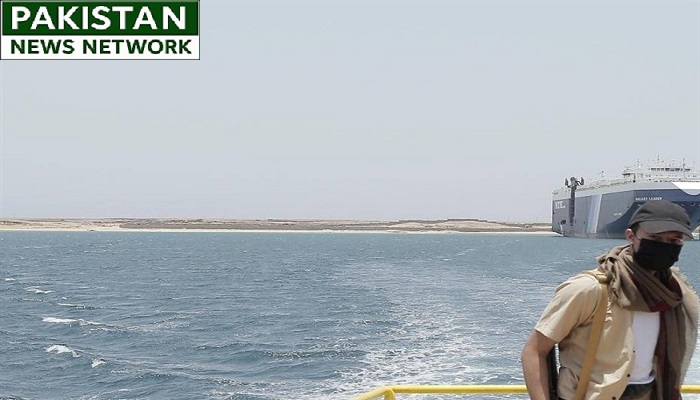
PNN – Indicators point to Yemen’s plan to initiate the second phase of its blockade against Saudi Arabia: the blockade of ports.
According to the report of Pakistan News Network; as Yemenis demonstrate their firm resolve to implement a “blockade-for-blockade” strategy against Saudi Arabia—having blocked the path of Saudi oil tankers over the past two days—the escalating tension between Sana’a and Riyadh has entered a more dangerous phase; global markets and supply chains are already feeling the repercussions of this intensifying confrontation.
In this context, for the third consecutive day, Sana’a forces continued to tighten their control over Saudi maritime traffic in the Red Sea, disrupting supply chains to the ports of Jeddah and Yanbu.
Second Phase of the Blockade against Saudi Arabia
While a number of Asian shipping companies have begun rerouting around the Cape of Good Hope to avoid attacks on their vessels by Yemeni forces, those forces are considering a shift from the first phase of the naval blockade against Saudi Arabia—which was limited to preventing the passage of Saudi ships or those operated by Saudi shipping companies—to a second phase. This new phase entails banning the passage of any vessels bound for Saudi ports, regardless of their nationality.
Regarding the additional measures Sana’a might take against Riyadh—which could include a complete halt to Saudi crude oil exports—Hizam al-Asad, a senior member of the Ansarullah movement’s political bureau and the Sana’a government, stated in a post on X yesterday: Saudi Arabia’s belief that smuggling oil via the Mediterranean guarantees the continuity of its flow is utterly foolish.
He added: The next steps Yemen takes will be more decisive and forceful, and could completely shut off the Saudi oil tap. These remarks allude to a scenario involving the total cessation of Saudi oil exports from the port of Yanbu.
Saudi Ports under Yemeni Blockade
Consequently, in response to any potential Saudi aggression, Sana’a might resort to targeting the East-West Pipeline, which transports approximately 7 million barrels of Saudi crude oil from the Eastern Province to the port of Yanbu.
According to reports from Yemeni sources—corroborated by international sources—the number of Saudi vessels turned back by Sana’a at the Bab al-Mandab Strait has reached ten.
In this context, a well-informed maritime source in the western Yemeni city of Hodeidah told the newspaper Al-Akhbar that all commercial vessels traversing the Red Sea are complying with the directives of Yemeni naval forces; specifically, all ships are keeping their identification systems active and providing crew identification details.
Despite Saudi Arabia’s claims that the blockade has had no impact on shipping traffic at the port of Jeddah, “MarineTraffic”—a website specializing in maritime traffic tracking—has reported a drop in the number of vessels passing through the Bab al-Mandab Strait to Saudi ports; the figure fell from 73 ships (recorded at the time Sana’a forces announced the naval blockade against Saudi Arabia) to approximately 29 ships yesterday.
Aerial imagery also reveals a buildup of dozens of vessels off the Saudi coast—particularly near Bab al-Mandab, as well as off the shores of Bishah and Jizan—while scores of oil tankers have been forced to alter their routes, whether in the Red Sea or the Gulf of Aden.
According to Reuters, four additional vessels have joined the six ships that Sana’a announced yesterday had been prevented from passing through the Red Sea.
Among these vessels were two Saudi oil tankers attempting to transit the Bab al-Mandab Strait before diverting toward the Suez Canal. With this development, the total number of Saudi oil tankers barred from passing through the strait has reached ten within 48 hours of the blockade on Yemen being imposed.
The disruption of Saudi oil flows through the Red Sea—occurring alongside the continued closure of the Strait of Hormuz—has impacted international oil markets.
Amid expectations that the price of oil will reach $100 per barrel by the end of this week, prices rose to $94 per barrel over the past few hours—a 4% increase following a drop to below $70 per barrel in the last two weeks.
Meanwhile, the US news agency Bloomberg reported a decline in investor appetite for Saudi Arabian oil due to fears of fresh attacks on vessels or risks associated with sanctions violations regarding Yemen.
Yesterday, a military source in Sana’a told the Lebanese newspaper Al-Akhbar that the blockade imposed on Saudi ports aims to intensify pressure on the Kingdom’s Red Sea exports and imports until it unconditionally meets Yemen’s legitimate demands.
The source stated that Sana’a’s forces would take calculated steps to strangle Saudi ports. The blockade strategy would not be limited to preventing the entry of Saudi-owned vessels, ships operating for Saudi shipping companies, or vessels bound for the Kingdom’s Red Sea ports; rather, it would adopt broader escalatory measures that could extend to the Arabian Sea and reach as far as the Indian Ocean.
Observers in Sana’a believe that the cost of a “blockade-for-blockade” scenario would be high for Saudi Arabia; as a major regional oil exporter relying on crude oil sales for over 70 percent of its budget, any move toward escalating tensions would entail massive losses, whereas the cost of meeting Ansarullah’s demands would certainly be lower.
Reuters estimates that a complete closure of the Bab el-Mandeb Strait could reduce global oil supplies by 7 percent, as it would prevent the majority of Saudi oil exports from leaving the region via their current routes.
The shipping data analytics firm Kpler stated that Yemen’s entry into the conflict shifts risks from the Strait of Hormuz to the Red Sea and threatens the Bab el-Mandeb Strait, which has become a vital route for the transport of Saudi crude oil and petroleum products, as well as for trade between Europe and Asia.