
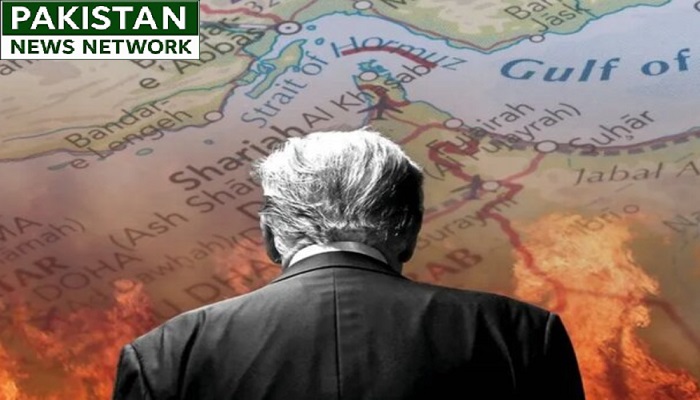
PNN – Trump’s unprecedented threat to bomb Iranian bridges and power plants signals a shift in Washington’s strategic calculus rather than merely a display of power. The transition from the rhetoric of “securing the Strait of Hormuz” to the threat of a war targeting infrastructure indicates that the U.S. strategy of military pressure, naval blockade, and psychological operations has failed to achieve its objectives, and that the White House is seeking to restore its eroded deterrence.
From this moment on, whenever the Islamic Republic of Iran fires upon a ship in the Strait of Hormuz, the United States will bomb a bridge or a power plant. This is the latest stance taken by U.S. President Donald Trump—a position that, while appearing at first glance to be a military threat, actually signals, above all, a shift in Washington’s strategic calculus. Having repeatedly emphasized in recent weeks the openness of the Strait of Hormuz, the security of shipping, and the need to curtail Iran’s ability to control this waterway, the U.S. President has now been compelled to draw a new red line regarding the very scenario he had previously portrayed as contained. This shift in tone is the clearest indication that the U.S. strategy of pressure has failed to achieve its primary objectives.
After moving past the ceasefire and abandoning the path of mutual understanding, the US government sought to confront Iran with a choice by combining military pressure, a naval blockade, threats of expanding the conflict, and psychological operations: either accept Washington’s terms and return to the negotiating table, or bear mounting military and economic costs. The objective of this strategy was not merely to inflict military damage, but to translate military superiority into a political gain at the negotiating table. However, the course of events demonstrated that this calculation did not yield the outcome the White House had anticipated.
The first sign of this failure was the collapse of the U.S. psychological operation. In recent weeks, coinciding with an increase in U.S. airstrikes on southern Iranian cities and islands, Western media and certain circles persistently speculated about a potential ground invasion, the occupation of Iran’s southern islands and coastlines, and an expansion of the conflict’s scope. The primary aim of this narrative-building was to induce psychological shock, alter the calculations of Iranian decision-makers, and foster the impression that Washington was poised to enter a new phase of the war. However, these scenarios neither materialized into concrete action nor succeeded in shifting Iran’s political resolve. Consequently, one of the United States’ key instruments of pressure lost its effectiveness before it could yield any results.
On the other hand, Iran sought to prevent the United States from transforming its military superiority into strategic dominance. Sustaining a response to attacks, maintaining the capacity to exert pressure on the security dynamics of the Persian Gulf, and raising the costs of continued conflict were all part of this strategy. In this context, persistent instability in the Strait of Hormuz—and its impact on the energy market—emerged as one of the most critical variables in the equation.
The rise in oil prices to the $95-per-barrel range is not merely an economic fluctuation; rather, it directly reflects heightened geopolitical risk along one of the world’s most critical energy transit arteries. Had the market accepted the U.S. narrative regarding the “securing of the Strait of Hormuz,” a significant portion of this risk premium would likely have been stripped from oil prices. However, market behavior indicates that economic actors—including insurance companies, shipping firms, and energy traders—continue to view the likelihood of disruption along this route as a serious possibility, given the effective operational actions taken by the Iranian Navy. This suggests that Washington’s narrative of establishing security has failed to exert its intended impact on the global market.
Alongside this, the rise in U.S. costs on the ground has also influenced the White House’s calculations. The increase in American casualties and the loss of advanced equipment over the past two weeks have sharply intensified political pressure on Trump. The greater the human, military, and economic costs of a conflict, the harder it becomes to turn it into a political success. This reality has led Washington to shift away from discussing the achievement of past objectives and instead define new red lines while threatening harsher measures.
Under these circumstances, Trump’s recent threat should be viewed as an attempt to break a strategic deadlock. This message is not directed solely at Iran; its primary intended audience includes shipping companies, insurers, investors, and the global energy market. Washington aims to convey that if shipping is threatened, the U.S. will intervene forcefully and will not allow the security of global trade to be compromised. Another objective of this message is to curb the crisis’s psychological impact on the oil market and prevent a further rise in the “risk premium” within energy prices.
However, from another perspective, this very shift in the nature of the threats amounts to an inadvertent admission that the previous U.S. strategy had failed. Had the strategy of military pressure, naval blockade, and psychological operations achieved its objectives, there would have been no need to move beyond threatening military targets to threatening critical infrastructure. The shift in rhetoric—from “controlling the situation” to “if Iran does X, we will destroy its infrastructure”—indicates that Washington has lost faith in the success of the earlier scenario and is attempting to restore its lost credibility by escalating the level of the threat.
However, this gamble could prove to be the costliest phase of the crisis. Unlike limited military strikes, a war targeting infrastructure can rapidly escalate into a cycle of reciprocal actions and reactions; targeting critical infrastructure could trigger retaliatory strikes against strategic infrastructure, energy facilities, and the interests of the United States and its allies, pushing the conflict to a level that would be difficult for any of the actors to manage.
Consequently, Trump’s latest threat should be viewed not as a sign of confidence in the success of the U.S. strategy, but rather as an attempt to alter the rules of the game following the failure to achieve desired objectives. The strategy—originally intended to compel Iran to accept Washington’s terms through military pressure, psychological operations, and a naval blockade—has now reached a point where the U.S. President, in a bid to salvage his waning credibility, has been forced to threaten a war targeting infrastructure. Should this threat escalate into actual conflict, it would plunge not only the Iran-U.S. dynamic but also the security and economies of the entire region—and even global energy markets—into an unpredictable crisis.