
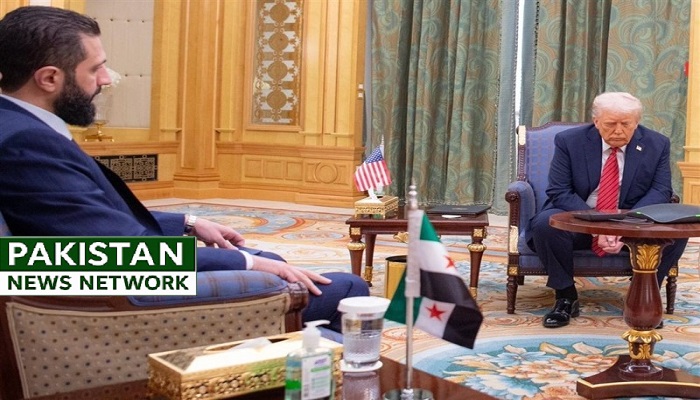
PNN – Trump, expressing disappointment with the performance of the Israeli army in confronting Hezbollah, called for Golani’s intervention in the case.
According to the report of Pakistan News Network, US President Donald Trump recently proposed an idea that sounds more like an unattainable White House wish than a workable strategic plan: Leaving the fight against Lebanon’s Hezbollah to the new Syrian government.
This plan, apparently designed to reduce the heavy burden of the Israeli regime’s erosive defeats in Lebanon, has been met with a cold and contemptuous response from Tel Aviv and a cautious “no” from Ahmed al-Sharaa (Abu Muhammad al-Julani), the former leader of the Tahrir al-Sham and the new ruler of Damascus. Trump’s fantasy of turning al-Julani into Israel’s security guard on Lebanon’s borders is not only far removed from the realities on the ground and in security matters, but also reveals deep divisions in the Western-Jewish camp.

A plan to escape the swamp; why did Trump think about outsourcing?
The secret of this strange proposal must be sought in the Lebanese quagmire. The occupation of southern Lebanon, which was designed to destroy Hezbollah and return tens of thousands of displaced Israeli settler families to northern occupied Palestine, turned into an intelligence-security failure, by the Zionists’ own admission. The back-breaking economic costs, the psychological erosion on the Israeli home front, and the inability to achieve a decisive victory have led the White House to conclude that continuing on this path will cost Netanyahu and America’s strategic ally the political collapse. Trump’s proposal is a dignified way out of this predicament: a tactical Israeli withdrawal from the front lines and handing the reins of war to a cheap, internationally irrelevant proxy in Damascus. Trump wants to shift the cost of containing Hezbollah to the fragile Golan Heights government, thereby saving Israel and keeping America’s hand in regional negotiations.
An Impossible Equation in Tel Aviv: Why Doesn’t Israel Trust Golani?
But the Achilles’ heel of this plan is hidden somewhere in Tel Aviv. While Trump wants Abu Muhammad Golani to play the role of Lebanese border police, Israeli security and military circles view him with a mixture of contempt and suspicion as a “terrorist in a suit”; a Salafi jihadist with an al-Qaeda-linked ID who, although he wears a suit today, is still, in the eyes of Mossad, the same extremist fighter he was yesterday. This distrust has three strategic roots:
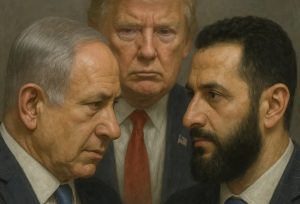
- Entrusting the security of northern occupied Palestine to someone who until yesterday was fighting against the West in the ranks of Al-Qaeda is indigestible for the Israeli security apparatus. They do not know whether Golani will become a “pragmatic Erdogan” or a “sleeping al-Zawahiri” in the long run. In other words, Israel does not know whether Golani will remain an ally in 5 years or become an enemy who organizes the Syrian army on the Golan border against Israel. This uncertainty is considered an existential threat to the rulers of the Zionist regime.
- Israel has occupied parts of southern Syria and the Golan Heights. The presence of a Syrian army (even under Golan command) near these areas could lead to a future Syrian claim of sovereignty over the occupied Golan Heights. Israel would rather have southern Syria remain a power vacuum than have a centralized (even friendly) government take power there.
- The most right-wing elements of Netanyahu’s cabinet, such as Ben-Gwer and Smotrich, consider any cooperation with someone like Golani to be a deadly political poison, and therefore accepting Trump’s plan could disintegrate the fragile ruling coalition in Israel.
Survival or Adventure: Golani’s Smart Calculation
Golani himself has fallen into this trap the quickest. He, who has been more like a survival strategist than an adventurous ideologue in the past year, knows full well that accepting this mission would be political suicide.
Syria today is a bankrupt and devastated country, parts of which are occupied by Turkey and Israel, and rival militias are rampant. In such circumstances, opening a new front against Lebanon’s Hezbollah would be not an opportunity, but sheer suicide for Golani’s fragile state-building project.
Hezbollah has four decades of experience in fighting, which even the Israeli army failed to defeat; therefore, the key question is how the fledgling Golani army can successfully complete such a mission? Therefore, the reluctance of the Syrian interim president to intervene in Lebanese political equations makes sense.
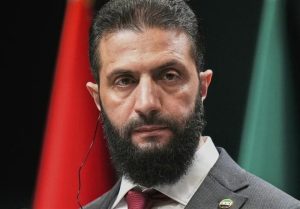
Overall, it seems that Trump’s plan to entrust the fate of the Lebanese war to Golani is destined for nothing but a dead end; because on the one hand, Israel will not accept entrusting its security to a “terrorist in a suit,” nor will Golani be foolish enough to fall prey to this trap, and ultimately, Hezbollah will not allow the equation to change in favor of the occupiers on the ground.
For this reason, many observers believe that this idea, rather than being a strategic solution, is solid evidence of the failure of the project to destroy the resistance in Lebanon and absolute chaos in the think tanks of the enemies of the resistance axis.